Easter Egg Template
- 23 pages
- PreK, Kindergarten, 1st, 2nd
$2.50 $5.00 on Teachers Pay Teachers
Half the Teachers Pay Teachers price. The same PDF, sold direct.
DownloadOr get it with All-Access: pick any 20 resources a month for $7.
New here? Your first month of All-Access is half off with code TEACHERTOK
Already bought this, or a member?
Instant download. One teacher's license: colleagues need their own copy. Each file carries a license number.
Also on Teachers Pay Teachers: see the Bright Path Sped store
About this resource
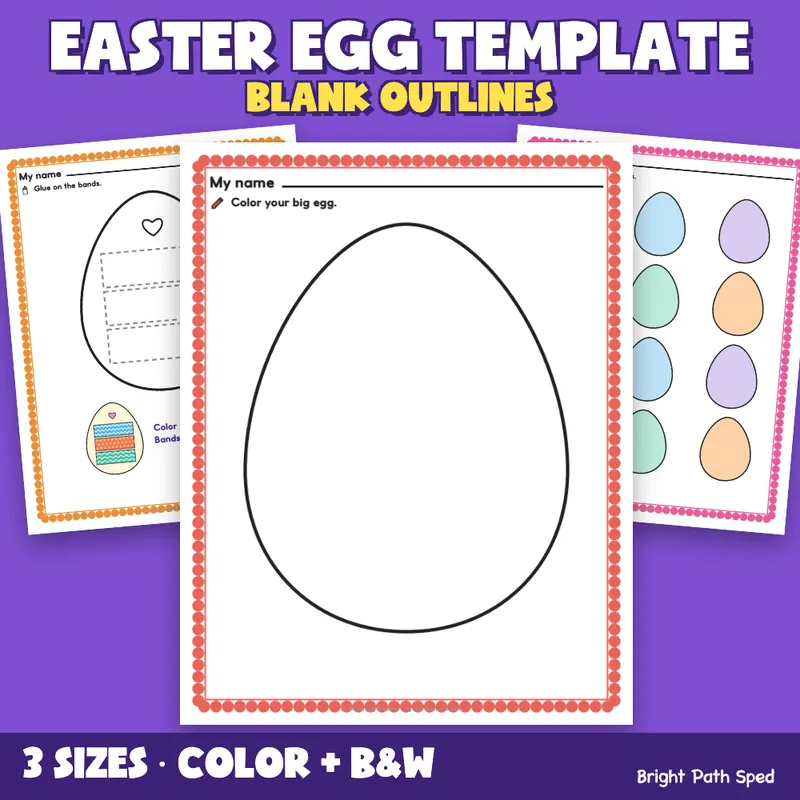
An Easter egg template pack: blank egg outlines in three sizes, each in black-and-white and in color, plus pattern bands and patches to cut and glue, a match-the-pair page, a roll-a-die decorate page and writing about your egg, in one print-and-go PDF for PreK to 2nd grade. It is a craft pack with no book needed, and it uses eggs only: no bunnies, chicks or characters.
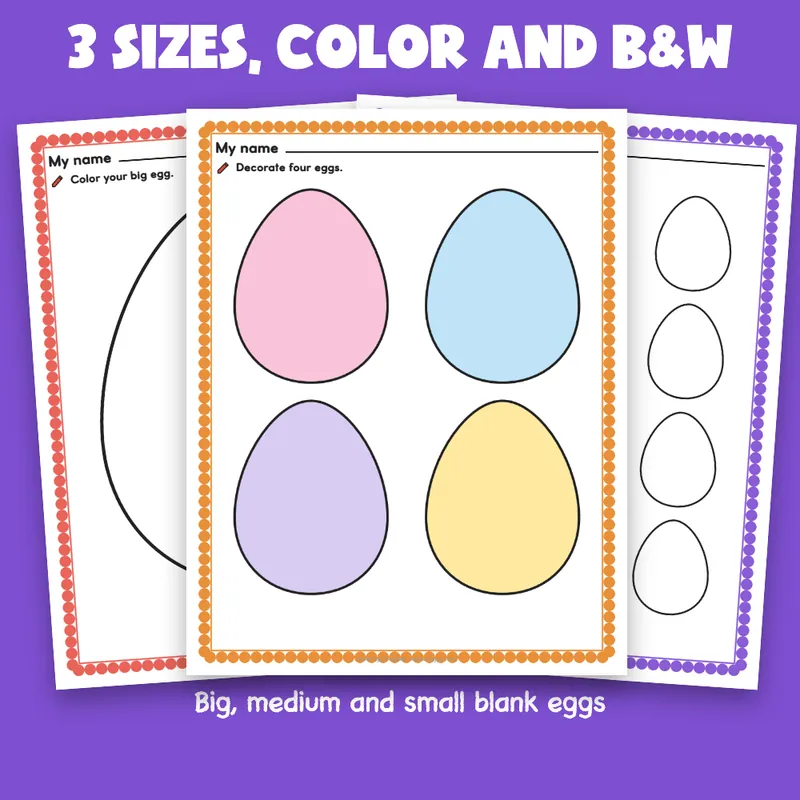
Start with the blank eggs. There is a big egg, one to a page, for coloring or decorating; a medium page with four eggs; and a small page with twelve little eggs for patterns, a class display or a center. Every size comes in black-and-white (save your ink) and in color. That is 34 blank eggs in all.
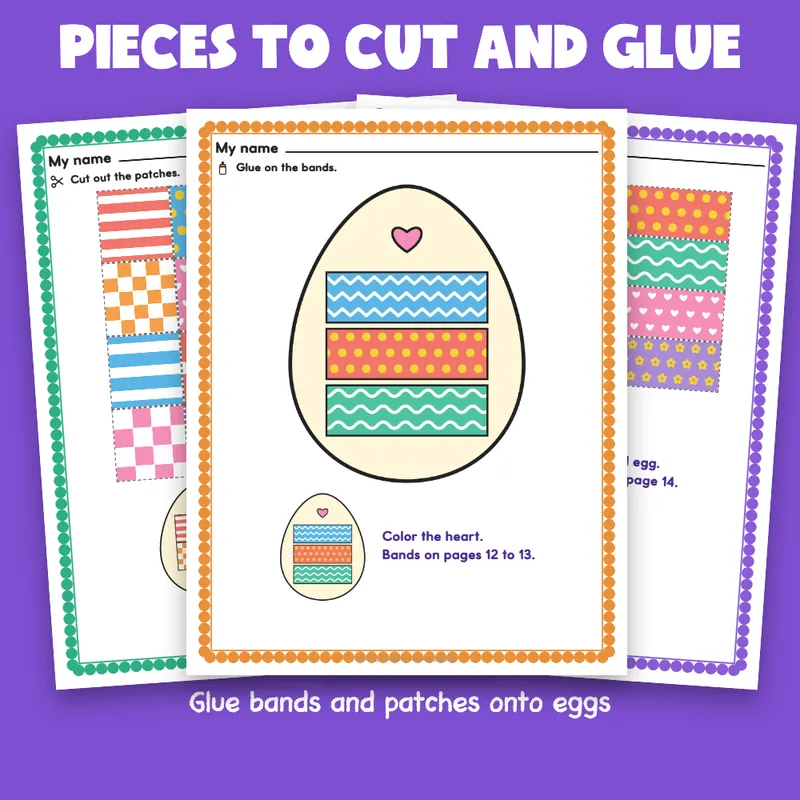
Then dress them up. 48 pieces are ready to cut: 16 square patches to color and the same 16 ready-colored, 8 pattern bands to color and 8 ready-colored. The eight patterns are stripes, dots, zigzag, wavy lines, checks, hearts, diamonds and flowers. Each child glues three bands onto the band egg, four patches onto the patch egg, or both, and every glue box is exactly the size of its piece (3.2 by 1.0 inch strips for the bands, 1.45 inch squares for the patches), so there is no guessing. The pieces are squares and strips in a grid, so every cut is a straight line. A finished model sits on each cutting page, and the child colors the heart on top of each egg.
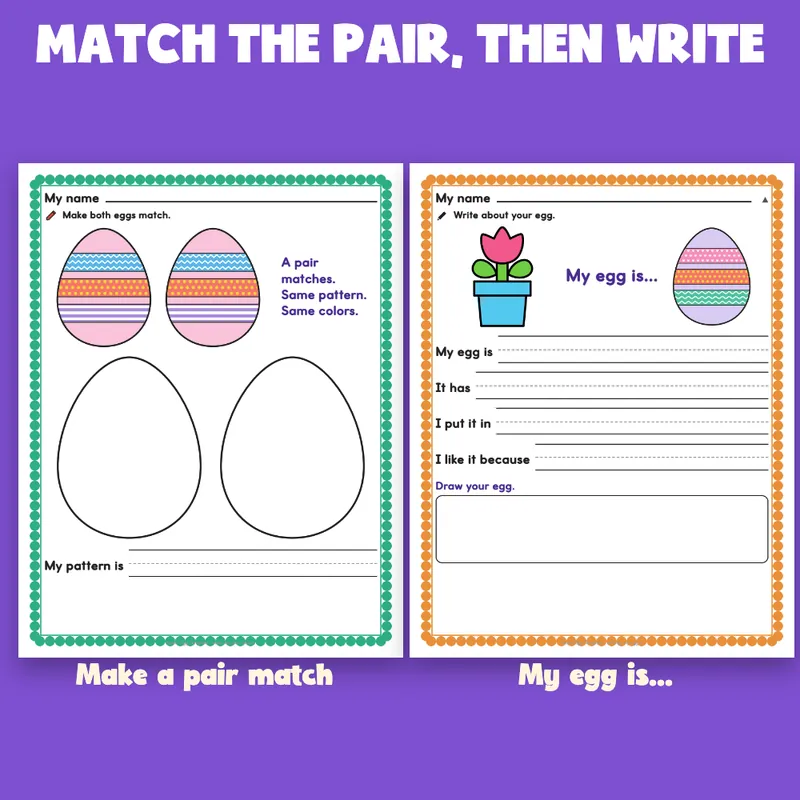
More ways to use the outlines: on the match page children decorate two blank eggs so the pair matches, with a model pair to look at. On the roll page a die picks the pattern (1 stripes, 2 dots, 3 zigzag, 4 wavy, 5 checks, 6 hearts) and the child draws it on a blank egg. Three writing pages go with it: trace and draw, fill in the sentences with a word bank, or write four lines that start "My egg is", "It has", "I put it in" and "I like it because". Every student page has one short instruction with a picture and a "My name" line.
How To Use It
1. Pick a size and print it on white paper or card stock.
2. Color it (or print the color page).
3. Cut around it, or have a grown-up cut ahead of time.
4. Decorate it: glue on bands and patches, draw a pattern, or match a pair.
What'S Inside
- Start Here: what is in the file, how to use the blanks, how the cut and glue works, and a five-day plan
- How to make an egg: four picture steps
- Big egg: 1 to a page, black-and-white and color (pages 4-5)
- Medium eggs: 4 to a page, black-and-white and color (pages 6-7)
- Small eggs: 12 to a page, black-and-white and color (pages 8-9)
- Pattern patches: 16 to color and 16 ready-colored (pages 10-11)
- Pattern bands: 8 to color and 8 ready-colored (pages 12-13)
- The band egg glue page: 3 band boxes and a heart to color
- The patch egg glue page: 4 patch boxes and a heart to color
- Make the pair match: a model pair and two blank eggs
- Roll and decorate: a die, 6 patterns and 2 blank eggs
- Writing on three levels: trace and draw, fill in, and "My egg is..." with 4 lines
- A "Who Did What This Week" class data page
- A family letter to send home
- A credits page (font and art license)
23 pages in all, 18 of them for students.
Cutting Built For Small Hands
The patches and bands sit edge to edge in a grid: patches are 1.45 inch squares, 4 across and 4 down, and bands are 3.2 by 1.0 inches, 2 across and 4 down. The curved egg outlines take more scissor skill, so cut them ahead of time or help. You will need crayons, scissors and glue sticks. Card stock suits the craft pages. Print the pieces pages more than once for a class.
Three Skill Levels
A small triangle beside the name line marks the four-line page; the trace and fill-in pages have none. Easier: trace and draw, or a partner who holds the glue stick. Harder: the four-line page. The writing pages are the only academic pages, so the craft pages carry no level marks.
Who This Is For
Preschool, PreK, kindergarten and 1st to 2nd grade classrooms, self-contained special education classrooms, and paraprofessionals who want a spring or Easter egg craft with blank outlines, patterns, matching and writing, ready to print.
What This Is, And What It Is Not
A printable PDF (print and cut). It is not Google Slides, Docs or PowerPoint, and it has no fillable fields. It is not a book companion and uses no book's characters or pictures. It makes no claim about any student's age or rate of progress.