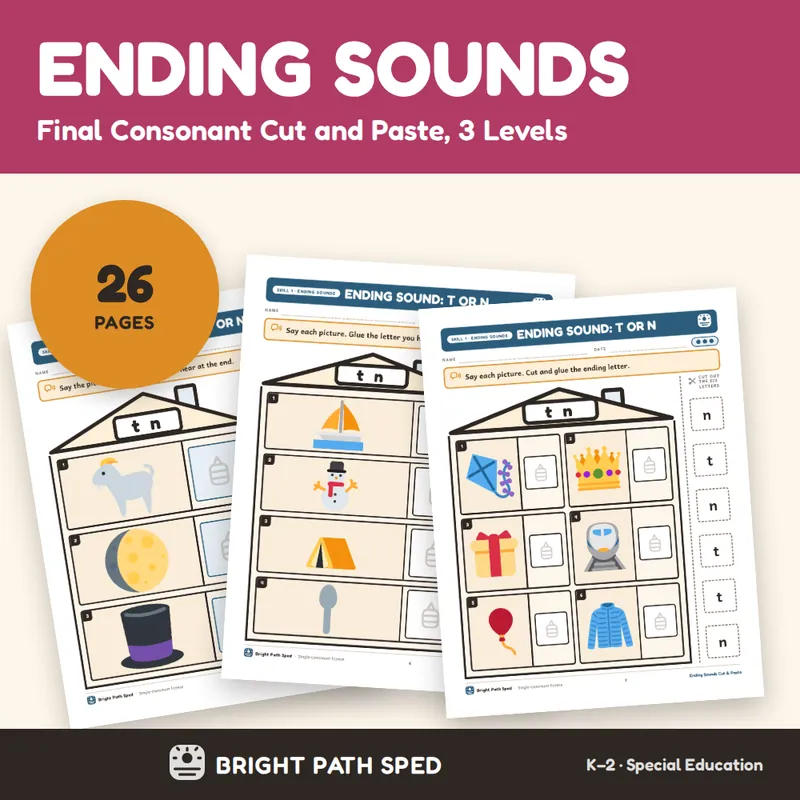
Ending Sounds K-2 Cut and Paste
- 26 pages
$4.00
DownloadOr get it with All-Access: pick any 20 resources a month for $7.
New here? Your first month of All-Access is half off with code TEACHERTOK
Already bought this, or a member?
Instant download. One teacher's license: colleagues need their own copy. Each file carries a license number.
Also on Teachers Pay Teachers: see the Bright Path Sped store
About this resource
A child who can tell you the first sound in a word and then guesses at the last one will spell cat as
"ca" for as long as nobody isolates the final consonant. This is the pack for that exact child. Five
skills, one ending-sound job each, three levels of every single one.
The last sound is the quiet one, so the pack takes it in steps: two sounds at a time first (t or n, then
k or m, then d or g — the pair adults have to think about too), then all six ending sounds with the word
printed beside the picture and its last letter cut out, then a sorting day where the little houses grow
from three to all six.
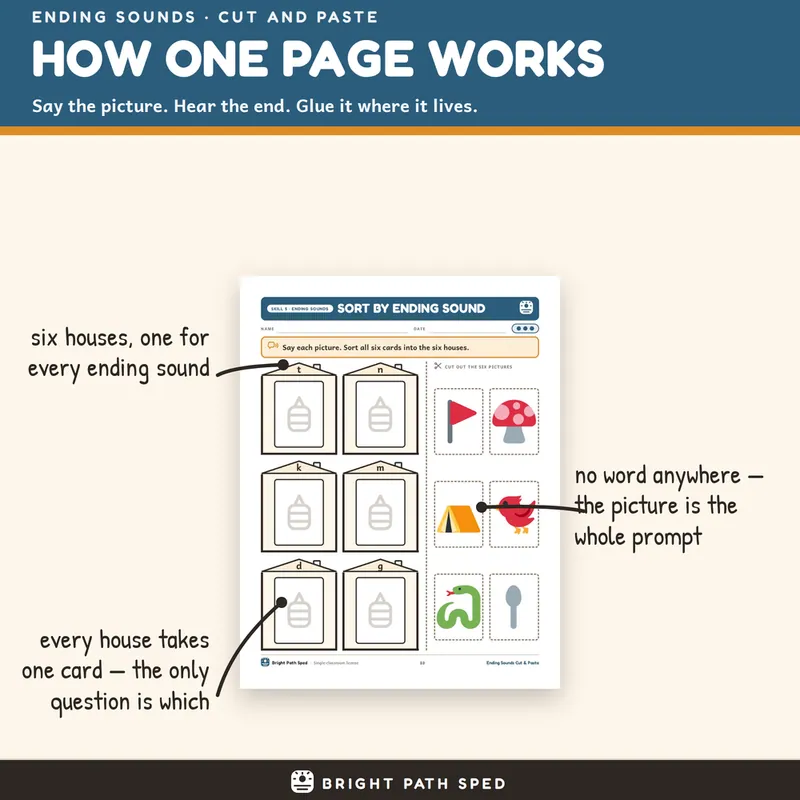
Every page is the same house, so a child who has done one page knows what to do on the next one: say
the picture, hear the end, glue it where it lives.
How The Three Levels Work
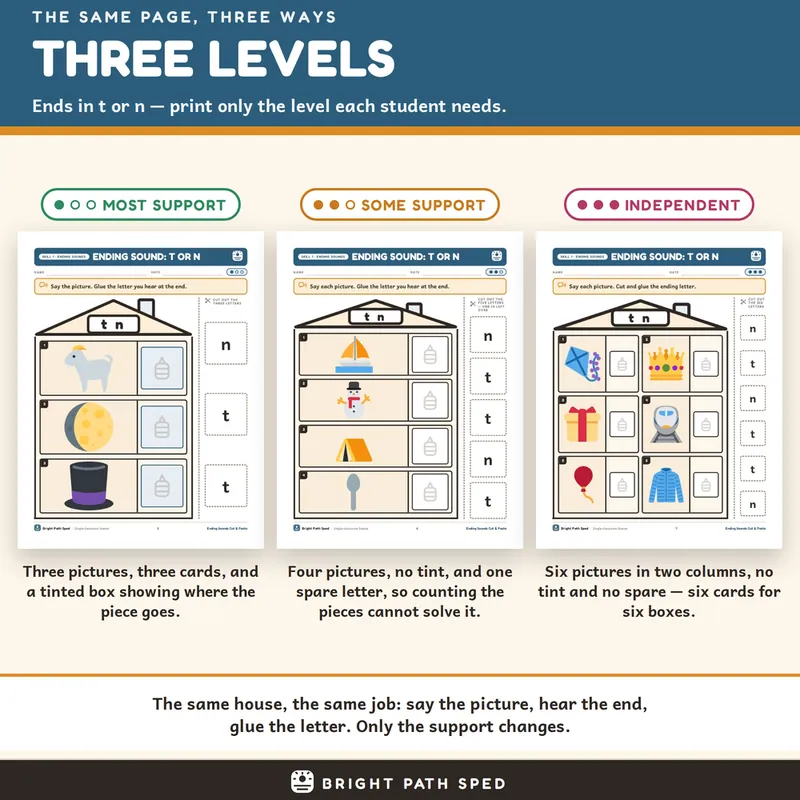
Level 1 — the fewest pictures, a tinted box showing exactly where the piece goes, and no spare piece to
account for. Both letters are still on the strip, because choosing between them is the skill; a strip of
identical pieces would be a page with the skill taken out of it.
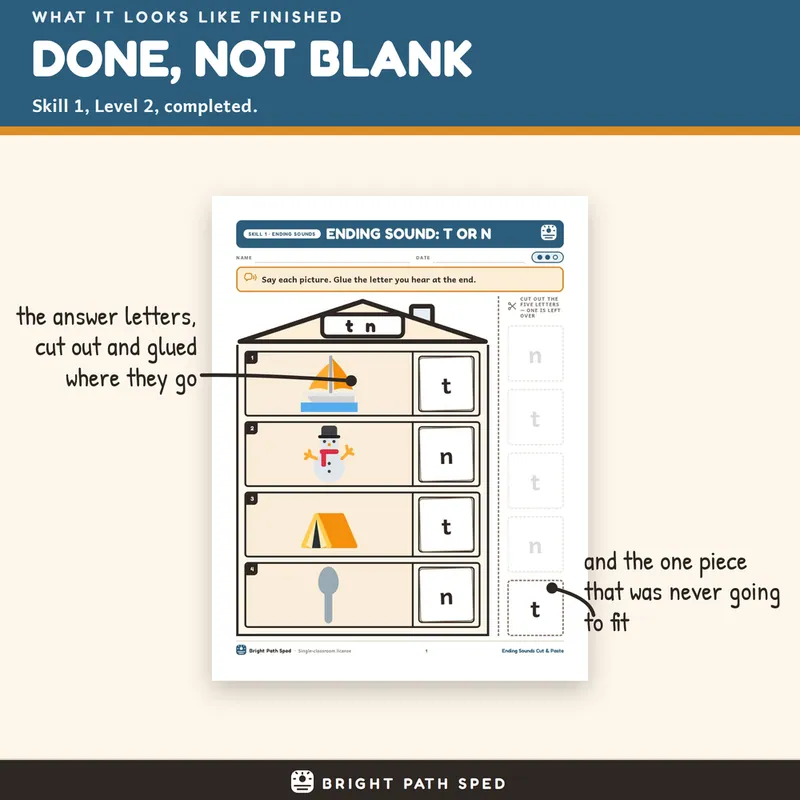
Level 2 — one more picture, no tint, and one spare piece. On the two-sound skills the spare is a second
copy of a letter already in play, so a student who counts the pieces instead of listening gets the page
wrong. On All Six Ending Sounds it is a letter that makes no real word in any frame printed on that page.
On the sorting day it is a picture whose ending sound has no house.
Level 3 — six pictures in two columns, no tint, nothing spare.
On every one of the 15 worksheets the cut strip is scrambled: a student who cuts the pieces left to right
and glues them top to bottom without listening scores at most half the boxes on any page.
The Five Skills
1. Ending Sound: t or n
2. Ending Sound: k or m
3. Ending Sound: d or g
4. All Six Ending Sounds — the word is printed with its last letter missing (do _) beside the picture
5. Sort by Ending Sound — picture cards into letter houses, growing from three houses to all six
Every Picture Names Its Word
On four of the five skills no word is printed anywhere on the sheet: the only print a student meets is
the two letters on the roof sign, the letters on the cut strip, and the letters on the little houses.
The picture is the whole prompt. So every picture in the pack is one that names itself — a goat, a top
hat, a snowman, a mushroom — and for every picture I wrote down the other names a five-year-old might
give it and checked that they end the same way (present for gift, jacket for coat, bug for ladybug,
sailboat for boat). A picture with a second name that changes the ending sound was dropped from the
pack rather than shipped with a hopeful answer key, each refusal recorded with its reason. Dog and pig,
whose only problem is a second name (puppy, piggy), appear only on All Six Ending Sounds, where "do _"
and "pi _" are printed beside them.
Every word in the pack is a real English word checked against a dictionary at build time, every ending
sound was verified against the spelling one word at a time (kite ends in t, cake in k; words that end in
ng are not here), and every page is full color that still reads as a clean photocopy.
What Is In The File
- 26 pages, one PDF
- 5 scripted lesson plan pages — a script in quotation marks a substitute could read cold, three level
notes, three "if a student is stuck" tips with the likely cause named, a try-it-today idea and a data
box on every plan
- 15 student worksheets (5 skills x 3 levels)
- 2 pages of answer keys, recomputed from the same data that draws the worksheets
- 1-page "how to use this packet" guide
- A name and date line, a big direction line and a cut rule on every worksheet
- No level word and no teacher note anywhere on a student page: the three dots on the name line are the
level code, and they are there for you, not for the child
Who This Is For
Self-contained, resource and early-intervention classrooms, and any K–2 room with students who can
find the first sound in a word and not yet the last one. It works alongside this store's CVC Words Cut
and Paste pack, which covers beginning, middle and ending sounds together; this one slows down and stays
on the end.
What This Is, And What It Is Not
A print-and-cut worksheet packet with a scripted plan page in front of each skill. It is not a fillable
form, not a full curriculum, and not a claim about how quickly any student will hear a final consonant —
every objective is written the way a classroom goal is written, with nothing clinical, no timeline and no
eligibility claim attached to it.