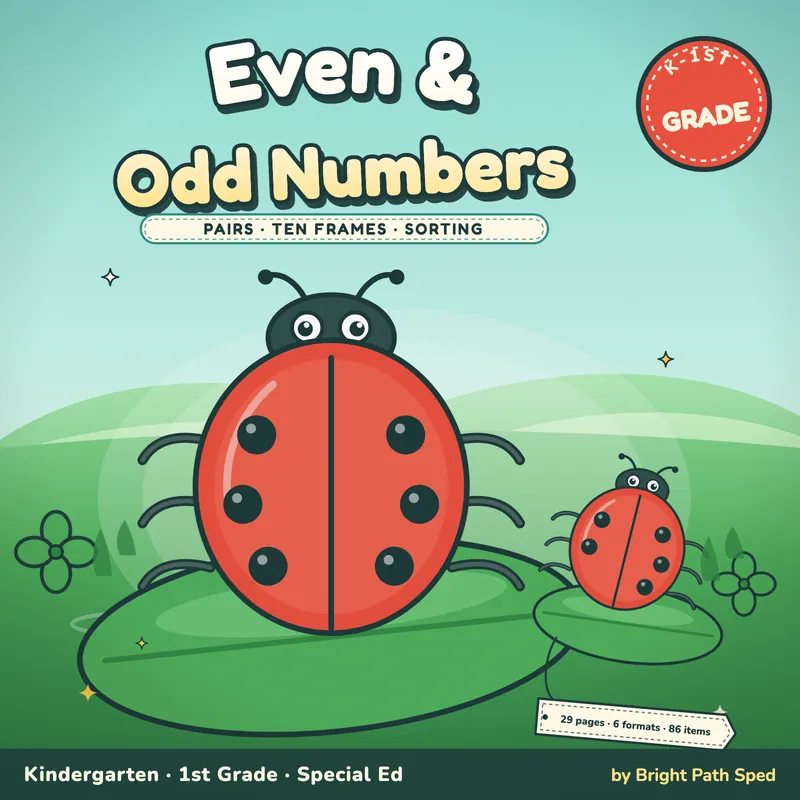
Even and Odd Numbers Worksheets
- 29 pages
- Kindergarten, 1st
$4.00
DownloadOr get it with All-Access: pick any 20 resources a month for $7.
New here? Your first month of All-Access is half off with code TEACHERTOK
Already bought this, or a member?
Instant download. One teacher's license: colleagues need their own copy. Each file carries a license number.
Also on Teachers Pay Teachers: see the Bright Path Sped store
About this resource
Even and odd numbers get taught with the same "circle it" worksheet over and over. This is a complete kit built
around ONE idea — make pairs, and see what's left over — practiced six genuinely different ways, with the
record-keeping a case manager or classroom teacher needs around it.
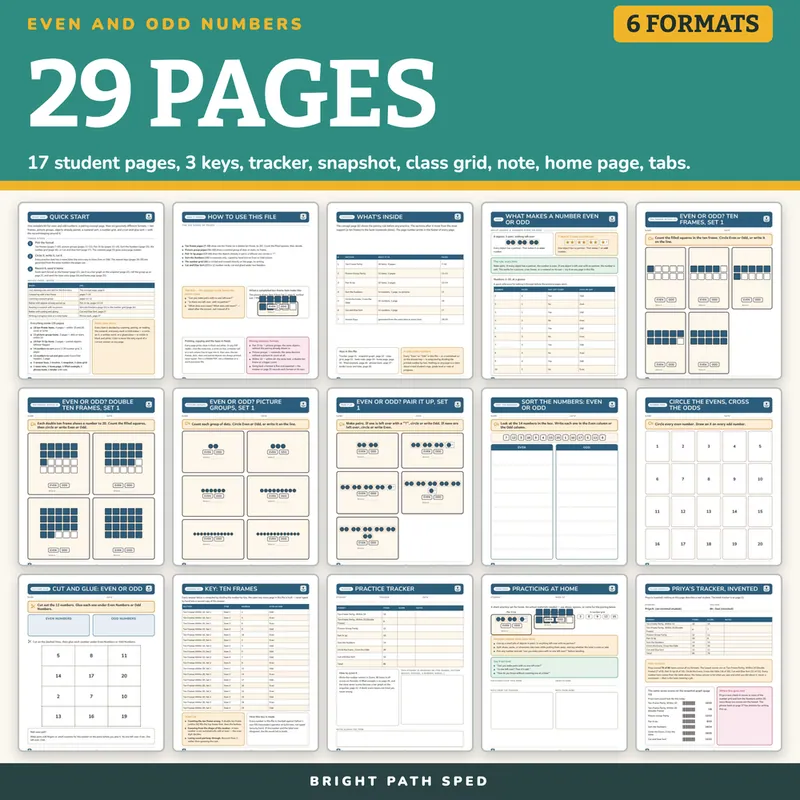
EVERYTHING INSIDE (29 pages)
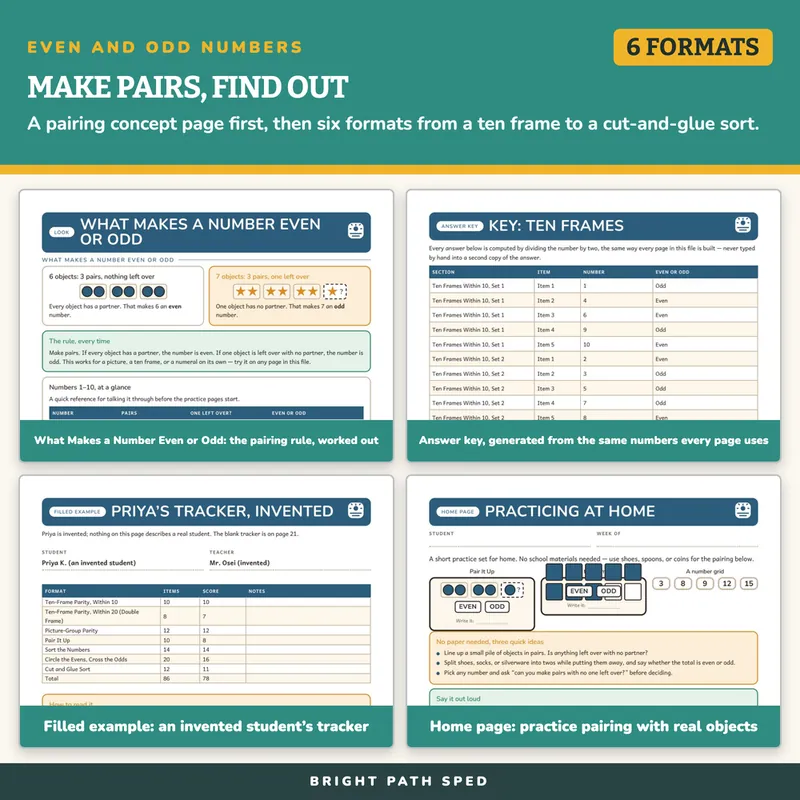
- A concept page that shows the pairing rule worked out with two real examples (6 objects, no leftover; 7
objects, one leftover), plus a 1–10 quick-reference chart
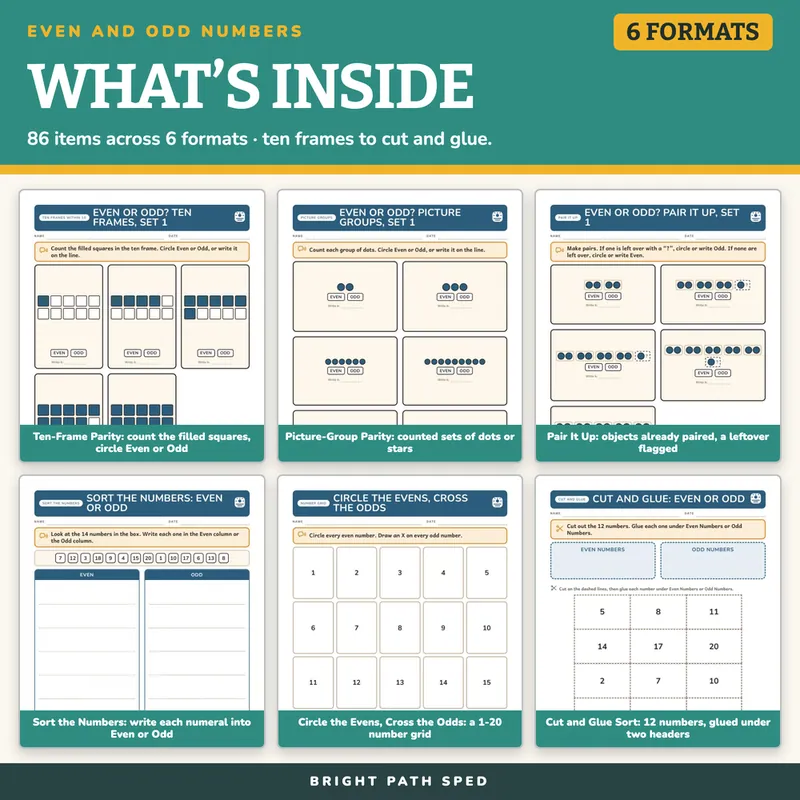
- 18 ten-frame parity items (4 pages) — within 10 (single frame) and within 20 (double frame), circle or write
Even or Odd
- 12 picture-group parity items (2 pages) — counted sets of dots or stars, within 15
- 10 Pair It Up items (2 pages) — objects drawn already paired, with any leftover flagged by a "?", so a child
looks for a partner instead of counting from one
- 14 numbers to sort by hand into an Even or Odd column (1 page, no pictures) and a 1–20 number grid to circle
and cross directly (1 page)
- 12 numbers to cut and glue under "Even Numbers" or "Odd Numbers" (1 page, 12 edge-to-edge pieces)
- 3 answer keys, generated from the same numbers every page uses, each with a "watch for" card
- 1 tracker, 1 snapshot bar-graph roll-up, 1 class practice grid
- 1 team note (a hand-off for between meetings), 1 home page (the same job for a family, with real-object ideas),
1 filled example (an invented student), 1 phrase bank, 1 binder cover and 6 divider tabs to cut out
Six Formats, Each A Different Task
1. Ten-Frame Parity — count the filled squares in a ten frame (or a double ten frame, to 20), then decide.
2. Picture-Group Parity — a counted group of dots or stars, no frame.
3. Pair It Up — the objects are already arranged in pairs; a lone leftover carries a "?". The child looks for a
partner rather than counting.
4. Sort the Numbers — 14 numerals only, copied by hand into an Even or Odd column.
5. Circle the Evens, Cross the Odds — a 1–20 number grid, marked directly on the page.
6. Cut and Glue Sort — 12 number cards, cut and glued under two headers.
Never color alone: every item is decided by counting, pairing, or reading the numeral, and every mark a child
makes — a circle, an X, a written word, a glued piece — reads in black and white. Nothing on any page is judged
by color.
Built For The Child Holding The Page
A big "My name" line, one short instruction, and large rounded numbers and boxes. Nothing on a student page is
written for an adult — there are no scores or timers on the pages a child holds.
Type In, Or Print
The name and date lines, the write-on lines, the tracker, the class grid, the team note and the home page are
type-in fields in any PDF reader. Every page also prints cleanly in black and white. This is a fillable PDF; it
is not a slideshow or a word-processor file.
Who This Is For
Kindergarten and first-grade classrooms, self-contained and resource rooms, and any teacher who wants six
different ways into the same skill instead of one worksheet repeated. The home page sends the same job to a
family; the team note hands off what changed since the last meeting.
What This Is, And What It Is Not
Even and odd number practice, and the record-keeping around it. It is not a probe, a goal bank, or a score
sheet, and it makes no claim about any student's age or rate of progress.