Fatty Legs Novel Study
- 44 pages
- 4th, 5th, 6th
$3.00 $6.00 on Teachers Pay Teachers
Half the Teachers Pay Teachers price. The same PDF, sold direct.
DownloadOr get it with All-Access: pick any 20 resources a month for $7.
New here? Your first month of All-Access is half off with code TEACHERTOK
Already bought this, or a member?
Instant download. One teacher's license: colleagues need their own copy. Each file carries a license number.
Also on Teachers Pay Teachers: see the Bright Path Sped store
About this resource
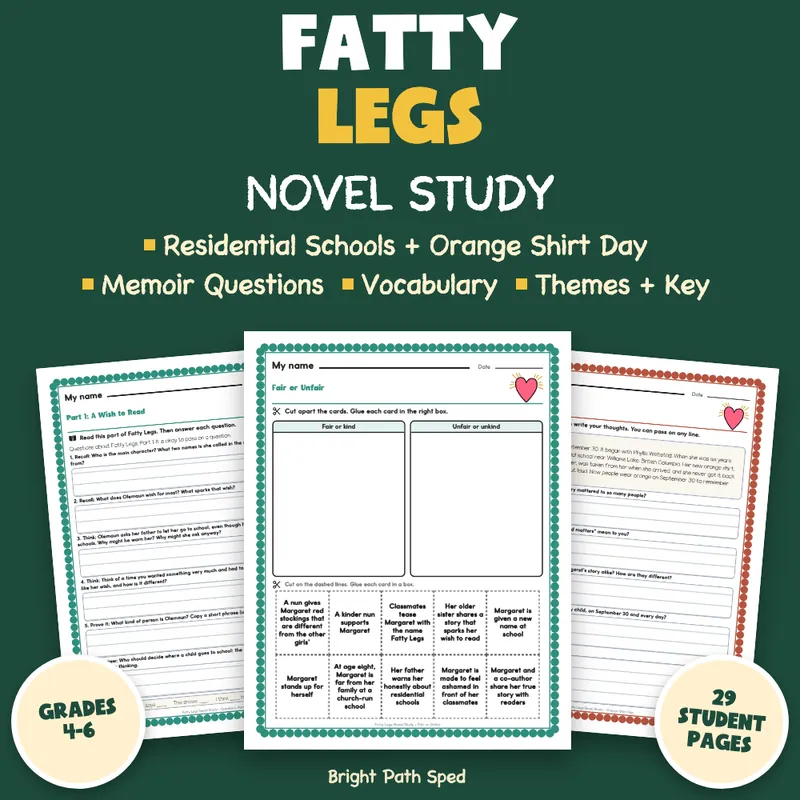
Looking for a Fatty Legs novel study that treats a hard topic with care? This is a complete memoir study for grades 4-6 to use with Fatty Legs: 24 book-specific talking questions in 4 parts, 18 vocabulary words, a character map, a memoir-detective page, feelings, cause-and-effect and staying-strong pages, a fair-or-unfair cut-and-sort, themes, an essay with a plan and a final project. It begins with a teacher note on teaching a sensitive topic and ends with an answer key.
Every question, word and page is our own. There is no text from the book in this file. Students use their own copy of the book. Every question is a discussion question with no graphic detail, and the chapter question pages say it is okay to pass.
EVERYTHING INSIDE (44 pages)
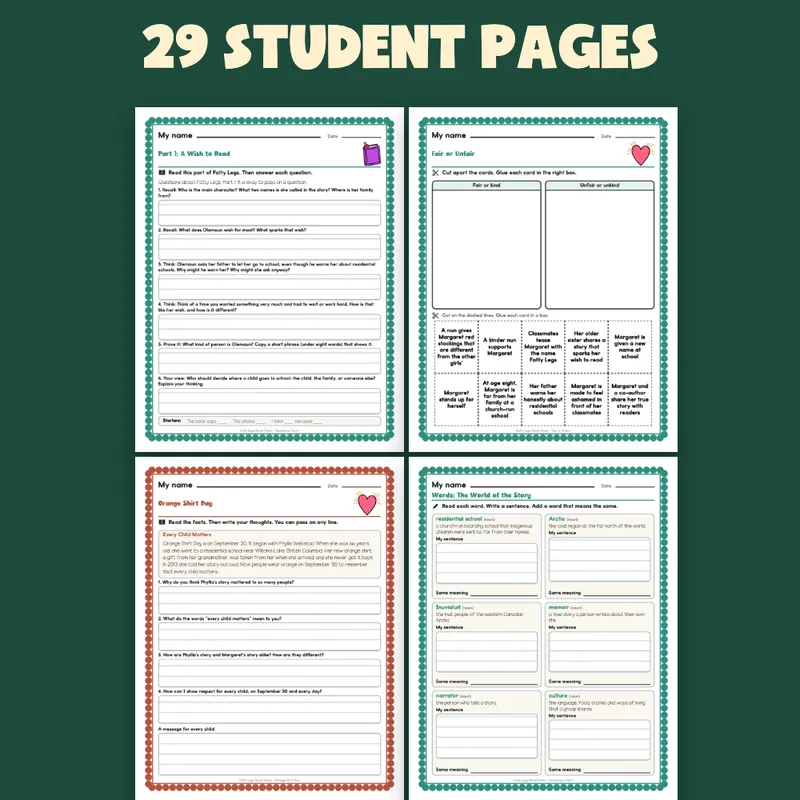
- 29 student pages, each with a "My name" line and one short instruction
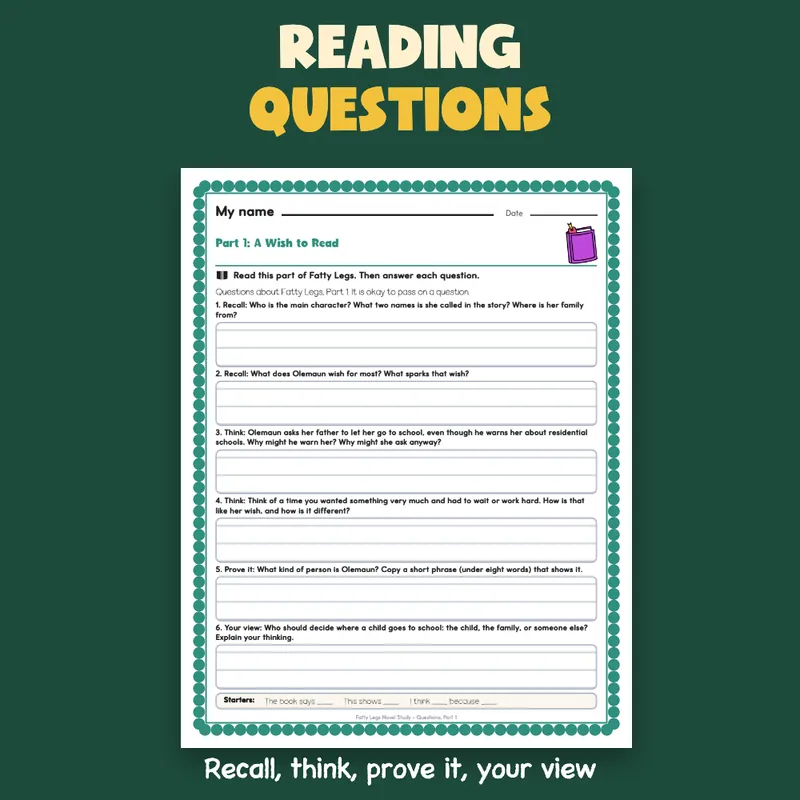
- 24 part questions in 4 parts, 6 questions on each page: recall, think, prove it and your view, about Olemaun's wish to read, going to school at age eight, the red stockings and the nickname, and standing up for herself (student pages 7-10)
- A before-you-read page, a part-summary page with a box for each part (somebody, wanted, but, so, then), and a character map for the main character and one other person
- "My Name and Me," an optional page where students write about their own name and what they are proud of
- A memoir-detective page: students check what their copy has (a narrator who says I, an author's note, photographs, and more) and tell how a memoir differs from a made-up story
- A how-she-feels page with a row for each part, a cause-and-effect page with 8 rows, a staying-strong chart (start, middle, end) and a problem-and-solution page
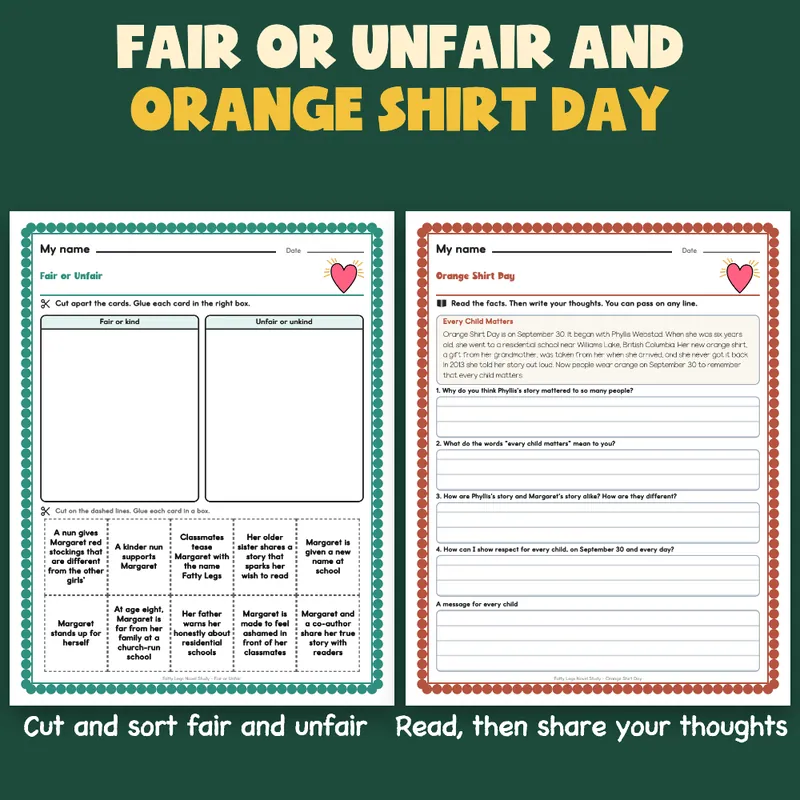
- A 10-card cut-and-sort called Fair or Unfair: events and choices from the book in our own words (5 fair or kind, 5 unfair or unkind) to cut apart and glue in the right box
- A traits-and-proof page (pick four words, prove each one), a write-a-letter page and a questions-I-still-have page
- Vocabulary: 18 words on 3 word pages (residential school, Arctic, Inuvialuit, memoir, humiliation, survivor, stockings, reconciliation and more, each with our own definition), plus a 12-word match
- A big-ideas page (4 themes), a text-evidence page (claim, evidence, reasoning) and a 6-question final review
- A three-prompt essay: a prompt page, a plan page with a checklist and a draft page
- An Orange Shirt Day page (student page 34): the facts of Phyllis Webstad's story in kid words, four reflection questions and a message for every child, with an okay-to-pass line
- A final project page with 3 choices (a word poster, a note to a friend or a book review), a work space and a checklist
- Teacher pages: a note before you begin, a how-to page with a plan for the whole book and a place to write your own chapters, a discussion guide with 6 questions, an answer key over four pages, an essay rubric, a filled example (an invented student with an invented memoir), a family page and a phrase bank (19 starters in 6 groups)
- Start Here page with a which-page-for-which-job chart
A Note On The Topic
Fatty Legs is a memoir about a child's time at a residential school in Canada, a hard part of history. The teacher note in this file explains how this study handles it: talking questions only, nothing graphic, a pass option for students, and no role-play of scenes from the book. It states only facts that two sources agree on. It points you to your local Indigenous educators or education office, to the Government of Canada's pages on residential schools, to the national truth and reconciliation archive and to the Truth and Reconciliation Commission of Canada's final report, so you can check every fact against sources you trust. Please read the book yourself before your class does.
How To Use It
1. Read the teacher note, then read the book in 4 parts. The how-to page has a plan and a table to write your own edition's chapters, because editions differ.
2. Students answer the question page for each part, and keep the character, feelings and cause-and-effect pages going alongside.
3. Talk about fairness and respect with the sort and the guide, teach the words, then finish with the final review, the essay or the project.
Answer Key Included
Recall and think questions have one-sentence sample answers. Opinion and text-evidence questions say Varies and tell you what to look for: a detail, a part of the book and a reason. Vocabulary has a model sentence for each word and the match answers. The key gives away how the story goes, so keep it from students until the book is done.
Built For The Student Holding The Page
A big "My name" line, one short instruction with a small picture cue, a plain colored border, sentence starters and room to write on every page. Nothing on a student page is written for an adult.
Invented Examples
The filled example is an invented student working on an invented memoir about a girl who moves far from her grandmother and wants to learn to swim, so it never repeats the book. It is not the book, and it says so on the page.
Type In, Or Print
The name line, every ruled box and every table cell are type-in fields in any PDF reader: click one, type, then save. You can also print any page. This is a fillable PDF; it is not a Google Slides or PowerPoint file.
What This Is, And What It Is Not
A study guide with original questions, vocabulary and graphic organizers for a memoir you teach with your own copy of the book. It is not the book, does not reproduce its text, is not a history lesson and does not match any one state's or province's standards. This resource is not affiliated with or endorsed by the authors of Fatty Legs, its illustrator, the publisher, or the owners of the book.
Who This Is For
Teachers of grades 4-6 reading the memoir as a class, in literature circles or independently, including for Orange Shirt Day units, and substitutes who need a ready-to-go question page.