Figurative Language Task Cards
- 33 pages
- 4th, 5th, 6th
$2.00 $4.00 on Teachers Pay Teachers
Half the Teachers Pay Teachers price. The same PDF, sold direct.
DownloadOr get it with All-Access: pick any 20 resources a month for $7.
New here? Your first month of All-Access is half off with code TEACHERTOK
Already bought this, or a member?
Instant download. One teacher's license: colleagues need their own copy. Each file carries a license number.
Also on Teachers Pay Teachers: see the Bright Path Sped store
About this resource
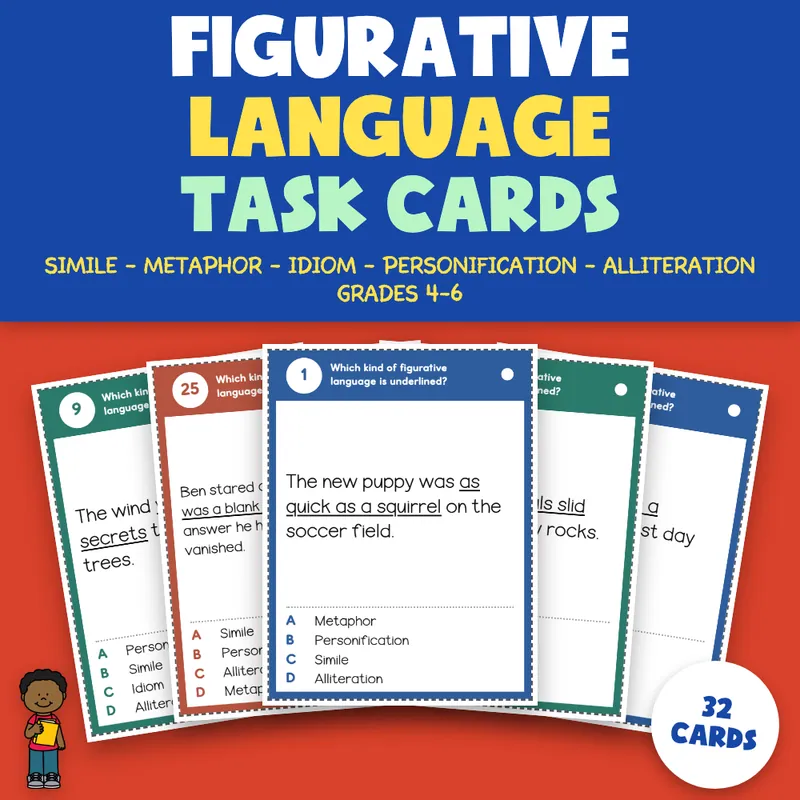
Looking for figurative language task cards that go past "which one is it"? This set has 32 multiple-choice cards for grades 4-6 on simile, metaphor, idiom, personification and alliteration. The figurative words on every card are underlined. Cards 1 to 10 are one sentence that asks which kind it is. Cards 11 to 22 are one sentence that asks the kind or what the underlined part means. Cards 23 to 32 are a short passage of two or three sentences. Every sentence is original, set in ordinary school, sports, family and nature scenes. Print, cut, and go: four big cards to a page, recording sheets, a five-column sort mat with cut-out labels, and an answer key that points to the underlined words and the clue on every card.
Five Student Activities Beyond The Cards
- The Five Kinds: a reference sheet with what each kind does, an example and a clue
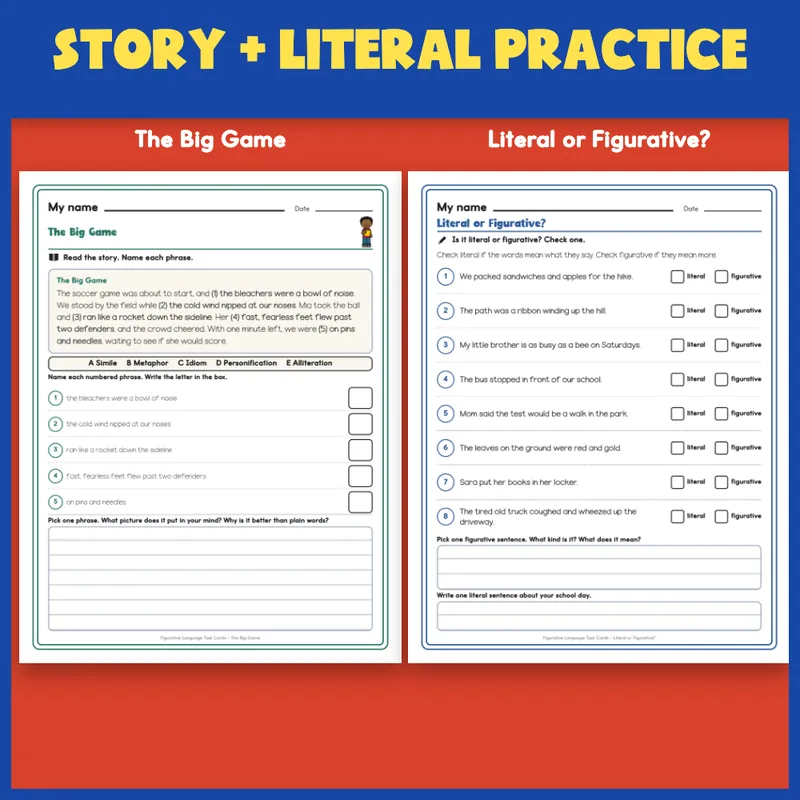
- The Big Game: a short story with 5 phrases to name
- Literal or Figurative?: 8 sentences to check
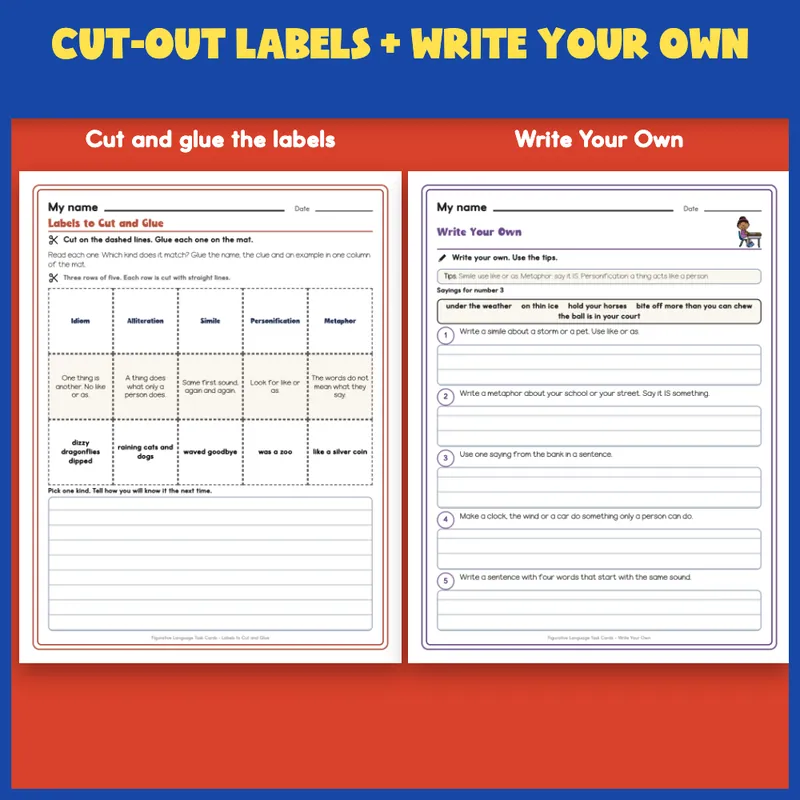
- Write Your Own: 5 prompts, one for each kind, with a bank of sayings
- Sort Mat: a five-column mat with cut-out labels to glue
Everything Inside
- 32 task cards across eight sheets, 4 to a sheet, each 3.7 by 4.9 inches, answer choices A to D; each set of 8 cards has its own color frame and header
- 21 cards ask which kind of figurative language is underlined; 11 ask what the underlined part means
- 10 of the 32 cards are short passages (cards 23 to 32); the rest are one sentence
- Every kind is on the cards: 7 similes, 6 metaphors, 7 idioms, 6 personification and 6 alliteration
- A circle, square or triangle on each card (10, 12 and 10 cards) so you can group students without telling them
- 1 reference sheet: the five kinds, each with what it does, an example and a clue
- 2 recording sheets (16 rows each) with a line for the clue words and check boxes A to D
- 1 five-column sort mat with 8 number boxes per column, and a sheet of 15 cut-out labels (a name, a clue and an example for each kind)
- 1 short story ("The Big Game") with 5 phrases to name; 1 literal-or-figurative page (8 sentences); 1 write-your-own page (5 prompts, one for each kind, with a bank of sayings)
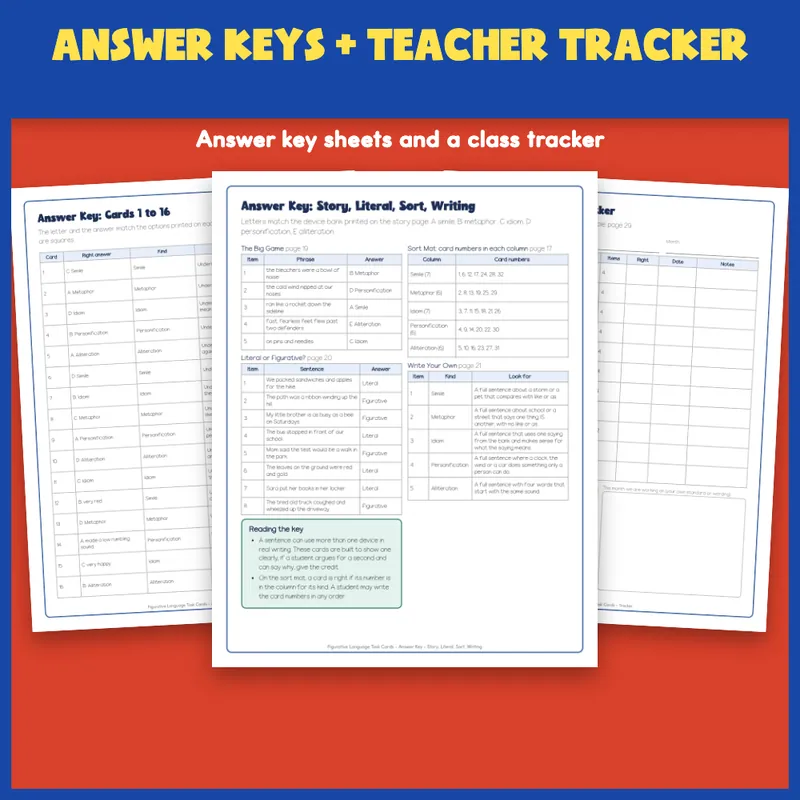
- 3 answer key sheets: every card's right letter and answer, kind, underlined words and clue; the story, the literal sentences, the sort mat and what to look for in each of the 5 writing prompts
- One sheet of ways to use the cards (stations, scoot, partner quiz, task box, exit ticket)
- 1 tracker, 1 class grid, 1 team note, 1 family page, 1 filled example (an invented student), 1 phrase bank (17 starters in 6 groups)
- Start Here, a how-to-read-a-page page, a binder cover and a page of divider tabs
Built For The Student Holding The Page
The student sheets (the recording sheets, sort mat, cut labels, story, literal-or-figurative page and writing page) have a big "My name" line, one short instruction with a small picture cue, and room to write. Nothing on a student sheet is written for an adult: the keys, ways to use the cards and records are on separate teacher pages. The cut-out labels are fifteen pieces that touch edge to edge, so the cutting is a few straight lines. The pages print clean in black and white.
Invented Example
The student in the filled example is made up and says so.
Print And Go
This is a printable PDF. Print the pages, cut the cards apart and laminate them if you like. The name lines, answer boxes and check boxes are also type-in fields in any PDF reader, if you would rather type than write. It is not a Google Slides, Docs or PowerPoint file, and it is not a self-grading online activity.
What This Is, And What It Is Not
A figurative language card set with the record-keeping around it. It is not a timed test, a screener, a clinical tool, or a claim about any student's age or rate of progress. There is no IEP goal language or eligibility wording anywhere in the file, and it does not claim to match any one state's standards: there is a line on the tracker for your own.