Final Consonant Deletion Minimal Pairs Picture Cards
- 19 pages
- Not Grade Specific
$2.50 $5.00 on Teachers Pay Teachers
Half the Teachers Pay Teachers price. The same PDF, sold direct.
DownloadOr get it with All-Access: pick any 20 resources a month for $7.
New here? Your first month of All-Access is half off with code TEACHERTOK
Already bought this, or a member?
Instant download. One teacher's license: colleagues need their own copy. Each file carries a license number.
Also on Teachers Pay Teachers: see the Bright Path Sped store
About this resource
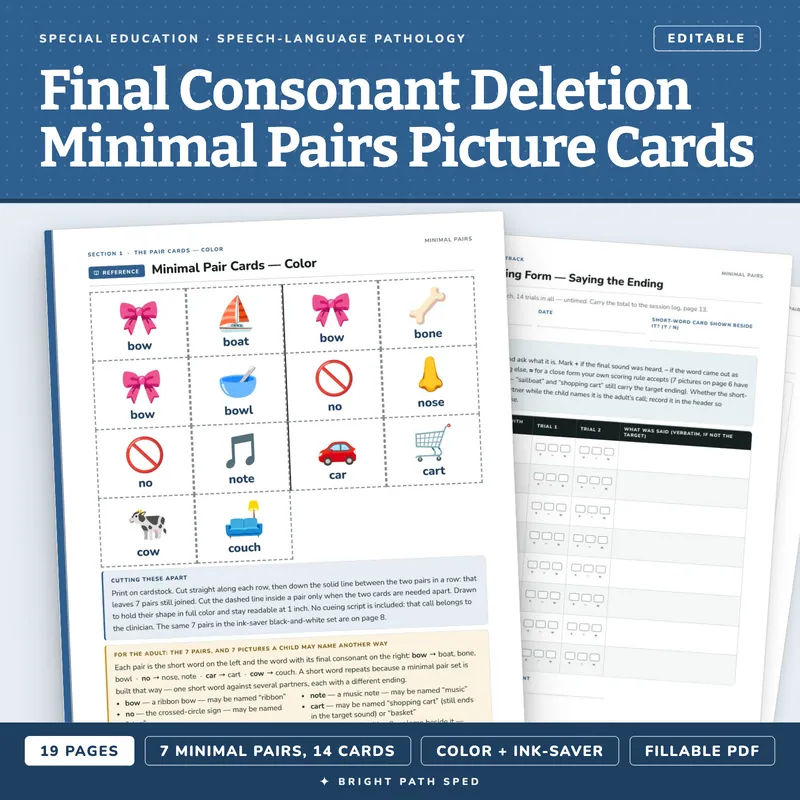
Final consonant deletion minimal pairs with a picture on BOTH sides: the word with its final consonant (boat) beside the real word it turns into when that consonant is dropped (bow). Every pair is two real, nameable things, cut as a touching pair, so the two cards show that the ending changes the meaning, not just the sound. 7 pairs built on 4 short words — bow/boat, bow/bone, bow/bowl, no/nose, no/note, car/cart, cow/couch — covering six different final sounds (t, n, l, z, t, t, ch), in full color and again in ink-saver black and white, with two scoring forms, a log, a weekly roll-up and graph, a family page and a phrase bank.
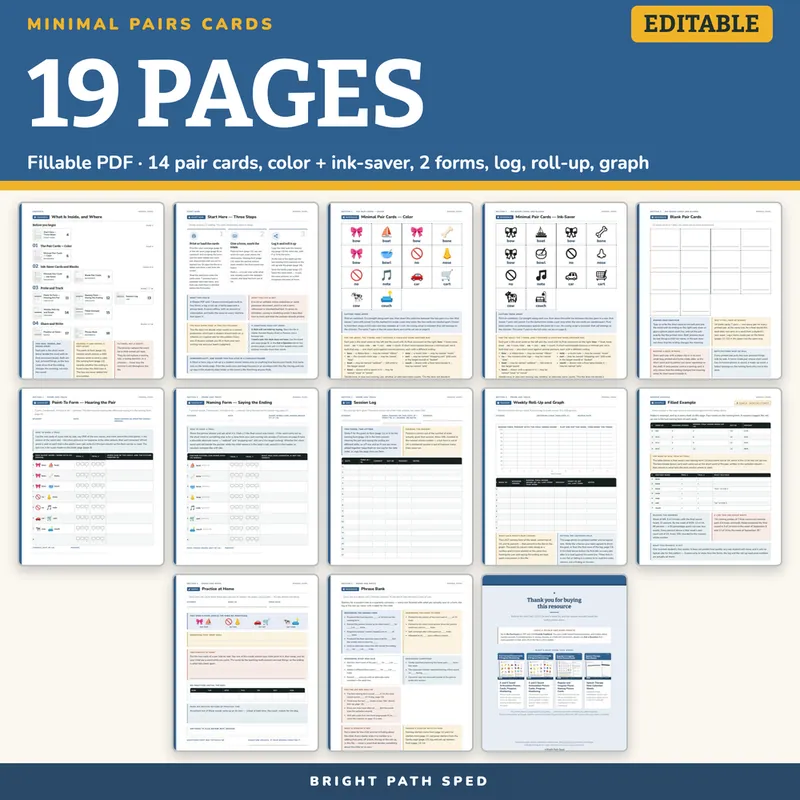
WHAT IS INCLUDED — 19 pages, 314 type-in fields
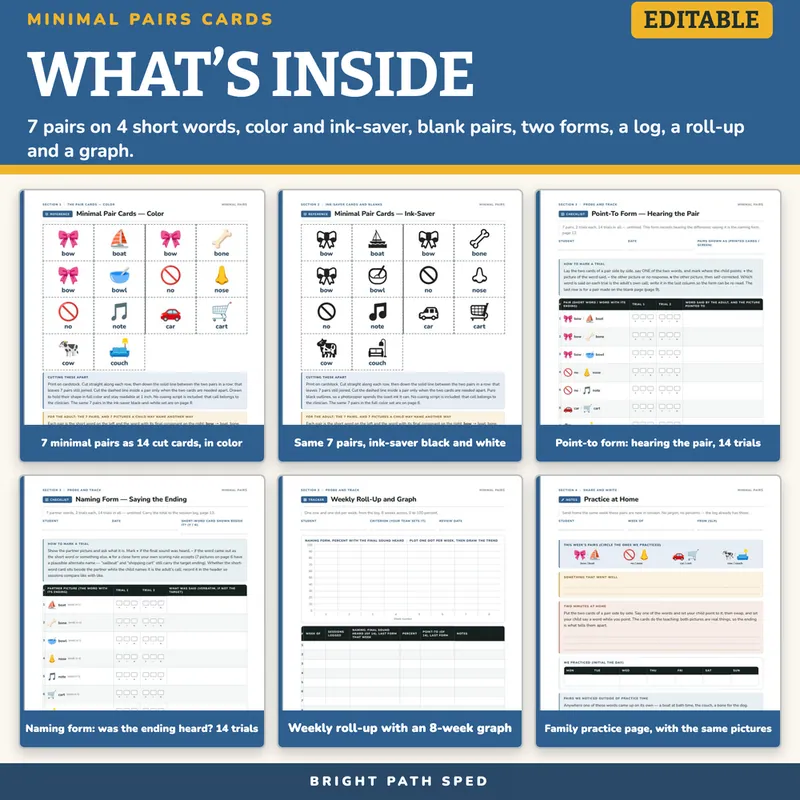
Picture Cards
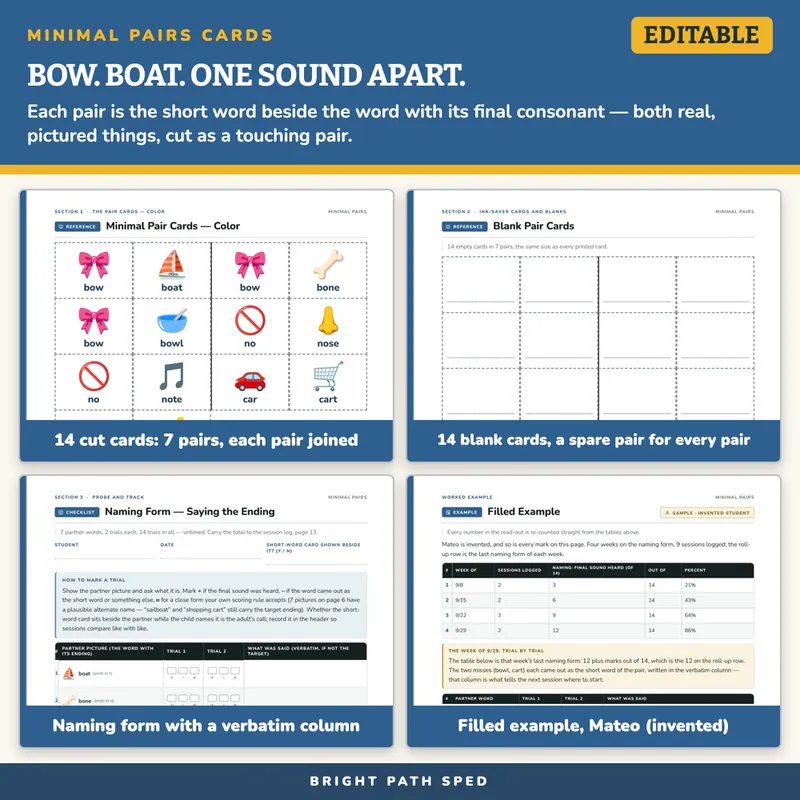
- 7 minimal pairs as 14 cut cards in full color, two pairs per row in a 4-across grid (the last row is one pair): the short word on the left of its partner, a dashed line between the two cards of a pair and a solid line between pairs, so one straight cut per row and one down the solid line leaves every pair still joined — big picture, word in large rounded type, nothing else on the card
- The same 14 cards again as an ink-saver set in pure black outlines, for the photocopier
- 14 blank cards (7 blank pairs) at the same size, for a pair this deck does not carry
- An adult box under the cards (not on the cards, so nothing extra is cut) listing the 7 pairs and the 7 pictures a child may name another way (bow "ribbon," boat "sailboat," bowl "soup," no "stop," note "music," cart "shopping cart," couch "sofa"), so the scoring rule is decided once, before the first probe
Probe And Track
- Point-To Form — hearing the pair: all 7 pairs with both pictures, 2 trials each (14 trials), marked + / – / ≈, a column for the word the adult said and the picture pointed to, a spare row for a home-made pair, and a correct-out-of-14 total
- Naming Form — saying the ending: the 7 partner pictures with the final sound each one carries, 2 trials each (14 trials), a verbatim column for what was actually said, a spare row, and a final-sound-heard-out-of-14 total; the two forms are never averaged into one number
- Session Log — 17 rows: date, form (P or N), correct, out of, percent, notes
- Weekly Roll-Up and Graph — 8 weeks across, 0–100 percent, one row per week with the last naming form's count and percent, the point-to count alongside, and a field for the team's own criterion
- Filled Example — an invented student, four weeks of naming forms plus that last form trial by trial, every percent re-counted from its own row
Share And Write
- Practice at Home — a family update built from four of the same pairs used in session (one per short word), a weekly practice table, and lines for the pairs a family noticed outside of practice time
- Phrase Bank — 19 observable-language starters across 5 groups (the naming form, the point-to form, what was said, carryover, the log and roll-up)
What This Is, And What It Is Not
It is a fillable PDF: type into the forms, the log, the roll-up, the family page and the blank cards, or print and use a pen. It works offline with no account or subscription. It is NOT an editable online slideshow or word-processor document, and it is not a norm-referenced or standardized test.
It carries no elicitation, cueing or modeling script. It does not decide what counts as a correct production, which pair a student should work on, a criterion, or a typical rate for this pattern — every one of those is the clinician's own call, written once and reused every session. Pictures replace the printed word list a child cannot yet read; they do not replace the clinician's scoring rule.
Who This Is For
Speech-language pathologists and special education teams with young or pre-reading students working on final consonants in words, and the families who get the practice page sent home.
Pictures: Noto Emoji by Google, Apache License 2.0 (color); Fluent Emoji by Microsoft, MIT License (ink-saver black and white).