Frindle Novel Study
- 36 pages
- 3rd, 4th, 5th
$3.00 $6.00 on Teachers Pay Teachers
Half the Teachers Pay Teachers price. The same PDF, sold direct.
DownloadOr get it with All-Access: pick any 20 resources a month for $7.
New here? Your first month of All-Access is half off with code TEACHERTOK
Already bought this, or a member?
Instant download. One teacher's license: colleagues need their own copy. Each file carries a license number.
Also on Teachers Pay Teachers: see the Bright Path Sped store
About this resource
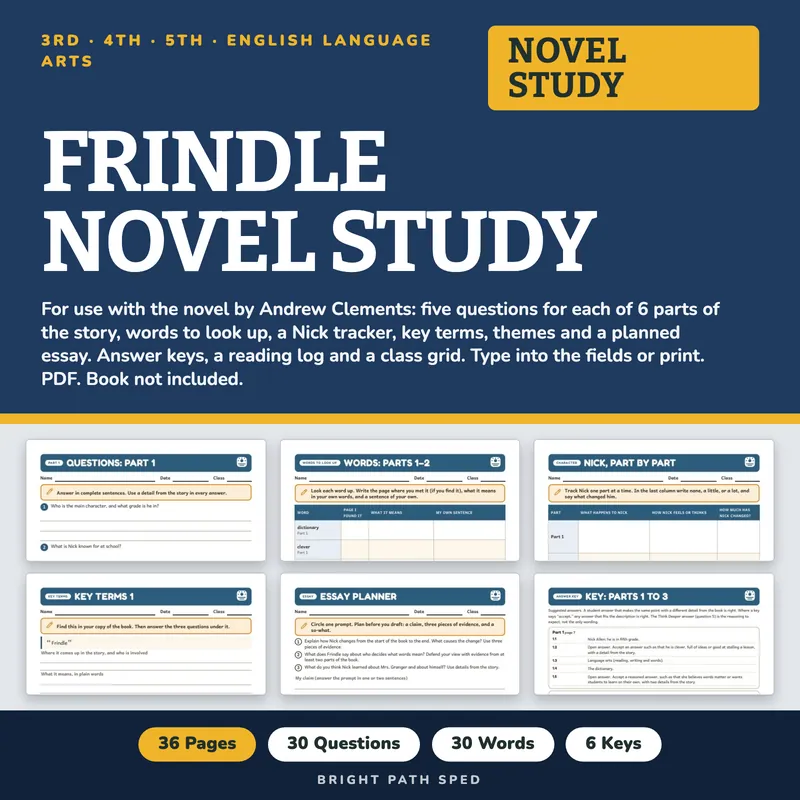
Teaching Frindle and writing the questions the night before? This novel study for 3rd, 4th and 5th grade does that work. It is made for use with the novel by Andrew Clements (the book is not included; students need their own copy, any edition). The story is divided into six parts by what happens. For every part: a question page with five questions on ruled lines, four short answers and one Think Deeper. For every two parts: a page of ten words to look up. Around them: a tracker for Nick, a page for six people in the story, four key terms to find and think about, four themes (words and meaning, creative ideas, rules and respect, looking back), sentence starters, and an essay planner with three prompts and a lined draft page. Every question, term and word has an answer key.
EVERYTHING INSIDE (36 pages)
- 18 student pages, every one with a name line, one instruction, and ruled lines or table cells with room to write
- Before You Read: 5 statements to agree or disagree with, revisited at the end
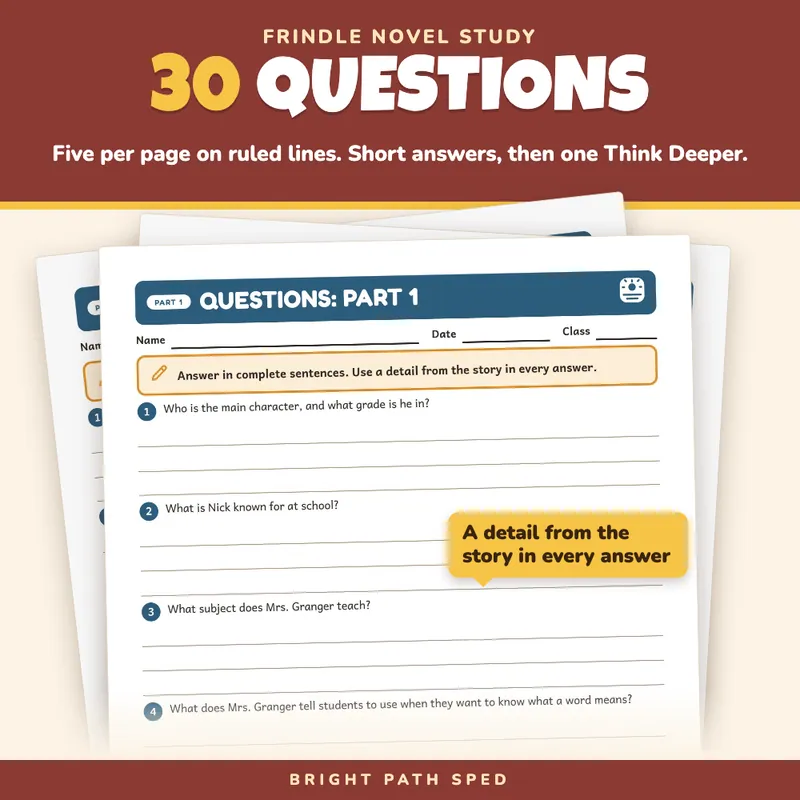
- 6 question pages, one per part: 30 questions in all, 3 ruled lines under a short answer, 5 under each of the 6 Think Deeper questions
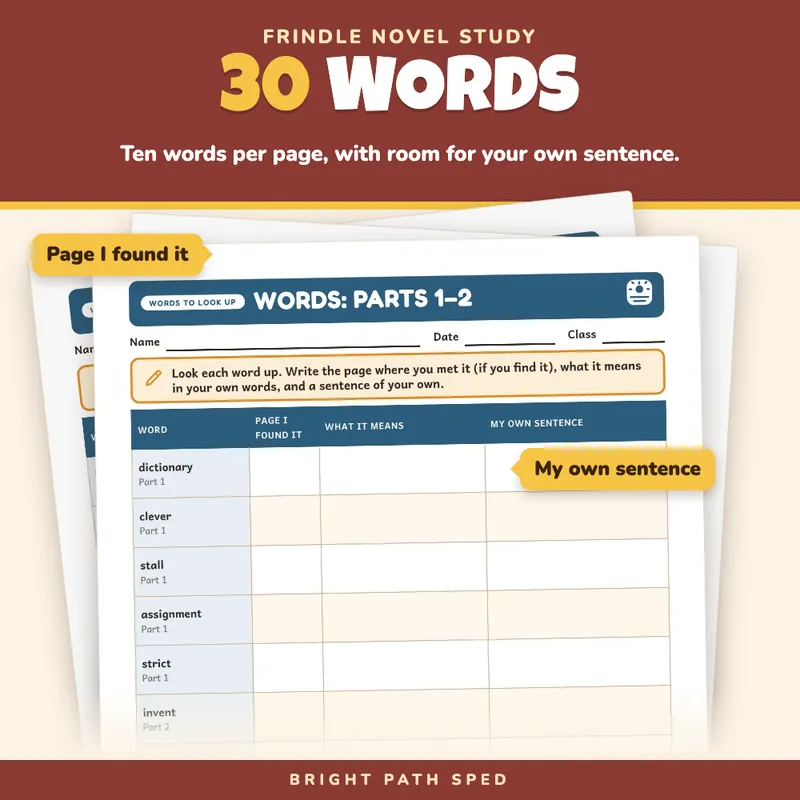
- 3 word pages: 30 words to look up, 10 per two parts, with columns for the page found, the student's own meaning and their own sentence
- Nick, Part by Part: a tracker with a row for each part
- The People in Nick's Story: Nick Allen, Mrs. Granger, Janet, Bud Lawrence, Nick's classmates and the people of the town (6 entries)
- Key Terms, 2 pages: Frindle, the Dictionary, Who Decides What a Word Means and the Letter (where, what it means, why it matters)
- Themes: 4 themes defined, the student chooses 2 and finds evidence for each
- Sentence Starters: 13 starters for claims, evidence, explanation, then-and-now and endings
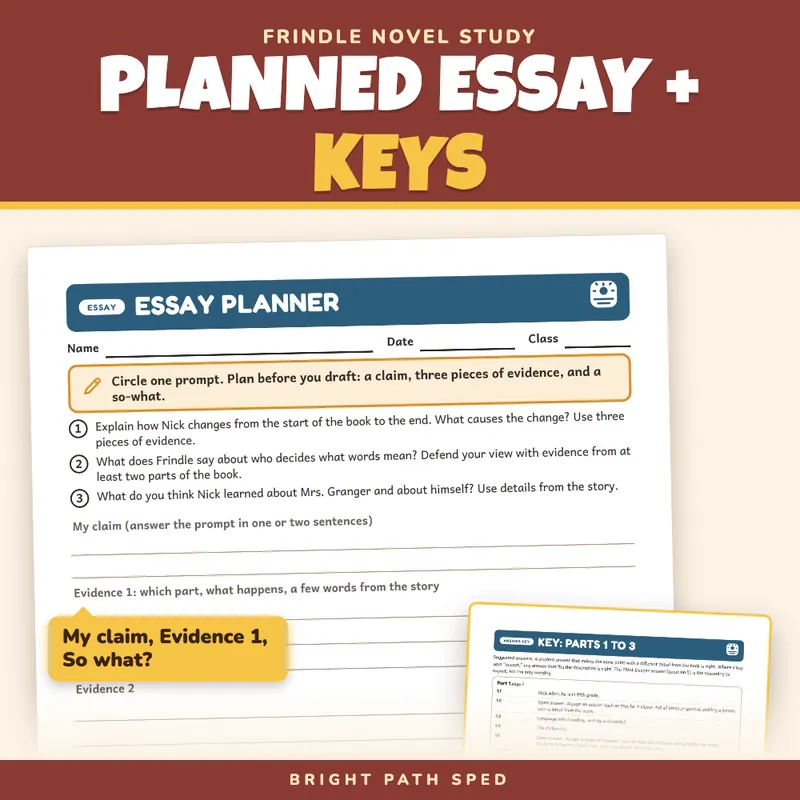
- Essay Planner with 3 prompts (claim, three pieces of evidence, so what, ending) and an Essay Draft page
- 6 answer keys: every question (three parts per page), the key terms, the 30 words, the people and themes, and the tracker and Before You Read pages, each with a notes box for your own wording
- A Reading Plan: one-line synopsis of each part, its study pages, and a blank for the chapters in your edition and your dates
- 1 reading log (one row per page or pair of pages), 1 class grid (15 students), 1 filled example for an invented student
- 1 family page with a discussion question per pair of parts, 1 phrase bank of 16 feedback and conference starters
- 1 binder cover and 6 divider tabs with a spine label to cut out
- Start Here and terms of use
How To Use It
1. Hand out Before You Read (page 5) before anyone opens the book, and fill in the Reading Plan with the chapters and dates in your edition.
2. Read a part, then give the word page (one per two parts) and the question page for that part.
3. As the class reads, students add to the Nick tracker and the people page.
4. After the last part: key terms, themes, sentence starters, then the essay planner and draft.
5. Check with the answer keys, log each page, roll the class up on the grid, and send the family page home.
Built For Grades 3 To 5
No mascots and no clip art. Clean pages, body text at 11 point or larger, a numbered question and ruled lines under it. The direction on every question page is the same: answer in complete sentences, with a detail from the story. The word pages ask students to look each word up and use it, and to write the page where they met it. Open questions have no single right answer, so the key says what a good answer does; preview the pages and read the book first.
Type In, Or Print
The name, date and class lines, every ruled line, the word and character tables, the reading log, class grid and family page are type-in fields in any PDF reader. Every page prints clean in black and white. This is a fillable PDF; it is not a Google Slides or PowerPoint file.
Who This Is For
Upper elementary ELA, resource rooms and co-taught classes, homeschool families and tutors reading this novel in any month. Several questions are open; the key says what a good answer does, so check the part notes against the edition in your room before you grade.
What This Is, And What It Is Not
A complete novel study with the record-keeping around it. There is no rubric or point value printed on any student page; the log has a blank for your own wording. It is not a test, a reading-level screener or a clinical tool, and it makes no claim about any student's grade level or rate of progress. The novel itself is not included and none of its text is reproduced.
This resource is not affiliated with or endorsed by Andrew Clements, the publisher of the book, or the owners of Frindle.