Functional Reading Life Skills
- 255 pages
- 3rd, 4th, 5th, 6th, 7th, 8th
$8.00 $16.00 on Teachers Pay Teachers
Half the Teachers Pay Teachers price. The same PDF, sold direct.
DownloadOr get it with All-Access: pick any 20 resources a month for $7.
New here? Your first month of All-Access is half off with code TEACHERTOK
Already bought this, or a member?
Instant download. One teacher's license: colleagues need their own copy. Each file carries a license number.
Also on Teachers Pay Teachers: see the Bright Path Sped store
About this resource
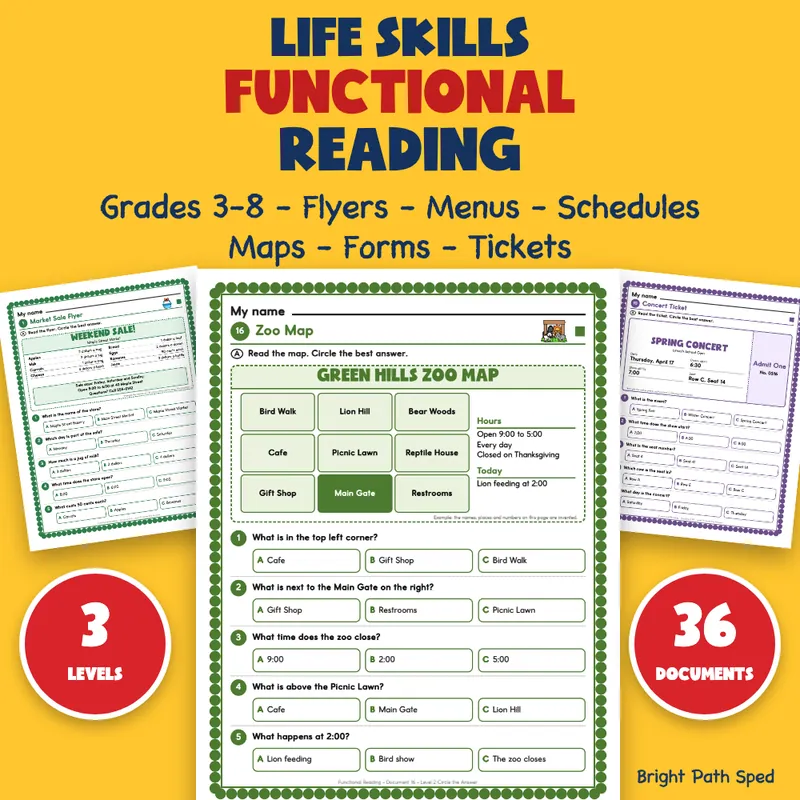
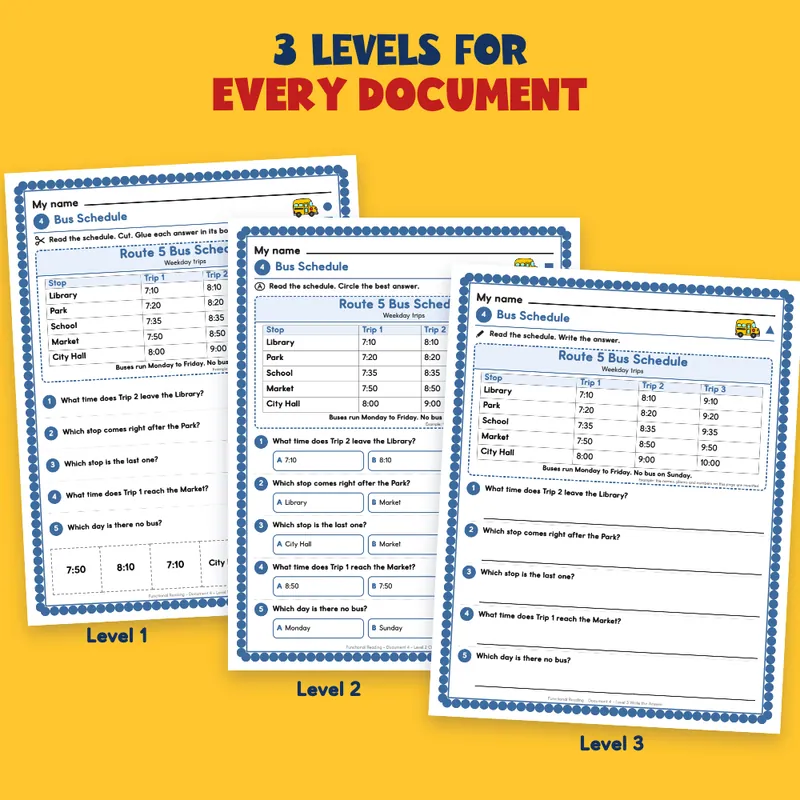
Reading a flyer, a bus schedule or a menu is a different skill from reading a story, and it is the one students use every day. These are 36 real-world documents, typeset like the ones students really see: each one is on its own worksheet with five questions under it, and every document comes three ways, so a whole group reads the same paper and each student answers at the level that fits.
EVERYTHING INSIDE (255 pages)
- 36 documents in 12 kinds, 3 of each, and 180 questions (5 for every document). Every business, school, place, date, time, price and phone number is invented, and every document says so in a small Example line:
- Flyers and ads: a market sale flyer, a bake sale ad, a yard sale flyer.
- Schedules: a bus schedule, a class schedule, an after-school clubs schedule.
- Menus: a school lunch menu for the week, a snack bar menu, a field day picnic menu.
- Tickets: a concert ticket, a zoo ticket, a train ticket.
- Newsletters and notes: a class newsletter, a book fair notice, a field trip note.
- Maps and hours: a zoo map, a park map, a school map, each with its hours or a key line.
- Signs and rules: library rules, computer lab rules, a recycling sign.
- Forms and sign-ups: a library card form and a lost and found report (both filled in for an invented student) and a field day sign-up sheet.
- Phone lists and directories: a school phone list, a building directory, a town information card.
- Calendars: a library events calendar, a school calendar, a summer camp calendar.
- Invitations and programs: a birthday party invitation, a spring program, an open house notice.
- Recipe cards: a fruit cup, trail mix and a yogurt parfait (no cooking, no heat).
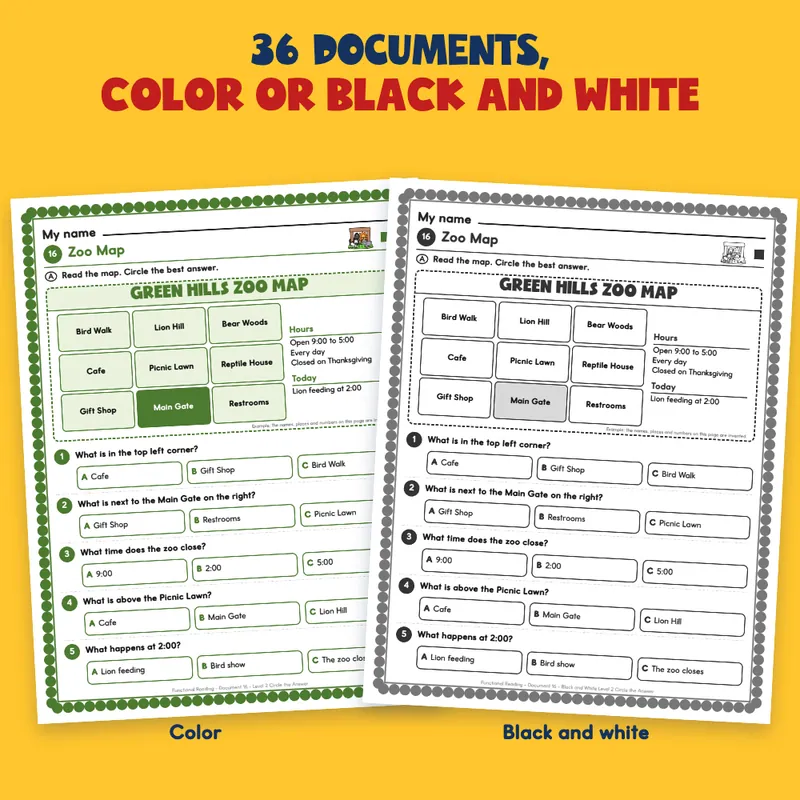
- 108 color student worksheets, three for every document:
- Level 1, Cut and Paste: six answer pieces (five answers and one left over) in one strip at the bottom, edge to edge, one straight cut for each line. The student glues each answer in the box by its question. No writing.
- Level 2, Circle the Answer: three choices, A, B and C, under every question.
- Level 3, Write the Answer: a ruled line under every question. The lines are type-in fields.
- 108 black-and-white copies: the same 108 worksheets with no color, for a clean class set.
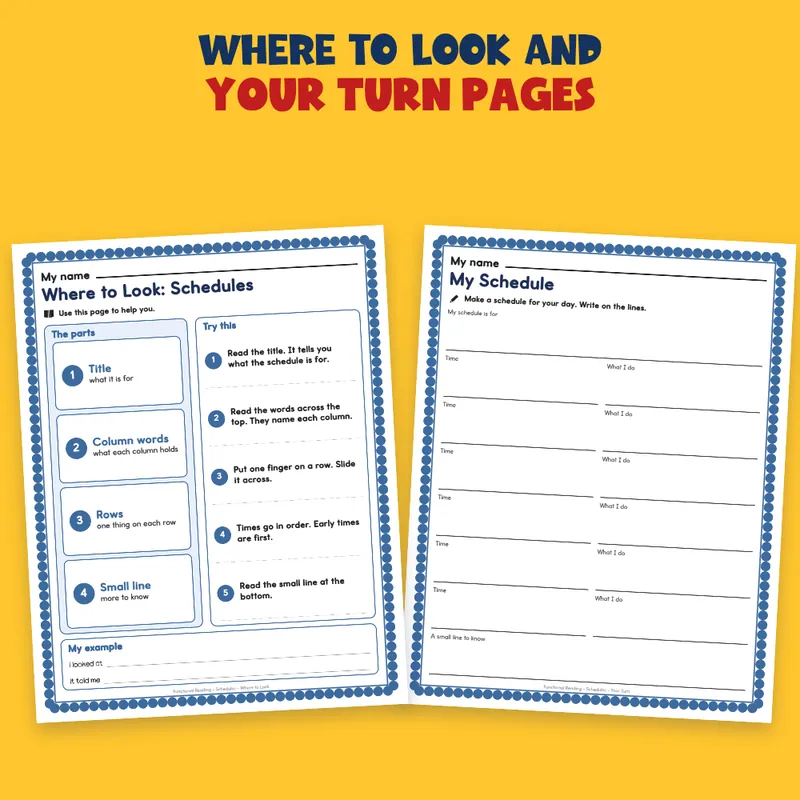
- 12 Where to Look pages, one for each kind of document: what each part tells you, and five things to try.
- 12 Your Turn pages, one for each kind: a blank flyer, schedule, menu, ticket, note, map, sign, form, list, calendar, invitation or recipe card the student fills in on type-in lines.
- 3 answer-key pages that cover all three levels (the answer for every question and the letter of the right choice for Level 2), and they fit the color and the black-and-white sheets.
- Words on Documents (20 words with plain meanings), My Reading Log (a circle to color for each of the 36 documents), a class record, a family note, a finished example sheet (an invented student), Start Here, How the Levels Work, an index with the page of every document, a black-and-white section page, terms of use and credits.
Built For The Student Holding The Page
A "My name" line, one short instruction with a picture cue, a scalloped border, a big numbered question, and room to answer: a glue box, three big choice boxes, or a ruled writing line. The document is printed at the top of the same sheet, so the student never turns the page. Nothing on a student sheet is written for an adult. A circle, square or triangle in the corner is the only level mark, so no one can tell whose paper is the easy one.
The Same Document, Three Ways To Answer
All three worksheets for a document carry the same paper and the same five questions. Only the way the student answers changes. The questions are mostly find-it questions (the day, the time, the price, the place, the name), with a few that ask what comes first or last or what is next to what on a map. The answer is always on the document.
Easy Cutting
The Level 1 strip is six equal pieces in one row, each more than an inch on a side, edge to edge with thick dashed lines. Every cut is one straight line.
Type In, Or Print
The Level 3 answer lines, the Your Turn pages, the class record and the family note are type-in fields in any PDF reader: click one, type, then save. Every page also prints and can be done by hand. This is a fillable PDF; it is not a Google Slides or PowerPoint file.
What This Is, And What It Is Not
Plain practice reading the things people read every day, with an answer key. The businesses, schools, places, dates, times, prices and phone numbers are invented practice examples. They are not instructions for any task, not a screener, not a clinical program and not a claim about any student, and they make no claim of alignment to any standard. Your own routine or your school's rule goes on the family note and the class record.
Who This Is For
Special education and life skills teachers in grades 3 through 8, resource room and self-contained classrooms, paraprofessionals and families who want everyday reading practice with a way to answer for every student.
If You Want More
Life Skills Reading Comprehension | 14 Themes, 140 Passages, 3 Levels Grades 3-8; Do I Have Enough Money? Worksheets | Menus, Flyers, Making Change Grades 6-12.