Initial Consonant Deletion Minimal Pairs Picture Cards
- 19 pages
- Not Grade Specific
$2.50 $5.00 on Teachers Pay Teachers
Half the Teachers Pay Teachers price. The same PDF, sold direct.
DownloadOr get it with All-Access: pick any 20 resources a month for $7.
New here? Your first month of All-Access is half off with code TEACHERTOK
Already bought this, or a member?
Instant download. One teacher's license: colleagues need their own copy. Each file carries a license number.
Also on Teachers Pay Teachers: see the Bright Path Sped store
About this resource
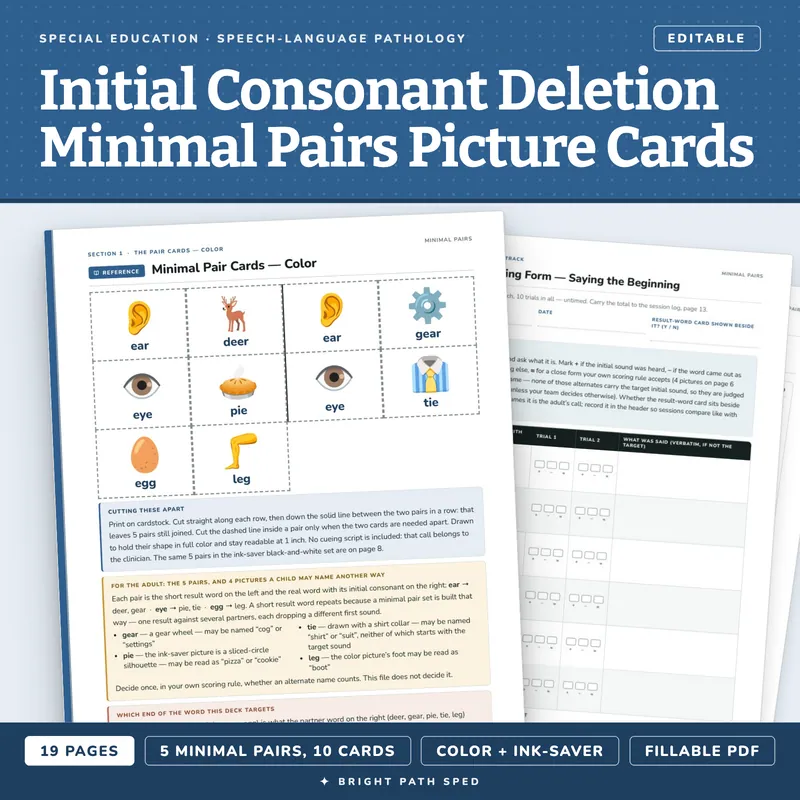
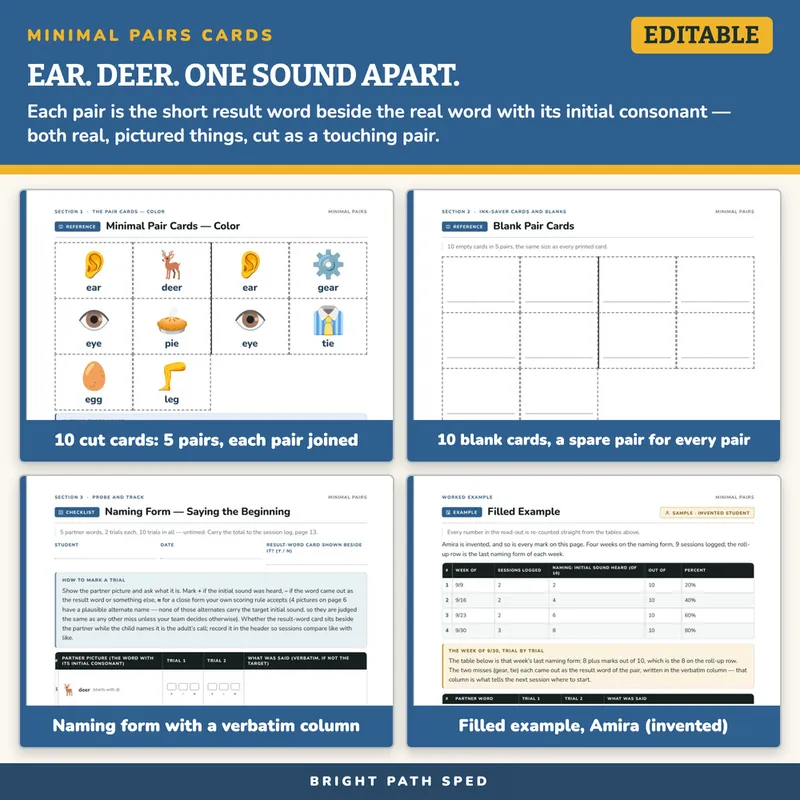
Initial consonant deletion minimal pairs with a picture on BOTH sides: the word with its initial consonant (deer) beside the real word it turns into when that consonant is dropped (ear). Every pair is two real, nameable things, cut as a touching pair, so the two cards show that the first sound changes the meaning, not just the sound. 5 pairs built on 3 short result words — ear/deer, ear/gear, eye/pie, eye/tie, egg/leg — covering five different initial sounds (d, g, p, t, l), in full color and again in ink-saver black and white, with two scoring forms, a log, a weekly roll-up and graph, a family page and a phrase bank.
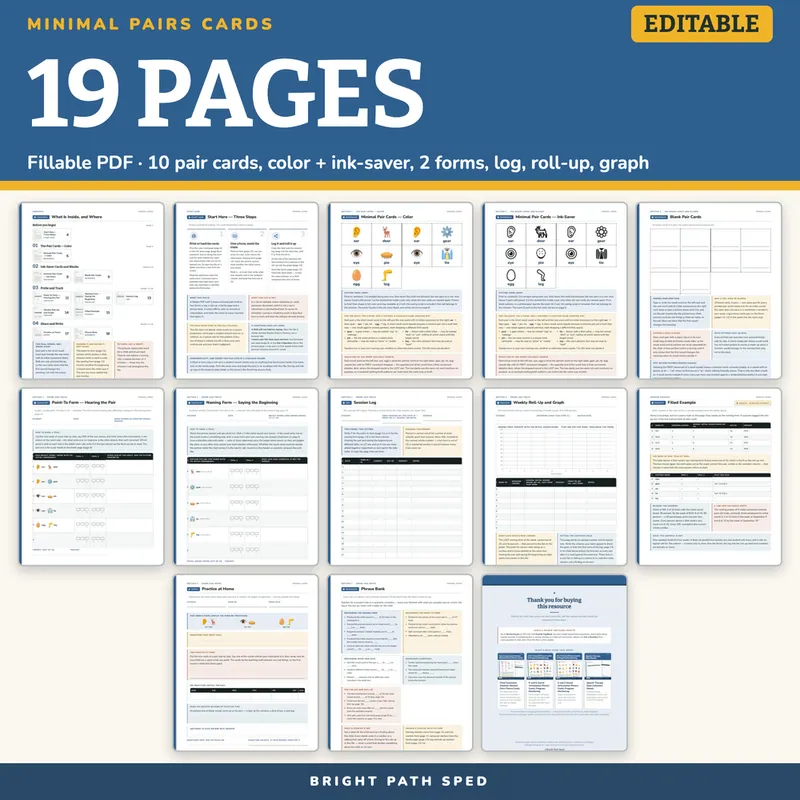
WHAT IS INCLUDED — 19 pages, 282 type-in fields
Picture Cards
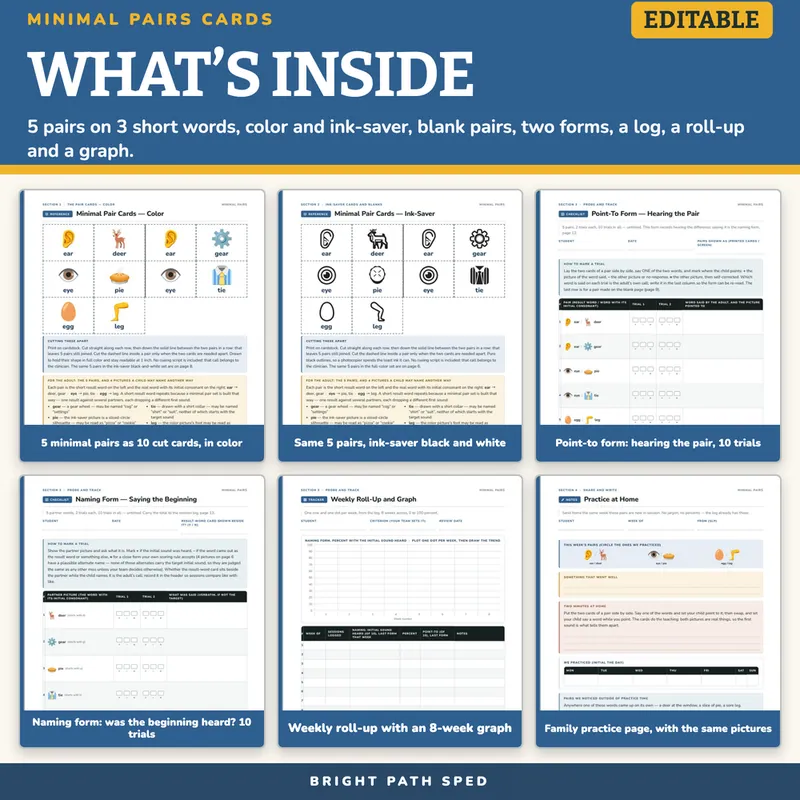
- 5 minimal pairs as 10 cut cards in full color, two pairs per row in a 4-across grid (the last row is one pair): the short result word on the left of its partner, a dashed line between the two cards of a pair and a solid line between pairs, so one straight cut per row and one down the solid line leaves every pair still joined — big picture, word in large rounded type, nothing else on the card
- The same 10 cards again as an ink-saver set in pure black outlines, for the photocopier
- 10 blank cards (5 blank pairs) at the same size, for a pair this deck does not carry
- An adult box under the cards (not on the cards, so nothing extra is cut) listing the 5 pairs and the 4 pictures a child may name another way (gear "cog"/"settings," pie's ink-saver version "pizza"/"cookie," tie "shirt"/"suit," leg's color picture "boot"), so the scoring rule is decided once, before the first probe
Probe And Track
- Point-To Form — hearing the pair: all 5 pairs with both pictures, 2 trials each (10 trials), marked + / – / ≈, a column for the word the adult said and the picture pointed to, a spare row for a home-made pair, and a correct-out-of-10 total
- Naming Form — saying the beginning: the 5 partner pictures with the initial sound each one carries, 2 trials each (10 trials), a verbatim column for what was actually said, a spare row, and an initial-sound-heard-out-of-10 total; the two forms are never averaged into one number
- Session Log — 17 rows: date, form (P or N), correct, out of, percent, notes
- Weekly Roll-Up and Graph — 8 weeks across, 0–100 percent, one row per week with the last naming form's count and percent, the point-to count alongside, and a field for the team's own criterion
- Filled Example — an invented student, four weeks of naming forms plus that last form trial by trial, every percent re-counted from its own row
Share And Write
- Practice at Home — a family update built from the three pairs used in session (one per short result word), a weekly practice table, and lines for the pairs a family noticed outside of practice time
- Phrase Bank — 19 observable-language starters across 5 groups (the naming form, the point-to form, what was said, carryover, the log and roll-up)
What This Is, And What It Is Not
It is a fillable PDF: type into the forms, the log, the roll-up, the family page and the blank cards, or print and use a pen. It works offline with no account or subscription. It is NOT an editable online slideshow or word-processor document, and it is not a norm-referenced or standardized test.
It carries no elicitation, cueing or modeling script. It does not decide what counts as a correct production, which pair a student should work on, a criterion, or a typical rate for this pattern — every one of those is the clinician's own call, written once and reused every session. Pictures replace the printed word list a child cannot yet read; they do not replace the clinician's scoring rule.
Who This Is For
Speech-language pathologists and special education teams with young or pre-reading students working on initial consonants in words, and the families who get the practice page sent home.
Pictures: Noto Emoji by Google, Apache License 2.0 (color); Fluent Emoji by Microsoft, MIT License (ink-saver black and white).