Julius Caesar Play Study Worksheets
- 44 pages
- 8th, 9th
$2.50 $5.00 on Teachers Pay Teachers
Half the Teachers Pay Teachers price. The same PDF, sold direct.
DownloadOr get it with All-Access: pick any 20 resources a month for $7.
New here? Your first month of All-Access is half off with code TEACHERTOK
Already bought this, or a member?
Instant download. One teacher's license: colleagues need their own copy. Each file carries a license number.
Also on Teachers Pay Teachers: see the Bright Path Sped store
About this resource
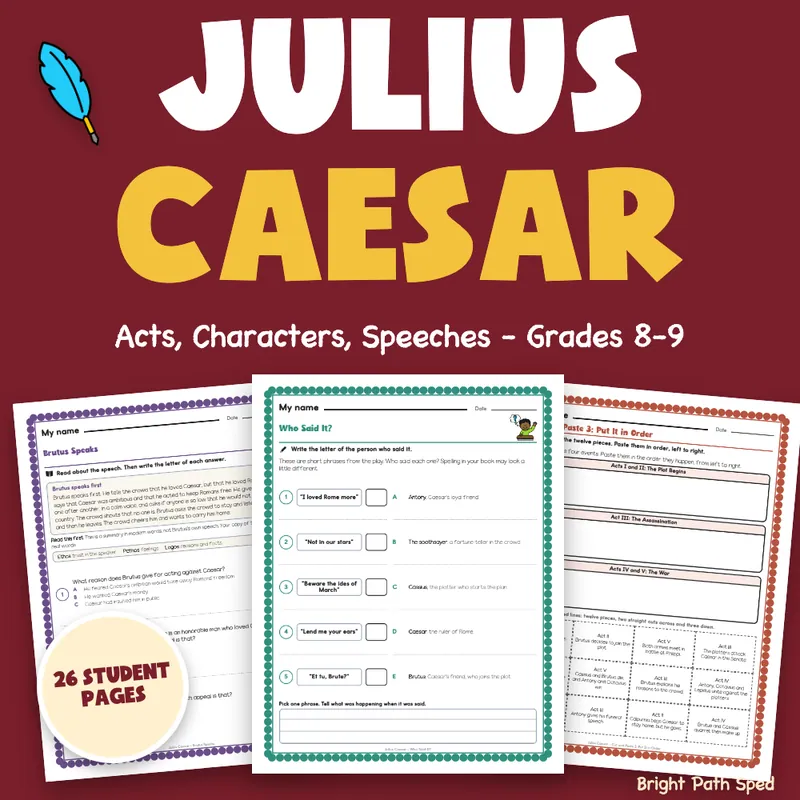
Teaching Julius Caesar and need pages students can actually work on? This is a complete study set for grades 8-9 (and a good fit for a strong grade 7 or an on-level grade 10). Students read a plain-words summary of each of the five acts, track seven characters, study Brutus's and Antony's speeches and name the appeals each one uses (ethos, pathos, logos), then connect the story: which act, who said it, cause and effect, and who is responsible for Caesar's death. They finish with a claim-evidence-reasoning paragraph, a quiz, three cut-and-paste sorts, including a twelve-event sequence, and exit tickets. Answer keys give the letters and a sample for every open answer.
EVERYTHING INSIDE (44 sheets)
- 26 student pages in 16 kinds of page, each with a name line and one short instruction
- 80 scored items spread over 17 scored worksheets, every answer key built from the same option lists that print on the page
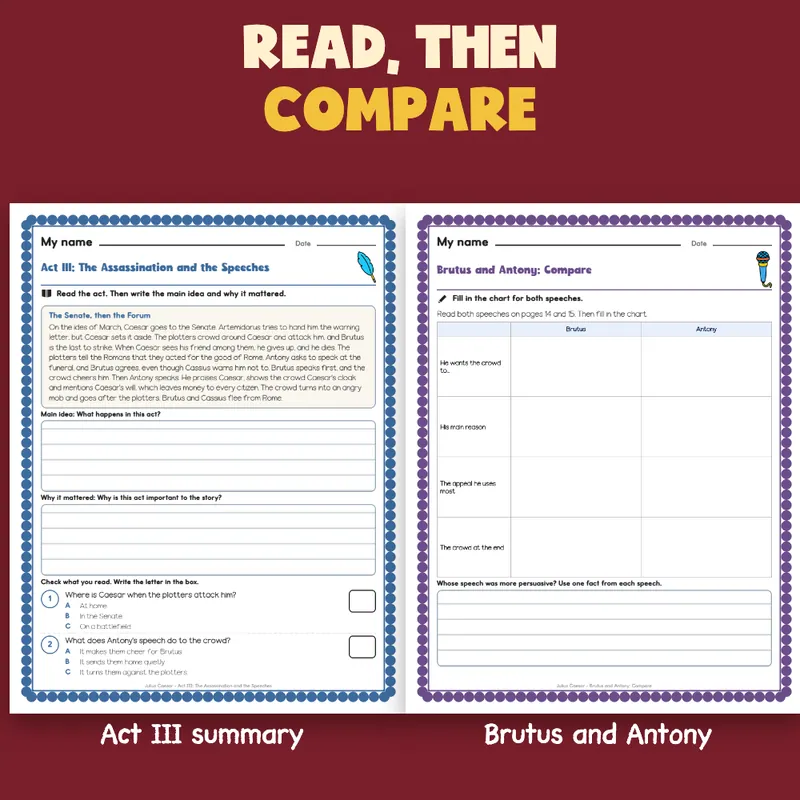
- 5 act summaries, one per act, of 106 to 132 words each, with a main idea box, a why-it-mattered box and 2 checks (10 checks in all)
- Story points covered: the soothsayer and the ides of March, Cassius persuading Brutus, the crown refused three times, Brutus joining the plot, Portia and Calpurnia, the assassination in Act III, Brutus's speech and Antony's funeral speech, the angry crowd, Antony, Octavius and Lepidus joining forces, the quarrel between Brutus and Cassius, Caesar's ghost, and the battle of Philippi with the deaths of Cassius and Brutus
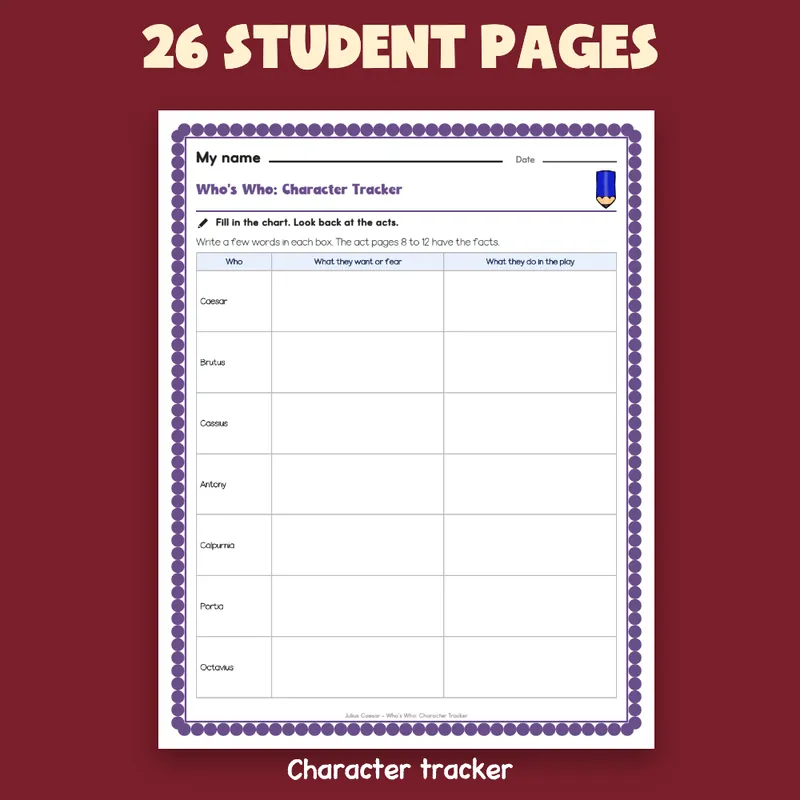
- 1 character tracker for 7 characters (Caesar, Brutus, Cassius, Antony, Calpurnia, Portia, Octavius): what each wants or fears and what each does
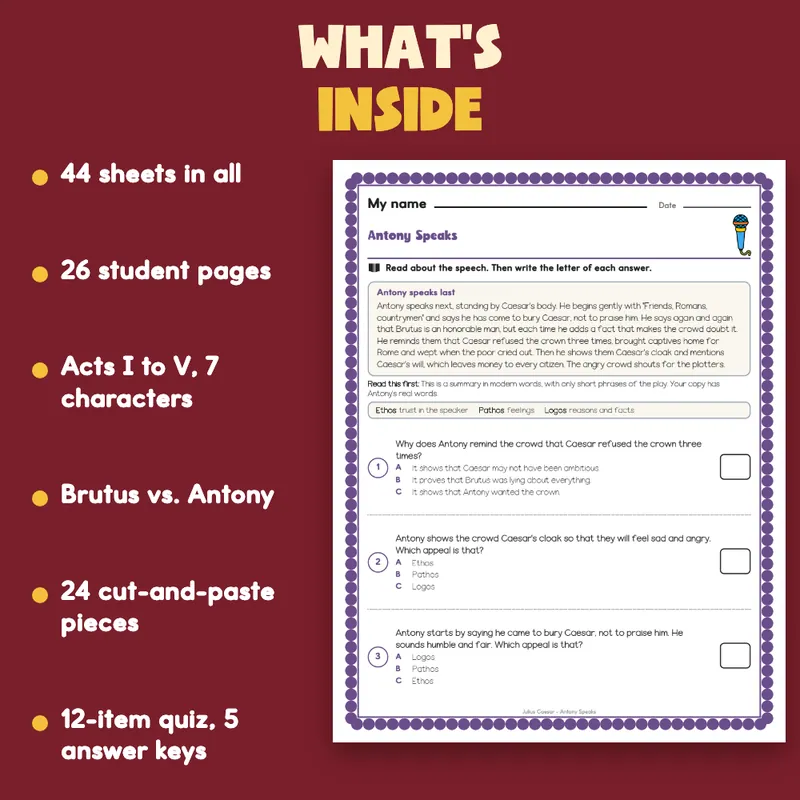
- 2 speech pages (Brutus Speaks, Antony Speaks) with a plain-words summary, a bank of the three appeals and 6 checks, plus 1 Brutus and Antony comparison chart with a writing box
- 1 Who Is Responsible? evidence chart for 4 people or groups, with what each did and what each could have done, and 2 claim-evidence-reasoning pages (an organizer and an 18-line paragraph page)
- 1 Before and After Check (5 questions, an answer box for each time) and 1 Before You Read page with 4 true-or-false items
- 1 Words to Know page: match 8 words (conspiracy, tyrant, ambition, omen, soothsayer, senate, persuade, honorable) to their meanings
- 1 Which Act? page with 6 events, and 1 Who Said It? page that matches 5 short phrases of the play to their speakers
- 1 cause and effect organizer with 4 causes
- 6 short-answer questions across two pages, 4 ruled lines each
- 12-item quiz across two pages; 4 exit tickets
- 24 cut-and-paste pieces on 3 sort mats: cause or effect and Brutus's speech or Antony's speech (6 pieces each in a 3 by 2 grid) and a sequence sort (12 events in a 4 by 3 grid, three full-width paste rows, four events in each)
- 5 answer keys with a sample for every open answer; 1 tracker, 1 class grid, 1 team note, 1 family page
- 1 filled example (an invented student), 1 phrase bank (17 starters in 6 groups)
- A binder cover with type-in teacher and class fields, and a page of divider tabs (Acts, Characters, Speeches, Sorts, Keys) with a spine label to cut out
- Start Here and a how-to-read-a-page page
Built For The Student Holding The Page
A "My name" line, one short instruction with a small picture cue, a plain scalloped border and big ruled boxes. Nothing on a student page is written for an adult: the keys and records are on separate teacher pages. The cut pages have their pieces edge to edge, so there are only a few straight cuts. Clip art is kept to one small picture per page. The file prints clean in black and white.
A Study Set, Not The Play Itself
Julius Caesar is a play by William Shakespeare, in the public domain. These pages are plain-words summaries written for this file, with only short phrases of the play (such as "Beware the ides of March"), so no long quotations are needed. Students still read, watch or listen to the play in your own edition; this set is not affiliated with any publisher or edition. Check the summaries against your own copy; they are not tied to any standard. Acts IV and V include battles and the deaths of Cassius and Brutus, so read ahead and decide how to handle them for your class. The only student in the file is an invented example, and it says so.
Type In, Or Print
The name line, every answer box, every check box and every ruled work box are type-in fields in any PDF reader: click one, type, then save. This is a fillable PDF; it is not a Google Slides or PowerPoint file.
What This Is, And What It Is Not
A set of Julius Caesar study pages with the record-keeping around it. It is not a timed test, a screener, a clinical tool, or a claim about any student's age or rate of progress. There is no IEP goal language or eligibility wording anywhere in the file, and no claim of alignment to any standard.
If You Want More
Great Depression Worksheets | Reading, Timeline, New Deal Sort Grades 6-8; Mayflower Compact Worksheets | Reading Sort Cut and Paste Grades 6-8; Constitutional Convention Worksheets | Readings Compromises Sort Grades 6-8.