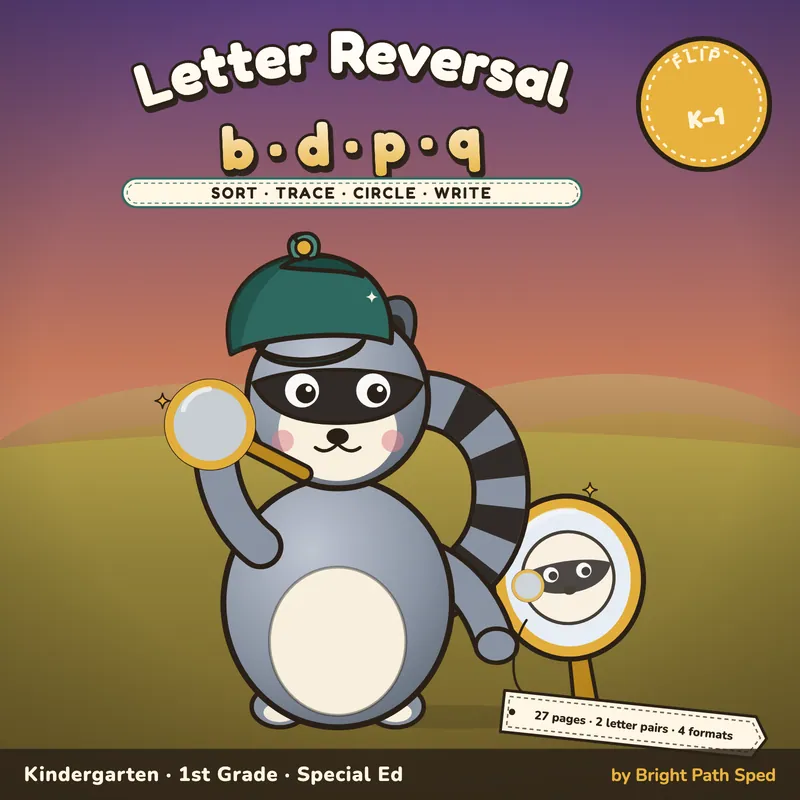
Letter Reversal Worksheets b d p q
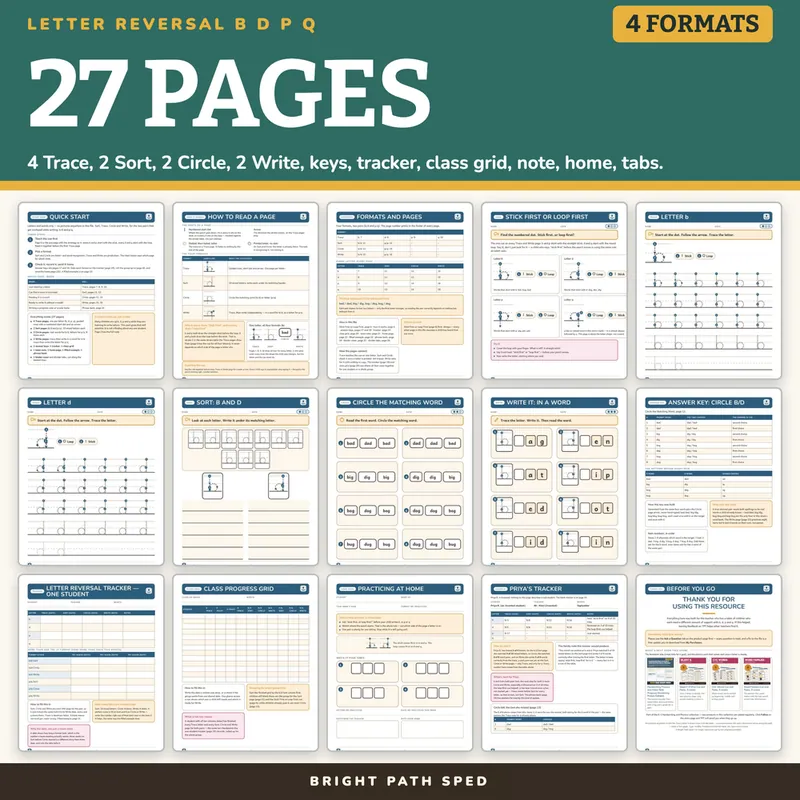
- 27 pages
- Kindergarten, 1st
$4.00
DownloadOr get it with All-Access: pick any 20 resources a month for $7.
New here? Your first month of All-Access is half off with code TEACHERTOK
Already bought this, or a member?
Instant download. One teacher's license: colleagues need their own copy. Each file carries a license number.
Also on Teachers Pay Teachers: see the Bright Path Sped store
About this resource
WHAT IS INCLUDED - 27 pages, 236 type-in fields
Setup
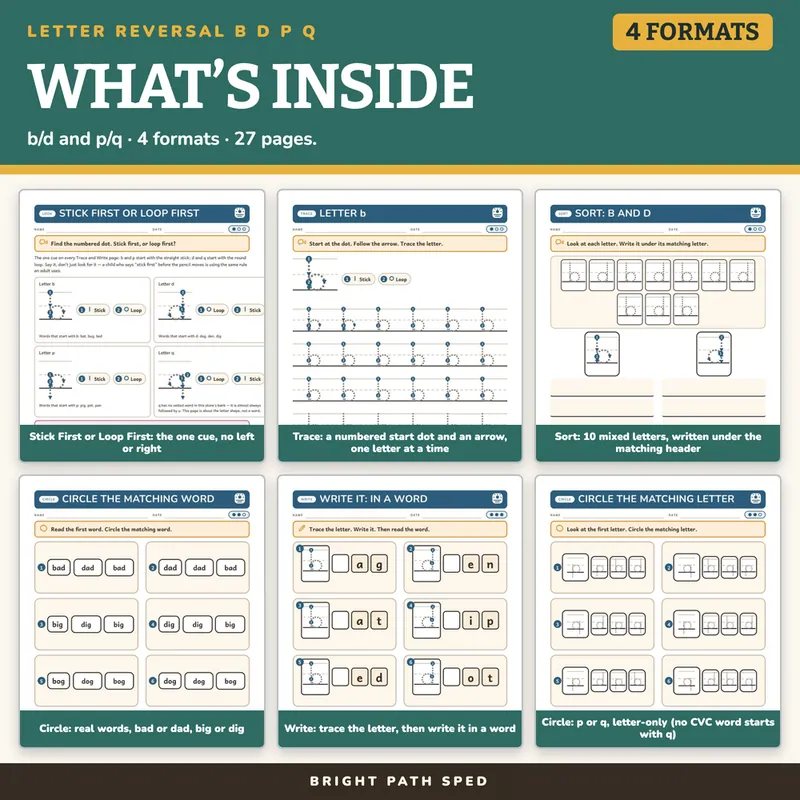
- Quick Start - a chooser that matches what a child is doing (just meeting the letter, matching it once printed, reading it in a word, writing it alone) to the page that fits
- How to Read a Page - the numbered start dot, the arrow, the dotted-then-faded trace, and a plain table of all four formats
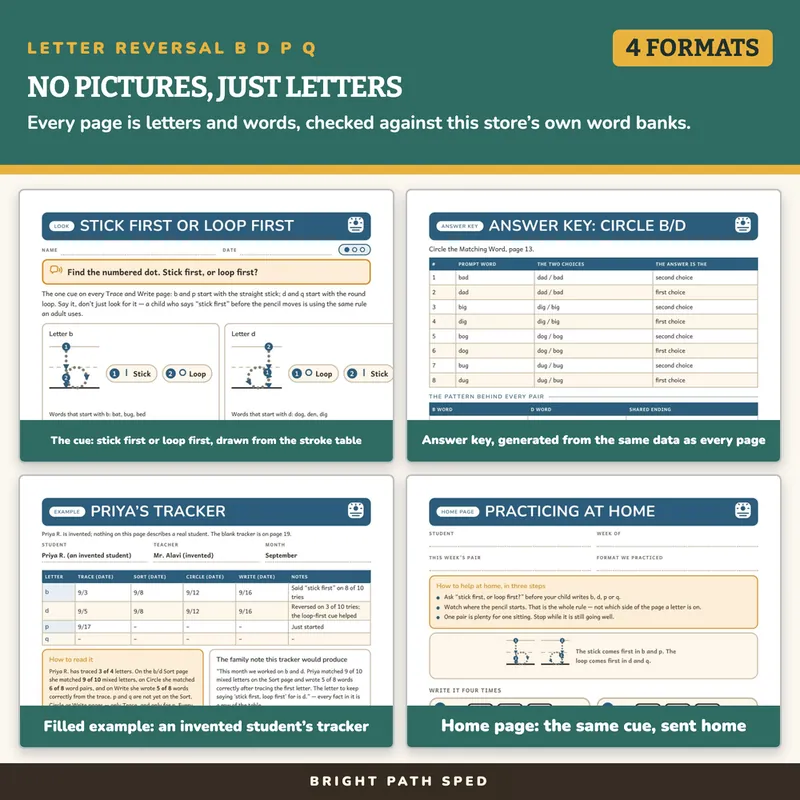
- Stick First or Loop First - the one page with the strategy itself: a guided model and a two-step order badge for each of b, d, p and q, plus the real words each pair starts (q has none — see below)
Tracking And Reporting
- 2 answer keys, generated from the same data every page uses, never typed by hand
- Letter Reversal Tracker - one row per letter, a date for Trace and a shared date for Sort, Circle and Write on that letter's pair
- Class Progress Grid - one row per student across all four letters and both pairs
- Progress Note - an observable-only hand-off page for the team, with fill-in-the-blank starters
- Practicing at Home - the same "stick first or loop first" question, sent home, with three write-it-yourself boxes
- A filled-in example for an invented student, Priya R. (b/d underway, p/q just started)
- A phrase bank of progress-note, family-note and next-step starters
- A binder cover and six divider tabs plus a spine label, cut along the dashed lines
What This Is, And What It Is Not
It is a fillable PDF. Open it in a PDF reader, click a line or a box on a teacher page, type, and Save As once per student. It works offline with no account or subscription. It is NOT a Google Slides, Google Docs or PowerPoint file. The tracing, sorting, circling and writing on the student pages are always pencil work, never type-in fields.
It is not a clinical tool and it names no condition, and it does not use the word "left" or "right" to teach the letters. Mixing up b, d, p and q is a common, ordinary part of learning to write; nothing in this file is a finding about, or a label for, any one student — that stays with your district's own process.
Who This Is For
Kindergarten and first-grade teachers, special education teachers and case managers building handwriting or phonics practice, and any classroom where a few children are still mixing up these four letters.