Martin Luther King Jr Color Sheets
- 29 pages
- PreK, Kindergarten, 1st, 2nd
$2.00 $4.00 on Teachers Pay Teachers
Half the Teachers Pay Teachers price. The same PDF, sold direct.
DownloadOr get it with All-Access: pick any 20 resources a month for $7.
New here? Your first month of All-Access is half off with code TEACHERTOK
Already bought this, or a member?
Instant download. One teacher's license: colleagues need their own copy. Each file carries a license number.
Also on Teachers Pay Teachers: see the Bright Path Sped store
About this resource
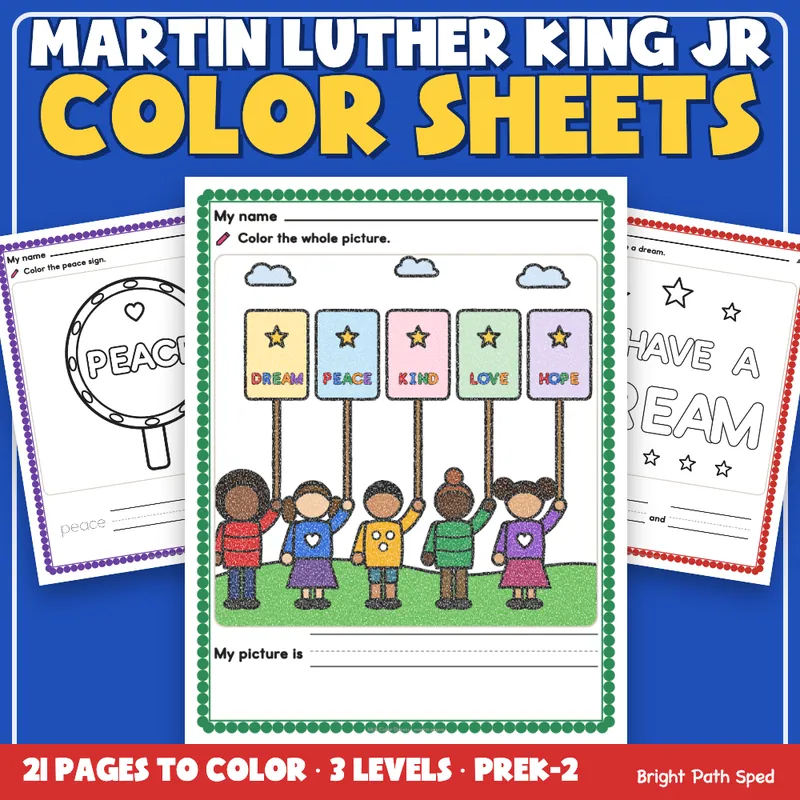
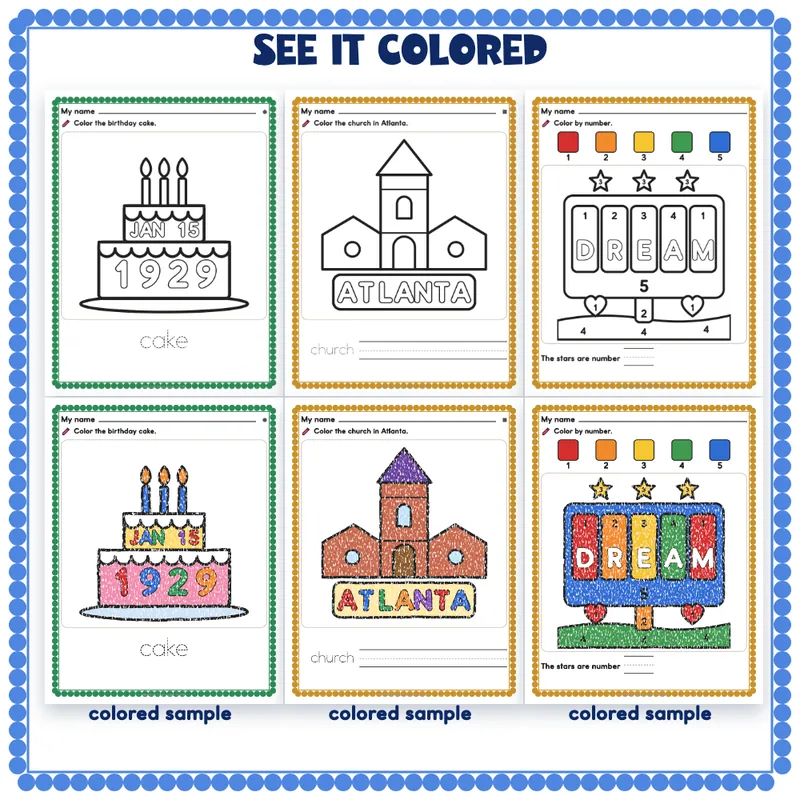
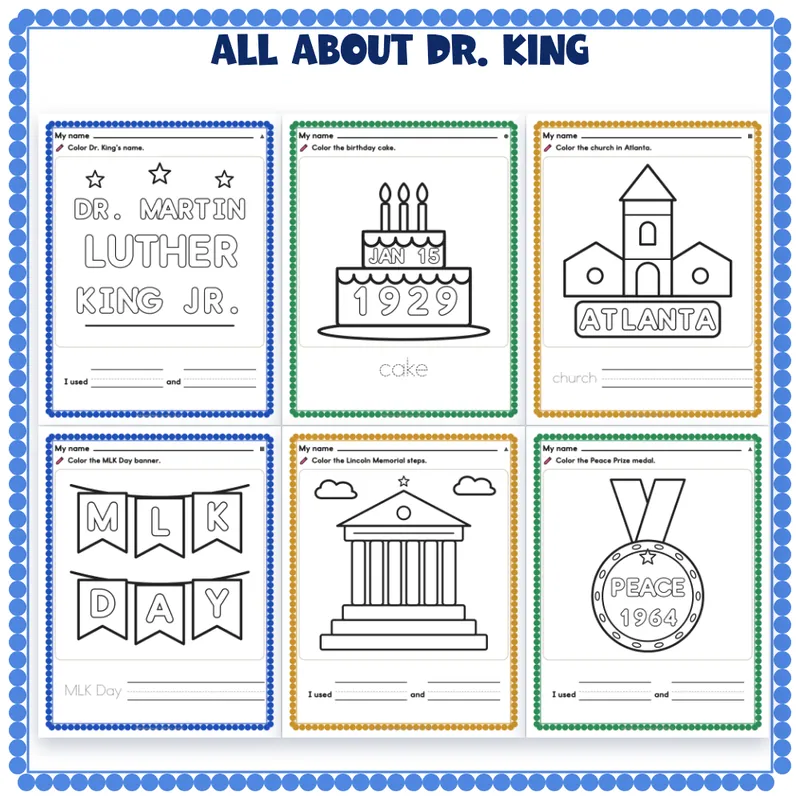
MLK Day and Black History Month coloring for PreK to 2nd grade: 19 one-picture coloring pages in three levels, a march scene, a color-by-number page, a short "Who was Dr. King?" reading page, a trace-and-write page and an "I have a dream" draw-and-write page, in one print-and-go PDF. Every picture is drawn for this pack and every page has its own subject: a peace dove, a birthday cake (Jan 15, 1929), a church in Atlanta, the Lincoln Memorial steps, a Peace Prize medal (1964), an MLK Day banner, the words "I have a dream" and Dr. King's name, hands together, kind words, signs that say PEACE, KINDNESS and FREEDOM, and a march scene of children carrying DREAM, PEACE, KIND, LOVE and HOPE signs. The children have no faces, so every child can color them any way they like. There is no portrait of Dr. King, no quotation and no national flag.
Each coloring page has a big "My name" line, one short instruction with a picture, a heavy outline and room to color. Under the picture, the starting pages have a word to trace, the building pages a word to trace and copy, and the ready-for-more pages two lines to write the colors used. A small shape next to the name line marks the level, so children are not comparing papers.
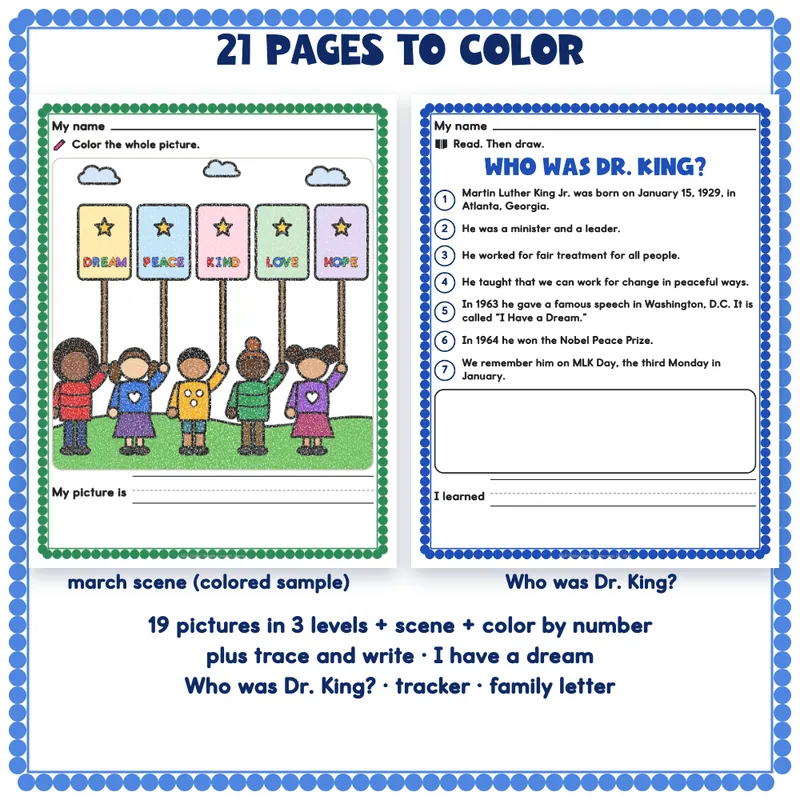
The reading page has seven short facts about Dr. King (his birth, his work, the 1963 speech, the 1964 Nobel Peace Prize and MLK Day) with room to draw and write what a child learned. Please check each fact against your own source before you share it.
What'S Inside
- Start Here: what is inside, the three levels, ways to use it for MLK Day and Black History Month
- Who was Dr. King? A reading page with 7 short lines and a draw-and-write box
- 7 starting pages: dove, friends, birthday cake, marching shoes, book, microphone, helping hand
- 6 building pages: our world, peace sign, kindness banner, MLK Day banner, church in Atlanta, hands together
- 6 ready-for-more pages: freedom sign, I have a dream, Dr. King's name, Lincoln Memorial steps, Peace Prize medal, kind words
- A march scene to color: five children carrying DREAM, PEACE, KIND, LOVE and HOPE signs
- Color by number, 1 to 5, with a color key: a DREAM sign
- Trace and write four words: dream, peace, kindness, freedom
- I have a dream: a draw-and-write page (the title of the famous speech, used as lettering)
- A class tracker, "Who Colored What"
- A family letter with questions to talk about at home
- A credits page and a What's next page showing four other resources from the store
29 pages in all, 24 of them for students (twenty-one pages to color: 19 coloring pages, the march scene and the color-by-number page).
How To Use It
1. Print the pages you need. Plain paper works; the pictures use heavy clean lines and almost no solid black.
2. Hand each child the level that fits today. The next shape up is always there.
3. Use it for MLK Day (the third Monday in January), Black History Month, a kindness week or an early finisher bin.
4. Staple a stack with the family letter and send it home.
Three Skill Levels
Starting: big simple shapes and a word to trace. Building: more parts to color and a word to copy. Ready for more: small spaces and patterns, and two lines to write the colors used.
Who This Is For
Preschool, PreK, kindergarten and 1st to 2nd grade classrooms, self-contained special education classrooms and paraprofessionals who want a gentle, faceless set of pictures for MLK Day.
What This Is, And What It Is Not
A printable PDF (print and color). It is not Google Slides, Docs or PowerPoint, and it has no fillable fields. It does not teach history lessons or make any claim about what a child should know at a given age; use your own materials and your district's guidance for what to teach.