Martin Luther King Jr Reading Comprehension
- 28 pages
- 2nd, 3rd, 4th, 5th
$2.50 $5.00 on Teachers Pay Teachers
Half the Teachers Pay Teachers price. The same PDF, sold direct.
DownloadOr get it with All-Access: pick any 20 resources a month for $7.
New here? Your first month of All-Access is half off with code TEACHERTOK
Already bought this, or a member?
Instant download. One teacher's license: colleagues need their own copy. Each file carries a license number.
Also on Teachers Pay Teachers: see the Bright Path Sped store
About this resource
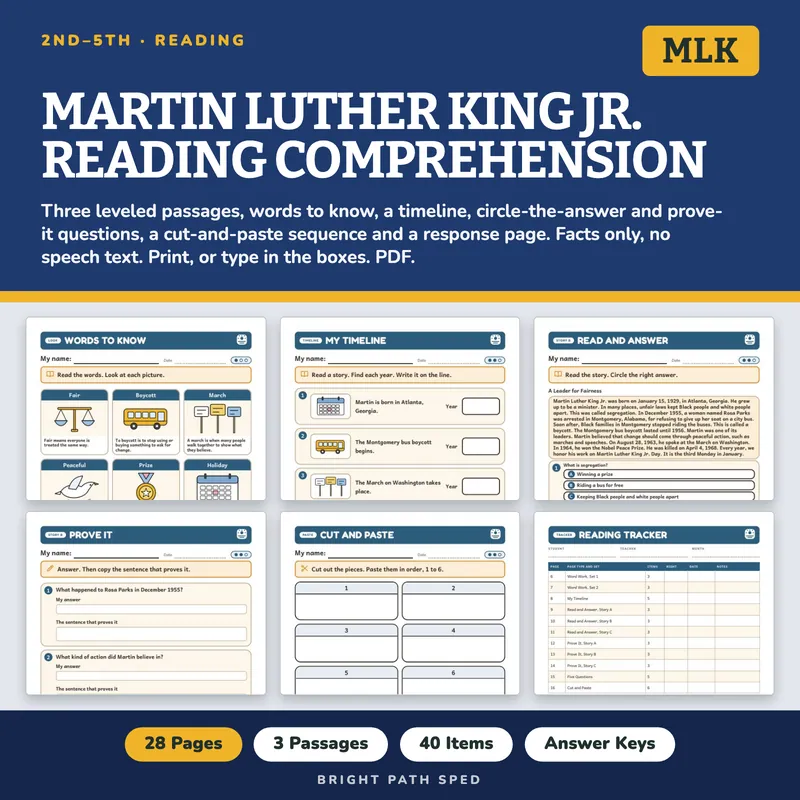
Three short stories about Martin Luther King Jr., in three lengths: a short, a medium and a longer story, with everything around them: six words to know, a timeline, circle-the-answer questions, a page where the child copies the sentence that proves each answer, an events-in-order cut and paste, and a response page. A group can read different stories and still talk together, because all three tell the same life in the same order. It comes with answer keys, a tracker, a class grid and a family page, so nothing has to be written from scratch.
EVERYTHING INSIDE (28 pages)
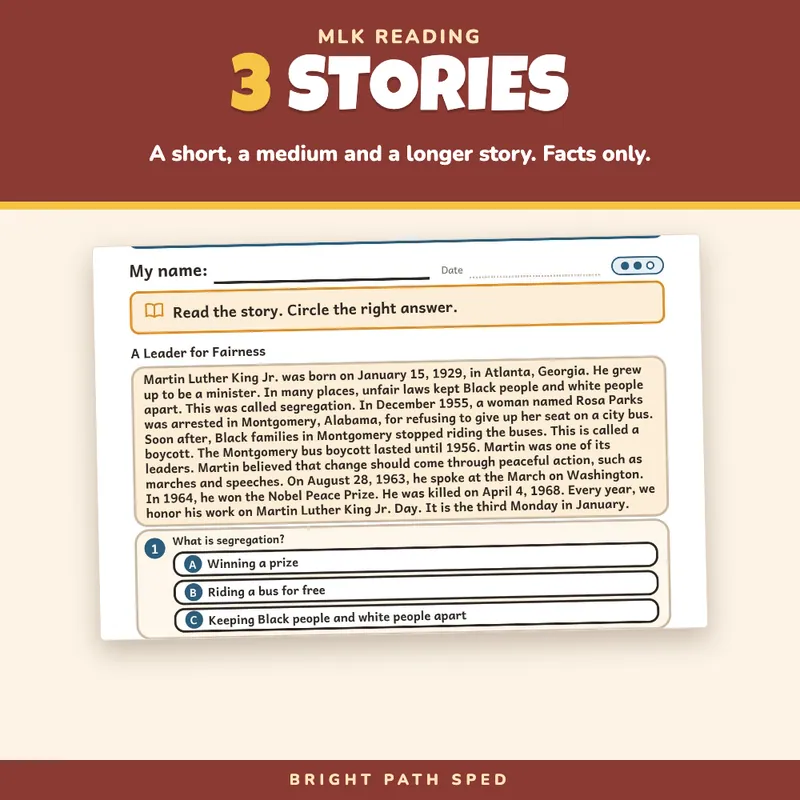
- 3 informational stories: Story A (a short story, about 92 words), Story B (a medium story, about 147 words) and Story C (a longer story, about 199 words)
- 13 student pages in 8 page types: Words to Know, Word Work, My Timeline, Read and Answer, Prove It, Five Questions, Cut and Paste and My Response
- 40 scored items on 11 pages, every answer in the keys
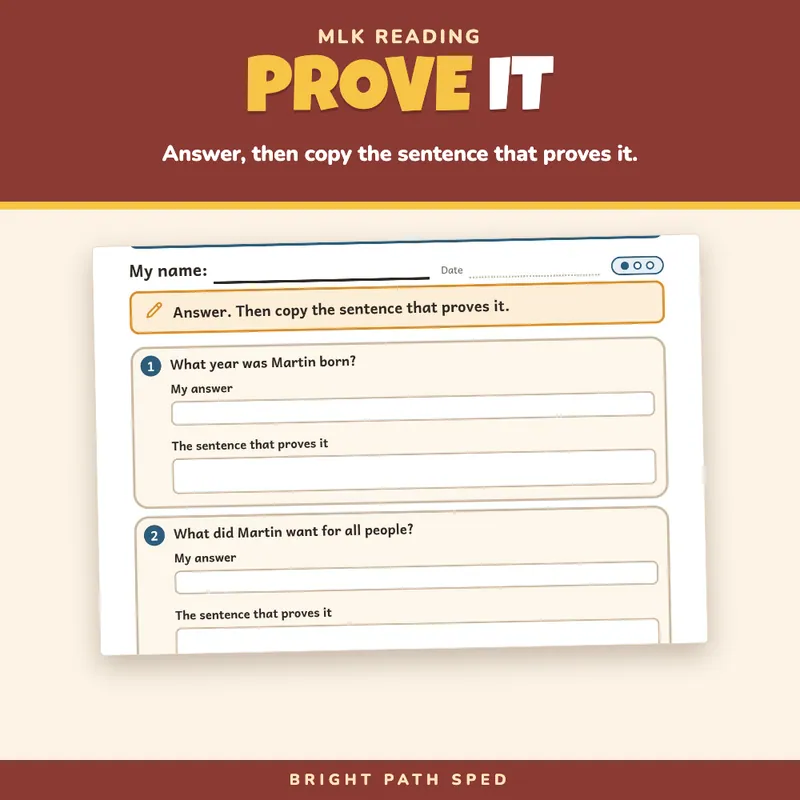
- 9 circle-the-answer questions (3 per story, with lettered choices) and 9 Prove It questions (3 per story): the child answers, then copies the sentence from the story that proves it
- 6 vocabulary words (fair, boycott, march, peaceful, prize, holiday), each with a drawn symbol and a meaning, plus 2 pages of Word Work where the child writes the meaning and a sentence in their own words
- 1 timeline of 5 events where the child finds each year in the story
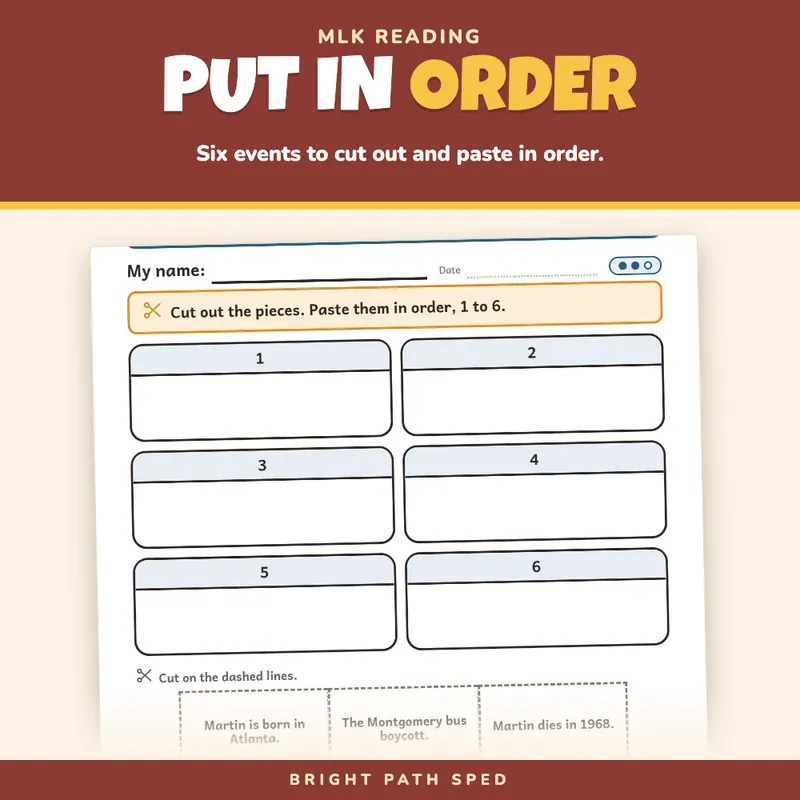
- 6 cut-and-paste pieces to put in order, 1 to 6
- 2 answer keys, with the proof sentence for every Prove It question
- 1 tracker (page, page type, items right, date) and 1 whole-class progress grid
- 1 team note (a hand-off page between team meetings) and 1 home page
- 1 filled example (an invented student), 1 phrase bank (16 observable-language starters), 1 binder cover and 6 divider tabs with a spine label to cut out
- Start Here and a how-to-read-a-page page
How To Use It
Pick the short, medium or longer story that fits the reader. Build the words first (Words to Know and Word Work), read, answer, then go back to the text to prove it. The dots at the top of each page show the step; there are no level words on a student page, so children do not compare pages.
Facts Only
The stories use dates and events a reference book gives: Martin Luther King Jr. was born on January 15, 1929, in Atlanta, Georgia; Rosa Parks was arrested in Montgomery, Alabama, in December 1955; the Montgomery bus boycott lasted until 1956; the March on Washington was on August 28, 1963; he received the Nobel Peace Prize in 1964; and Martin Luther King Jr. Day is the third Monday in January. Story C also gives the date and place of his death.
What Is Not Included
There is no speech text and no quotations from Martin Luther King Jr. or anyone else, and no made-up dialogue. There are no photographs or drawings of real people: the pictures are symbols we drew (a book, a bus, signs, a dove, a medal, a calendar and scales). It is not a full unit on the civil rights movement and not a lesson plan.
Built For The Child Holding The Page
A big "My name" line, one short instruction, large rounded type and big answer boxes. The drawing box on the response page is about two inches tall. The file prints clean in black and white.
No Guessing The Answer
On the circle-the-answer pages the position of the right choice is checked so it does not sit in the same spot three times in a row. There is no word bank anywhere in the file: the child writes the meaning of each word and finds the proof sentence in the text.
Type In, Or Print
The name line and every answer box are type-in fields in any PDF reader: click one, type, then save. The same goes for the tracker, the class grid, the team note and the home page. This is a fillable PDF; it is not a Google Slides or PowerPoint file.
Who This Is For
Second through fifth grade classrooms, self-contained and resource rooms, reading groups, centers, sub plans and morning work around Martin Luther King Jr. Day. The teacher can read any story aloud.
What This Is, And What It Is Not
A set of reading comprehension worksheets with the record-keeping around it. It is not a timed test, a screener, a clinical tool, or a claim about any student's age or rate of progress. There is no IEP goal language or eligibility wording anywhere in the file.