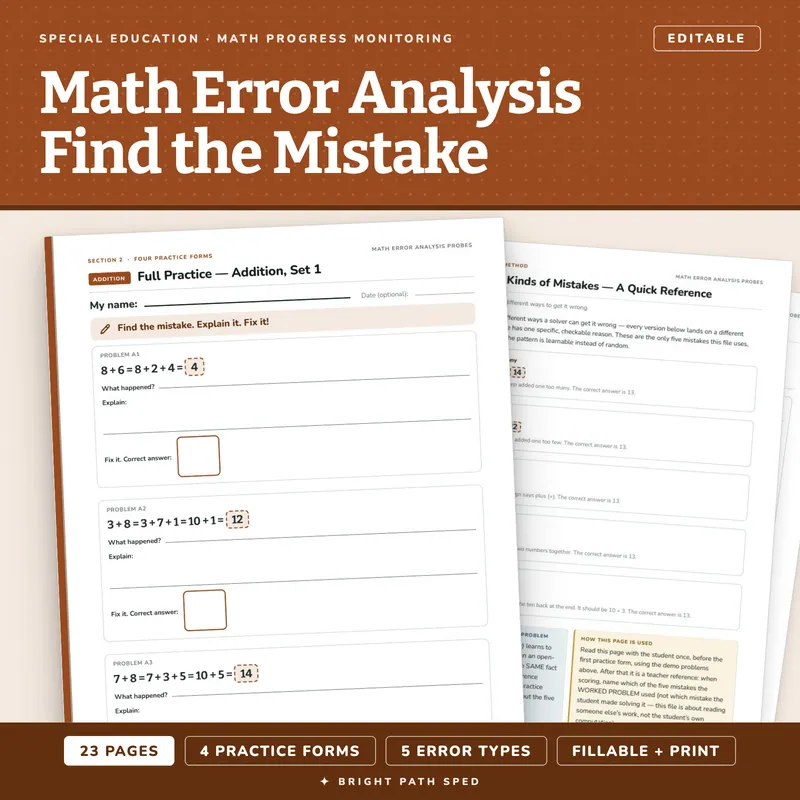
Math Error Analysis Find the Mistake
- 23 pages
- 1st, 2nd
$1.50 $3.00 on Teachers Pay Teachers
Half the Teachers Pay Teachers price. The same PDF, sold direct.
DownloadOr get it with All-Access: pick any 20 resources a month for $7.
New here? Your first month of All-Access is half off with code TEACHERTOK
Already bought this, or a member?
Instant download. One teacher's license: colleagues need their own copy. Each file carries a license number.
Also on Teachers Pay Teachers: see the Bright Path Sped store
About this resource
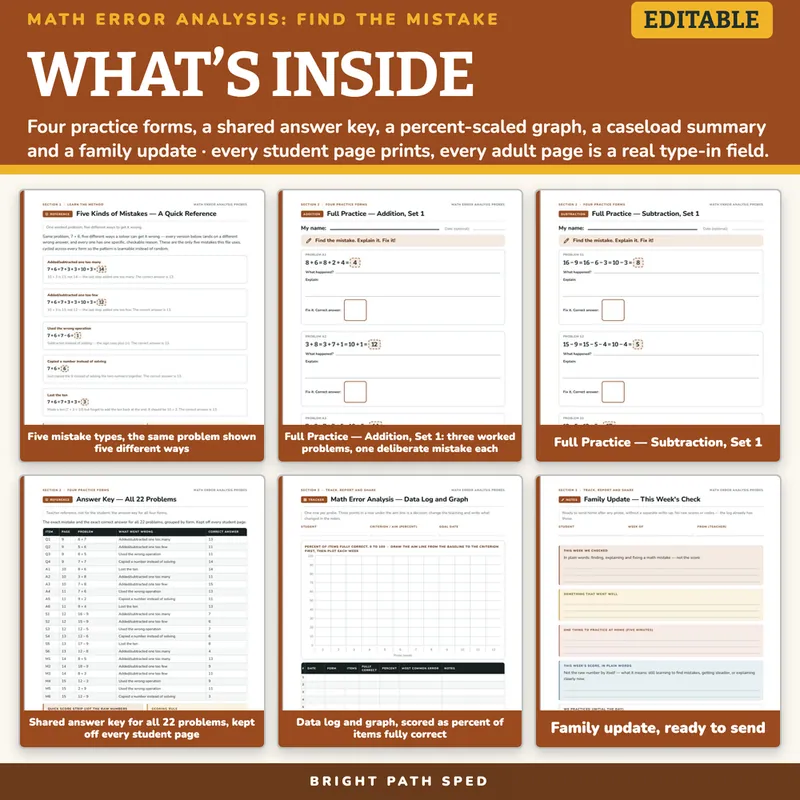
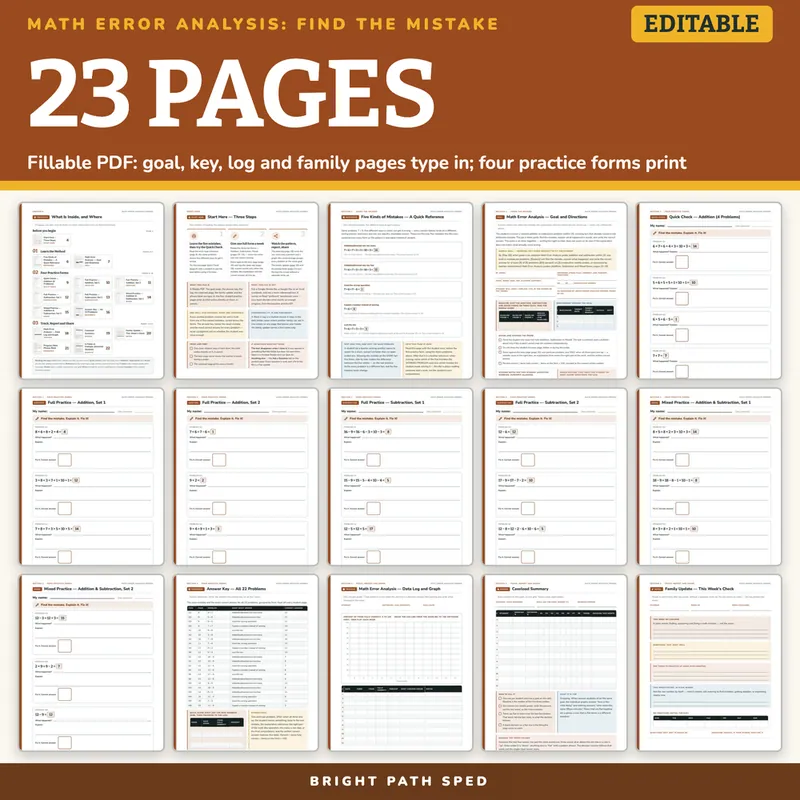
Everything inside: 23 pages · 22 worked addition/subtraction problems across 4 practice forms (a 4-problem Quick Check, two 6-problem Full Practice forms, and a 6-problem Mixed form) · a reference page naming the 5 mistakes this file uses · a shared answer key for all 22 problems · a data log and graph scored as percent of items fully correct · a caseload summary · a family update · a 19-starter phrase bank across 5 groups · a worked, invented example.
Every problem crosses ten (addition sums 11–18, subtraction minuends 11–18 with single-digit subtrahends) and is built from one of five named, checkable mistakes, cycled across the forms so the pattern is learnable instead of random:
1. Added/subtracted one too many (the last step is off by one, too high)
2. Added/subtracted one too few (the last step is off by one, too low)
3. Used the wrong operation (added when the sign says minus, or subtracted when it says plus)
4. Copied a number instead of solving (the "answer" is just one of the numbers already in the problem)
5. Lost the ten (the make-a-ten step is started but never finished)
WHAT IS INCLUDED — 23 pages
Learn The Method
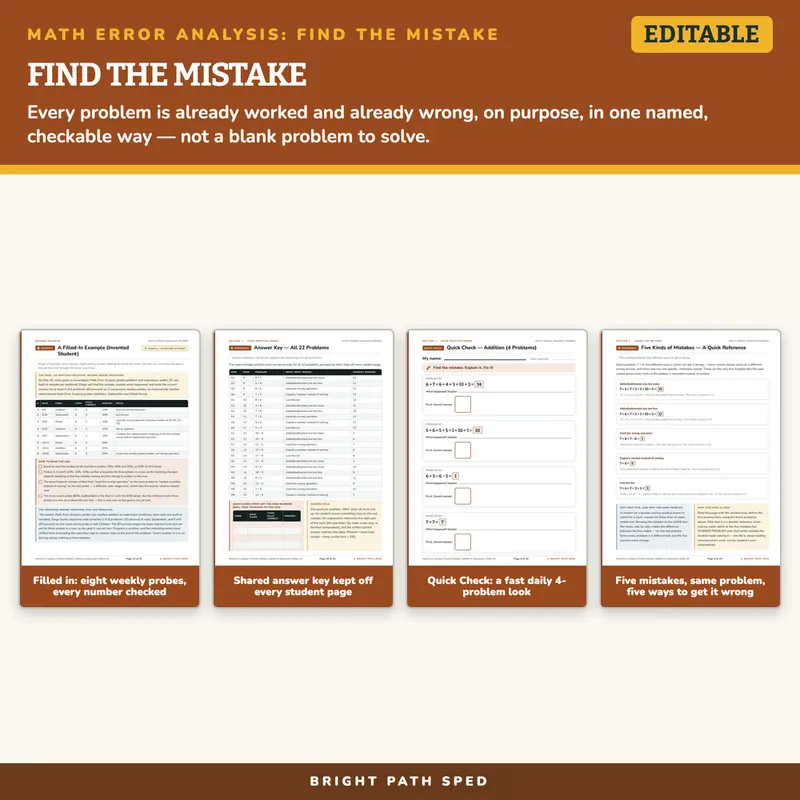
- Five Kinds of Mistakes — A Quick Reference — the same problem shown five different ways to get it wrong, so the five reasons are visible side by side before the first practice form
- Math Error Analysis — Goal and Directions — a sample goal with a six-part fill-in frame, a 3-probe baseline table, a 3-row benchmark table, and the scoring rule (a point counts only when the mistake, the explanation and the correct answer all line up)
Four Practice Forms, Plus A Shared Key
- Quick Check — Addition (4 problems, one page) — a fast daily look
- Full Practice — Addition (6 problems, two pages) and Full Practice — Subtraction (6 problems, two pages) — the weekly probe forms
- Mixed Practice — Addition & Subtraction (6 problems, two pages) — for periodic review
- Every student page is clean: a "My name" line, one short instruction with a drawn icon, each worked problem, and room to write what happened, explain it, and write the correct answer
- Answer Key — the exact mistake and the exact correct answer for all 22 problems, in one table, kept off every student page, plus a quick score strip
Track, Report And Share
- Math Error Analysis — Data Log and Graph — a 12-row log (date, form, items, fully correct, percent, most common error, notes) and a graph scaled 0–100 percent
- Caseload Summary — 12 students by 8 probes, one decision column
- Family Update — a ready-to-send communication page: what was checked, one win, a home-practice idea, this week's score in plain words, and a 7-day practiced table
- Progress Note Phrase Bank — 19 observable-language starters across 5 groups (accuracy on the probe, pattern across probes, next steps, quarterly report sentence, caseload-wide)
- A Filled-In Example — a worked, invented example (Diego, second grade) with 8 weekly probes rotating the three full forms, every percent checked against its own row
Plus a Start Here quick-start, a 3-section contents page with real page thumbnails, 3 section dividers, and a "what's next" back page.
What This Is, And What It Is Not
It is a fillable PDF. Open it in a PDF reader, click a field, type, Save As once per student. It works offline with no account or subscription. It is NOT a Google Sheets file, a Google Doc, or an Excel workbook, and it is not a norm-referenced test — it carries no fixed "proficient" benchmark score anywhere in the file. The four student practice pages print; the goal page, answer key, log, caseload page, family update and phrase bank are type-in.
It is not a blank-problem probe. The store's existing Addition and Subtraction Within 20 Progress Monitoring Probes and Subtraction Within 20 Progress Monitoring Probes check whether a student can compute the fact at all; this file checks whether a student can catch a mistake already made in someone else's work, which is a different, later-stage skill. Use the blank-problem probes to confirm the fact is solid first; use this one once it is, to build the self-monitoring skill on top of it.
It is not a curriculum, and it does not set a fixed number of correct problems that counts as "proficient" for any student. What enough progress looks like is the team's own judgment, written in from the baseline and the IEP; this file never sets that number on its own. No age, eligibility or IDEA-timeline claim anywhere; no health data is pre-filled, and the example student (Diego) is invented and named as such on page 22. Addition and subtraction within 20 only, and only the ten-crossing subset of those facts (sums/minuends 11–18) — this first build does not cover facts that do not cross ten, multiplication or division, or multi-digit regrouping.
Who This Is For
Special education teachers, math interventionists and case managers who need a repeatable way to track whether a student can find, explain and fix a math mistake — not just whether the final answer on a blank problem is right.
If You Want More
Addition and Subtraction Within 20 Progress Monitoring Probes and Subtraction Within 20 Progress Monitoring Probes are the blank-problem, compute-it-yourself companions — use them to confirm the fact first. Addition Facts Fluency, Timed Progress Monitoring Probes Editable measures speed on facts already known, a different skill from error analysis.