Menu Math Worksheets
- 82 pages
- 2nd, 3rd, 4th, 5th
$2.50 $5.00 on Teachers Pay Teachers
Half the Teachers Pay Teachers price. The same PDF, sold direct.
DownloadOr get it with All-Access: pick any 20 resources a month for $7.
New here? Your first month of All-Access is half off with code TEACHERTOK
Already bought this, or a member?
Instant download. One teacher's license: colleagues need their own copy. Each file carries a license number.
Also on Teachers Pay Teachers: see the Bright Path Sped store
About this resource
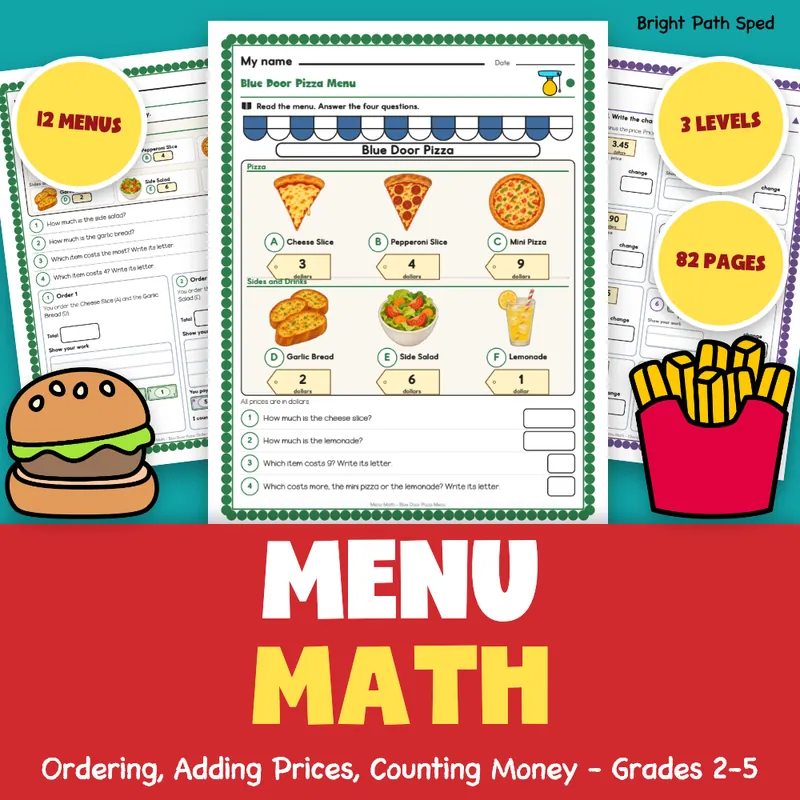
Teaching menu math and need pages students can actually work on? This is a complete set for grades 2-5 life skills and math: read a menu from an invented restaurant, find prices, add the prices of two items, count the money you pay with, and (at Level 3) find your change. Everything is practice with made-up restaurants and made-up prices, in three levels. Level 1 uses whole-dollar prices and bills. Level 2 uses prices in quarters and adds quarters to the payment. Level 3 uses prices to the nickel, mixed coins, and asks for the change. Answer keys give every answer.
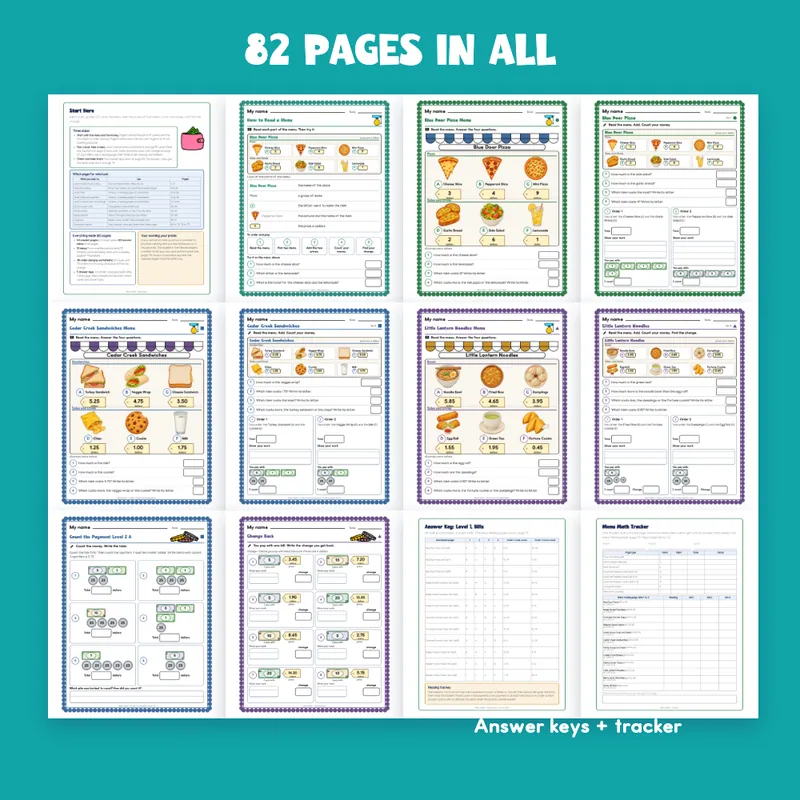
EVERYTHING INSIDE (82 pages)
- 63 student pages in 12 kinds of page, each with a name line and one short instruction
- 424 scored items across 59 scored pages, every answer computed from the same price lists and payment piles that draw the page
- 12 menus from invented restaurants (Blue Door Pizza, Maple Street Pancakes, Dockside Fish and Chips, Ballpark Snack Stand, Green Spoon Soup and Salad, Cedar Creek Sandwiches, Penny Scoop Ice Cream, Golden Crust Bakery, Fiesta Corner Tacos, Little Lantern Noodles, Berry Good Smoothies, Sunny Hill Diner): 4 a level, 6 pictured and lettered items each, 72 priced items in all
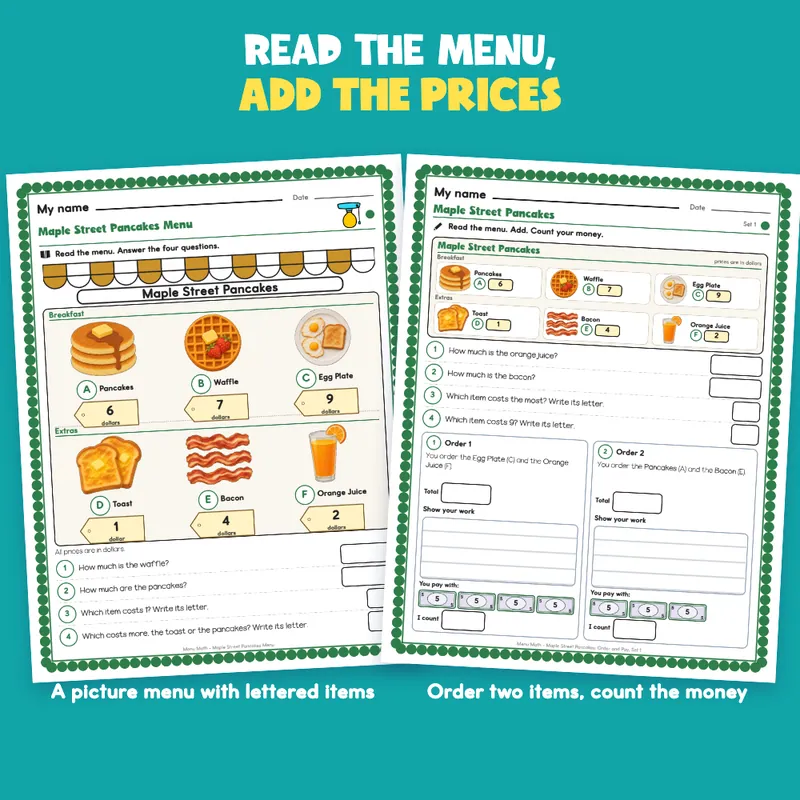
- 12 menu reading pages, one for each menu, with 4 questions each (48 in all): find a price, find an item by its price, tell which of two items costs more
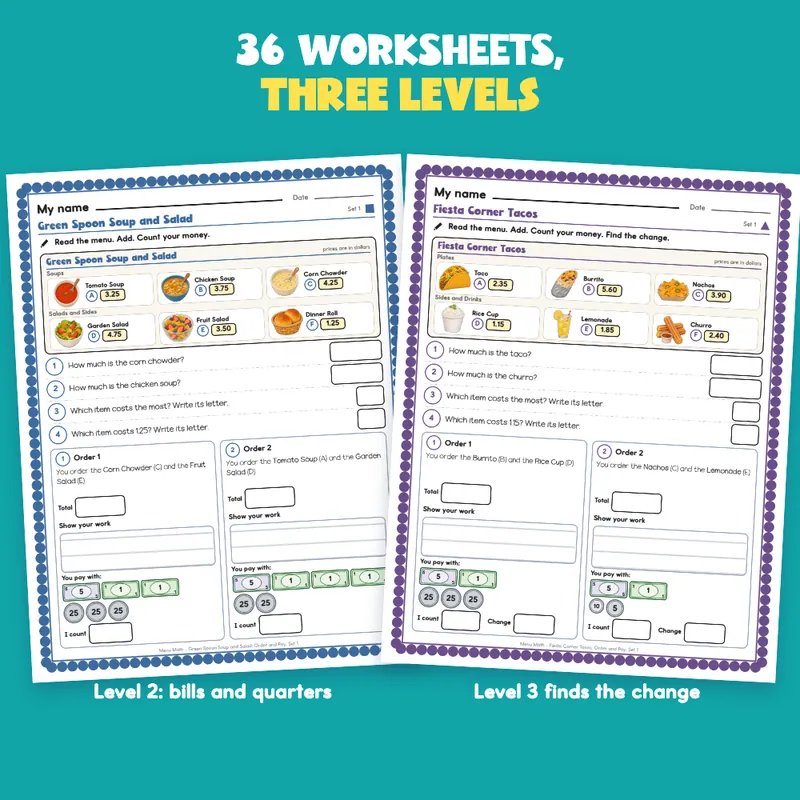
- 36 order-and-pay worksheets, 12 a level: the menu printed on the sheet, 4 menu questions, then 2 orders of 2 items each (72 orders in all). Write the total, count the money shown in "You pay with", and at Level 3 write the change. Each worksheet has a "Show your work" box for each order
- Level 1: 12 worksheets (96 items), whole-dollar prices, payments in bills; Level 2: 12 worksheets (96 items), prices in quarters, payments in bills and quarters; Level 3: 12 worksheets (120 items), prices to the nickel, payments in bills and mixed coins, a change question on all 24 orders
- Know Your Money: 4 bills (one, five, ten, twenty) and 4 coins (penny, nickel, dime, quarter) shown with their values, plus 4 wallets to add up
- 6 Count the Payment pages (2 for each level, 6 piles a page, 36 piles in all)
- How to Read a Menu: the parts of a menu, five steps to order and pay, 3 try-it questions; Menu Words: a word bank and 6 sentences to finish
- Change Back: 8 problems paying with a five, ten or twenty dollar bill
- Make My Own Menu (6 items to name and price) and Order From My Menu (3 order slips)
- 1 Think It Through page: 3 written questions, 4 ruled lines each; 1 menu math quiz of 7 items (letters A to C); 1 self check (8 statements)
- 5 answer keys (the three levels' worksheets, the menu reading pages, and money, words, counting, quiz and writing)
- 1 tracker (eight type rows and 12 menu rows), 1 class grid (15 students, 9 skill columns), 1 team note, 1 family page
- 1 filled example (an invented student), 1 phrase bank (17 starters in 6 groups)
- A menu index, a binder cover with type-in teacher and class fields, and a page of divider tabs (Menus and Money, Level 1: Bills, Level 2: Quarters, Level 3: Change, Keys) with a spine label to cut out
- Start Here and a how-to-read-a-page page
Built For The Student Holding The Page
A "My name" line, one short instruction with a small picture cue, a plain scalloped border and big boxes to write in. A small circle, square or triangle by the page title marks the level (a shape, never a number). Nothing on a student page is written for an adult: the keys and records are on separate teacher pages. Bills and coins are drawn at a size a student can count, and each one carries its number, so the file prints clean in black and white. Every menu is a picture menu: each item has a picture of the food, a letter, a name and a price in a big tag, so a student can find an item by its picture or by its letter.
Invented Menus And Prices
Every restaurant, item and price is made up for practice. None is a real restaurant. Prices are written the way a register shows them (2.35), the menu says they are in dollars, and no currency symbol is used anywhere in the file. The only student in the file is an invented example, and it says so.
Type In, Or Print
The name line, every answer box, every table cell and every ruled work box are type-in fields in any PDF reader: click one, type, then save. The pages also print. This is a fillable PDF; it is not a Google Slides or PowerPoint file.
What This Is, And What It Is Not
A set of menu and money practice pages with the record-keeping around it: reading a menu, adding the prices of two items, counting a payment of bills and coins, and finding change. It is not a timed test, a screener, a clinical tool, or a claim about any student's age or rate of progress. There is no IEP goal language or eligibility wording anywhere in the file, and no claim of alignment to any standard. The tracker has a blank line for your own goal wording.
Who This Is For
Teachers of life-skills and special education classes, math intervention and resource rooms for grades 2-5, and families who want real-world money practice with menus a student can read.
If You Want More
Do I Have Enough Money? Worksheets (menus, flyers and making change for older students); Counting Mixed Coins to a Dollar Task Box.