Money Bingo
- 73 pages
- Kindergarten, 1st, 2nd
$1.75 $3.50 on Teachers Pay Teachers
Half the Teachers Pay Teachers price. The same PDF, sold direct.
DownloadOr get it with All-Access: pick any 20 resources a month for $7.
New here? Your first month of All-Access is half off with code TEACHERTOK
Already bought this, or a member?
Instant download. One teacher's license: colleagues need their own copy. Each file carries a license number.
Also on Teachers Pay Teachers: see the Bright Path Sped store
About this resource
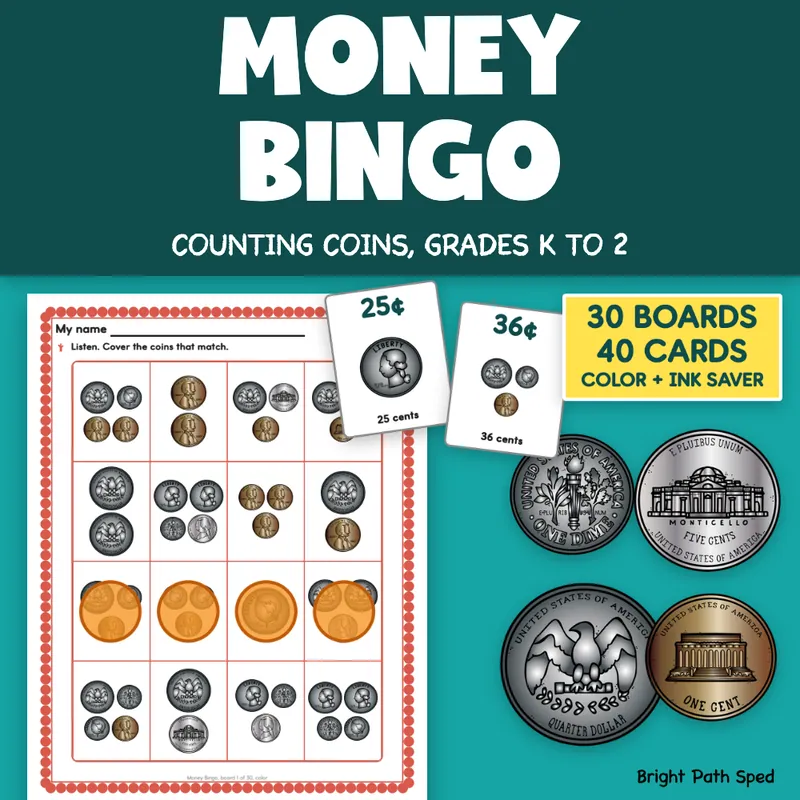
Money Bingo turns counting coins into a game. The caller reads a value, "twenty-seven cents," and every player counts the coins on their board to find the group that adds up to it. Each of the 40 groups holds one to four real US coins (a penny, a nickel, a dime, a quarter, front and back mixed) and has its own total, so a call matches exactly one group. Print it tonight and play it tomorrow.
WHAT IS INCLUDED - 73 pages
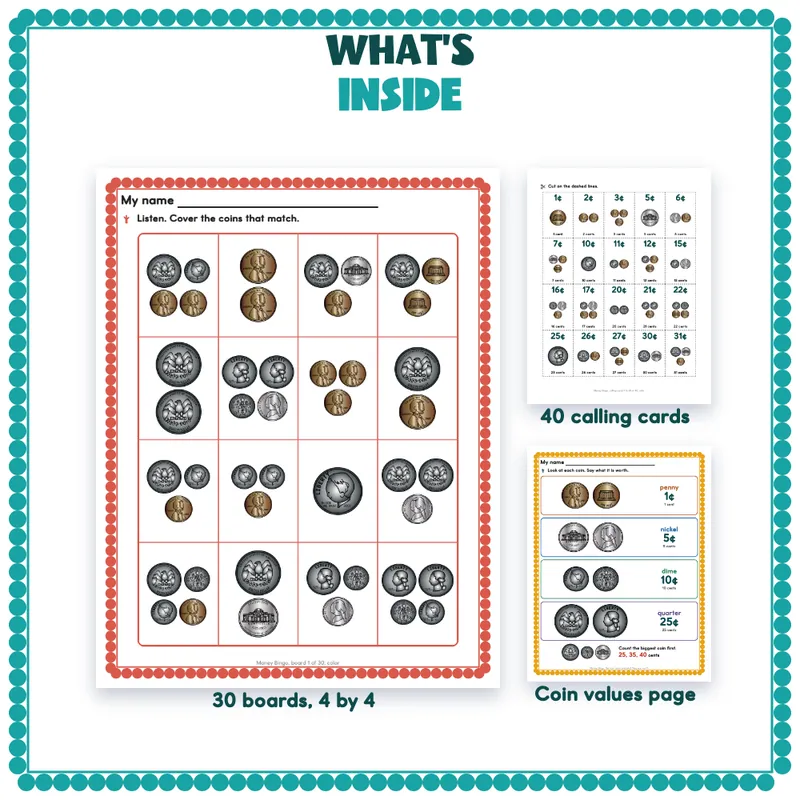
- 40 calling cards: the value (27¢), the words (27 cents) and the coins that make it; 20 cards a page, edge to edge for straight cuts
- 30 boards, 4 by 4: 16 coin groups on every board, no free space; no two boards carry the same 16 groups
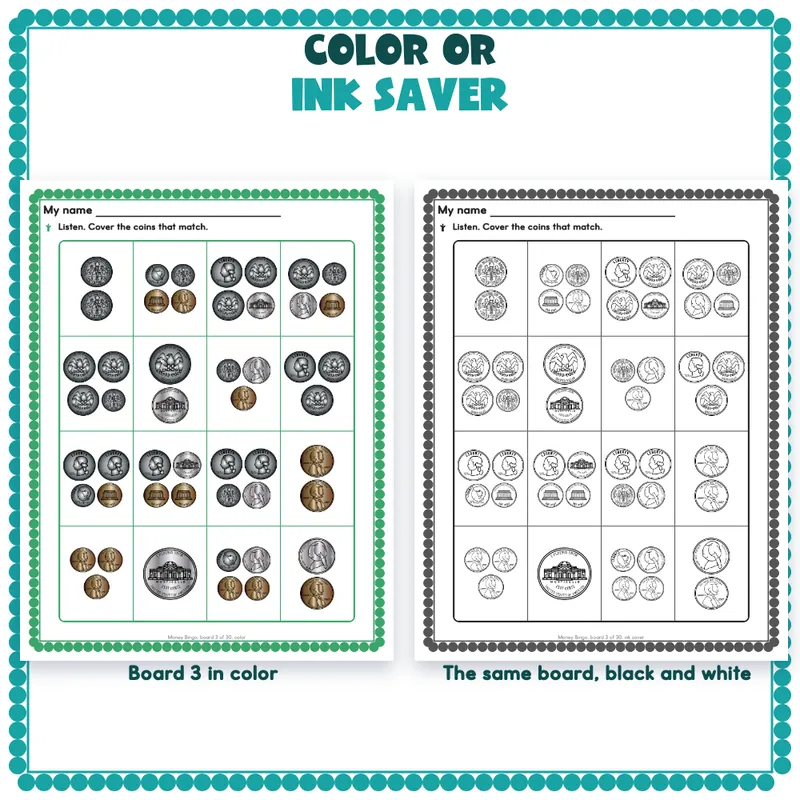
- The same 30 boards and 40 cards again in black and white (ink saver)
- The four single coins (1, 5, 10 and 25 cents) are in the deck, with 9 groups of two coins, 14 groups of three and 13 groups of four
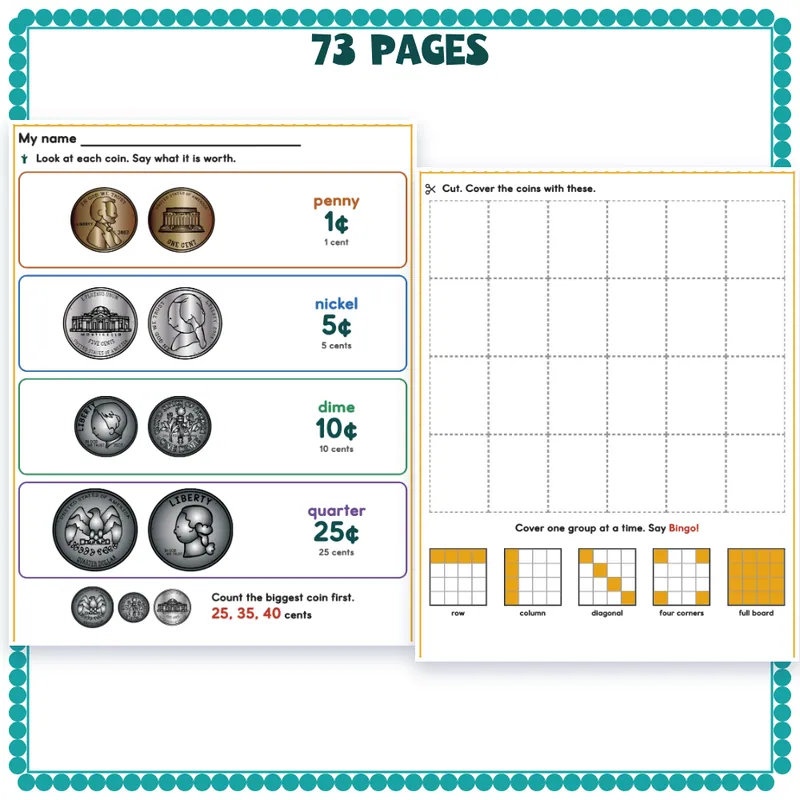
- A coin values page: the penny, nickel, dime and quarter, both sides, each with its name and its value, and a count-the-biggest-coin-first example
- A call sheet and answer key: all 40 values with a tick box and the coins that make each one
- A worked example: an invented game on Board 5, seven calls, and the top row fills on the seventh
- 24 blank markers (cut on the dashed lines) and the five ways to win
- A note home with 12 lines to type or write
- A Start Here page: set up, how to play, and three ways to level it
- A What's Next page and a credits page
The Coins
The coins are Educlips clip art of real US coins, drawn at the size the real coins compare, so the dime is smaller than the penny. Groups are listed biggest coin first, the way children are taught to count them. Boards show coins only: counting them is the game. The call sheet shows the answer for every value.
How To Play
1. Give each player a board and markers (or counters, beans or dot markers). Look at the coin values page together first.
2. The caller turns a card and says the value: "Twenty-seven cents." Players say it back.
3. Each player counts the coins on the board and covers the group that adds up to that value.
4. A row, a column, a diagonal or the four corners wins. The winner says Bingo and tells how many cents each covered group is; the caller checks them on the call sheet.
Three ways to level it are on the Start Here page: match the coins on the card to the coins on the board, say the cents only, or say the coins and have the group call out the total first.
Who This Is For
Teachers of kindergarten, first and second grade who want coin practice that feels like a game: whole-class review, math centers, small groups, intervention, and special education groups. Families can use the note home and the coin values page at the kitchen table.
What This Is, And What It Is Not
It is a printable bingo game in a PDF, with a fillable note home. It is not a Google Slides or PowerPoint file. It practices naming coins and counting groups of up to four coins, with totals up to 100 cents. It does not teach dollars, making change or word problems.