Money Coins Cut and Paste Worksheets 3 Levels Differentiated Special Education
- 41 pages
$4.50
DownloadOr get it with All-Access: pick any 20 resources a month for $7.
New here? Your first month of All-Access is half off with code TEACHERTOK
Already bought this, or a member?
Instant download. One teacher's license: colleagues need their own copy. Each file carries a license number.
Also on Teachers Pay Teachers: see the Bright Path Sped store
About this resource
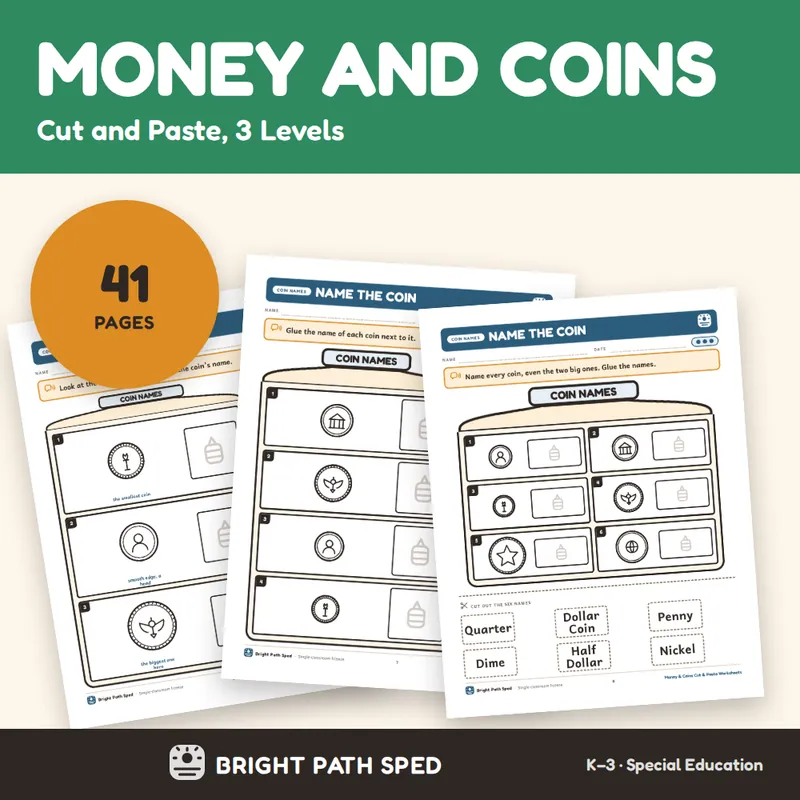
Nine coin skills. Every one of them printed three times, at three levels of support, so the whole room can work the same page at the same time.
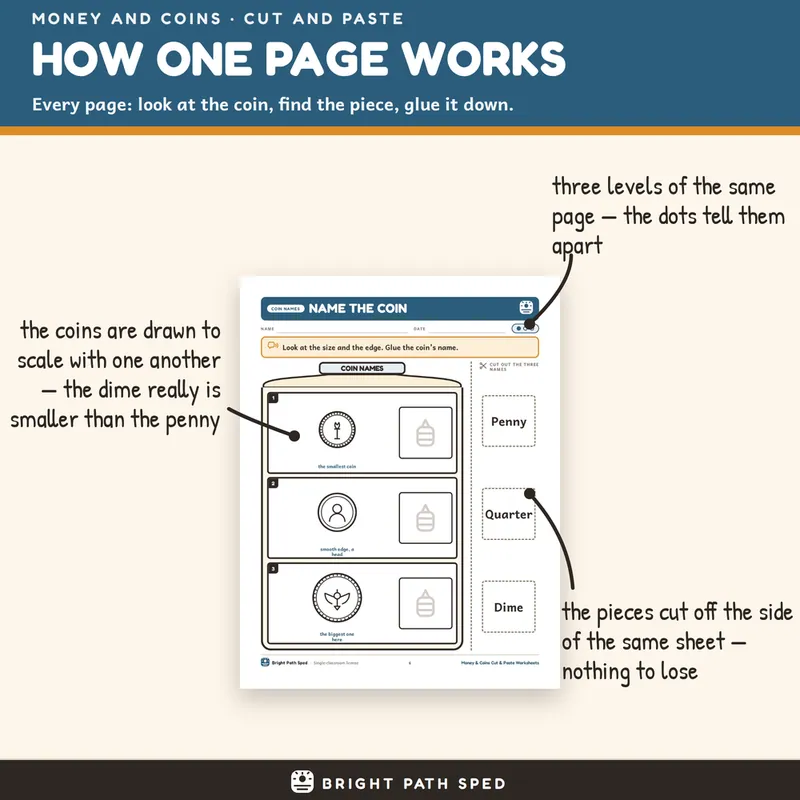
Twenty-seven cut-and-paste worksheets in one PDF. The cut strip sits on the same page as the work, so nothing gets separated on the way to the desk.
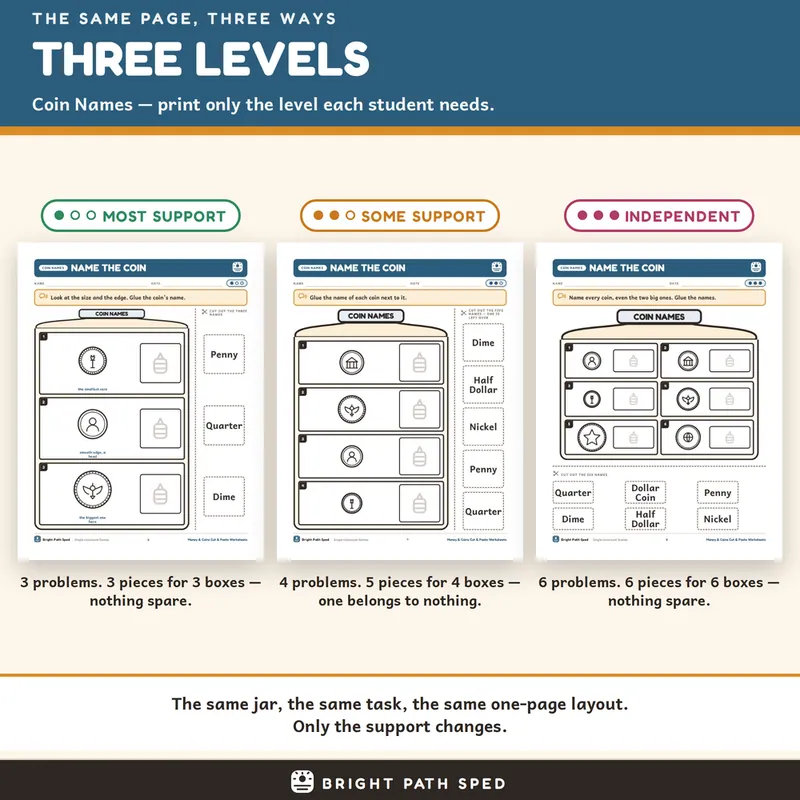
How The Three Levels Work
Level 1 - two or three items, coins drawn as large as the page allows, and the running total printed under every coin: 10, 20, 21. There are exactly as many pieces on the strip as there are answers, so there is no wrong piece to pick up.
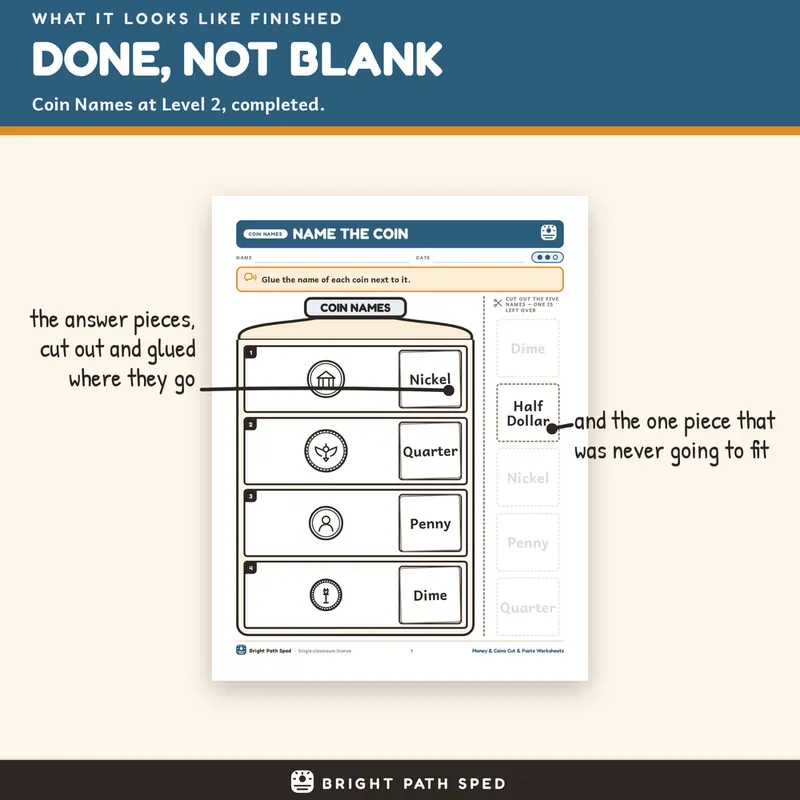
Level 2 - four items, no printed totals, and one spare piece on the strip that belongs to nothing: a half dollar among the four common coins, a 50 cent among the values, a dime with no dime mat, a SAME label where nothing is equal.
Level 3 - six items, nothing cued, and the coins are no longer sorted biggest first. A penny sits in front of the quarter, which is exactly how coins come out of a pocket.
The Nine Skills
1. Name the coin
2. What is it worth - values up to a dollar
3. Sorting coins onto mats
4. Counting pennies
5. Counting nickels and dimes by fives and tens
6. Counting mixed coins
7. Comparing amounts, then greater than and less than
8. Make the price - which coins pay for this exactly
9. One more coin - what single coin closes the gap
No Coin Has Its Value Written On It
A worksheet with "10 cents" printed across the dime is not teaching coin values, it is teaching reading, and the student is lost the moment a real dime is put in front of them. The coins here are told apart by three things that all survive a black-and-white photocopy:
SIZE - the drawn diameters are in the same ratio as the real coins, so the dime really is smaller than the penny and the quarter really is bigger than the nickel.
EDGE - the dime, quarter and half dollar carry the reeded edge they actually have. The penny and nickel are smooth, because they are.
PICTURE - a different line drawing in the middle of each one.
The half dollar and the dollar coin appear at Level 3, so the pack does not stop at a quarter.
Sorting That Needs An Idea, Not A Match
Level 1 sorts pennies from dimes. Level 2 adds a third mat and a tenth coin that belongs on none of them. Level 3 has four mats and not one of them names a coin - they say WORTH 1 CENT, WORTH 5 CENTS, WORTH 10 CENTS, WORTH 25 CENTS. A student can only sort those if they know what each coin is worth.
Money You Can Actually Use
The last six pages are a shop. Read a price tag and glue the coins that pay for it exactly, then work out the one coin that turns what you have into what you need. Set up a table with the same items and real price tags and the page becomes a functional-skills lesson.
What Is In The File
- 41 pages, one PDF
- 27 worksheets (9 skills x 3 levels)
- 6 colour section dividers for your binder
- 1-page teacher guide to the three levels, with what to do when a student is stuck
- 3 pages of answer keys, with the spare Level 2 piece named on every line
- Name and date line and a scissors rule line on every worksheet
- Black-line art with a colour accent on the level banner only, so a grayscale copy works exactly as well as a colour one. There is no separate B&W file because you do not need one.
Who This Is For
Self-contained, resource and life-skills classrooms, early intervention, and any elementary room with a wide skill range in it. Also useful as a progress-monitoring set: a clean Level 3 in May beside a Level 1 in October is a data point you can put in a report.