Narrative Language Progress Monitoring Editable
- 21 pages
- Not Grade Specific
- PDF, fillable
$4.00
DownloadOr get it with All-Access: pick any 20 resources a month for $7.
New here? Your first month of All-Access is half off with code TEACHERTOK
Already bought this, or a member?
Instant download. One teacher's license: colleagues need their own copy. Each file carries a license number.
Also on Teachers Pay Teachers: see the Bright Path Sped store
About this resource
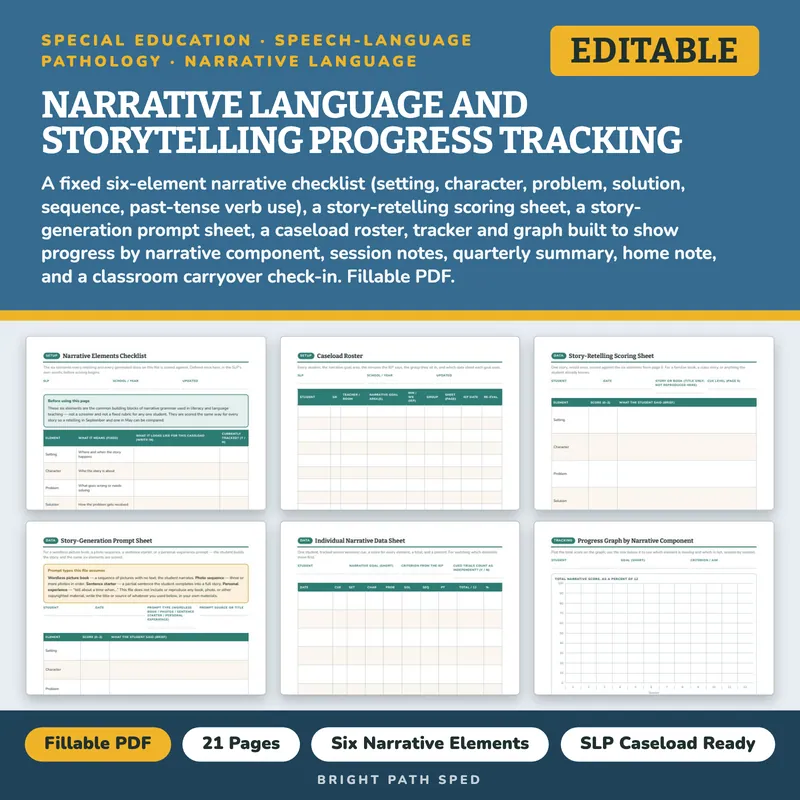
The store's speech data sheets score a trial as right or wrong. Narrative language does not break down that cleanly — a retelling can have a clear character and setting and still lose the thread on sequence, or land a solution with no past-tense verbs anywhere in it. This file scores a retelling or a student-generated story against six fixed elements — setting, character, problem, solution, sequence, and past-tense verb use — every time, so a story from September and a story from May are measured against the same six things instead of one blended percent. A story-retelling scoring sheet, a story-generation prompt sheet built around prompt TYPES (wordless picture book, photo sequence, sentence starter, personal experience — no book or photo is included or reproduced), an individual narrative data sheet, and a narrative element summary that lines up every element at a glance carry the caseload through a quarter, backed by the store's usual roster, schedule, attendance log, cumulative tracker, a progress graph built to show which element is moving and which is not, session notes, quarterly summary, a narrative home note and a classroom carryover check-in.
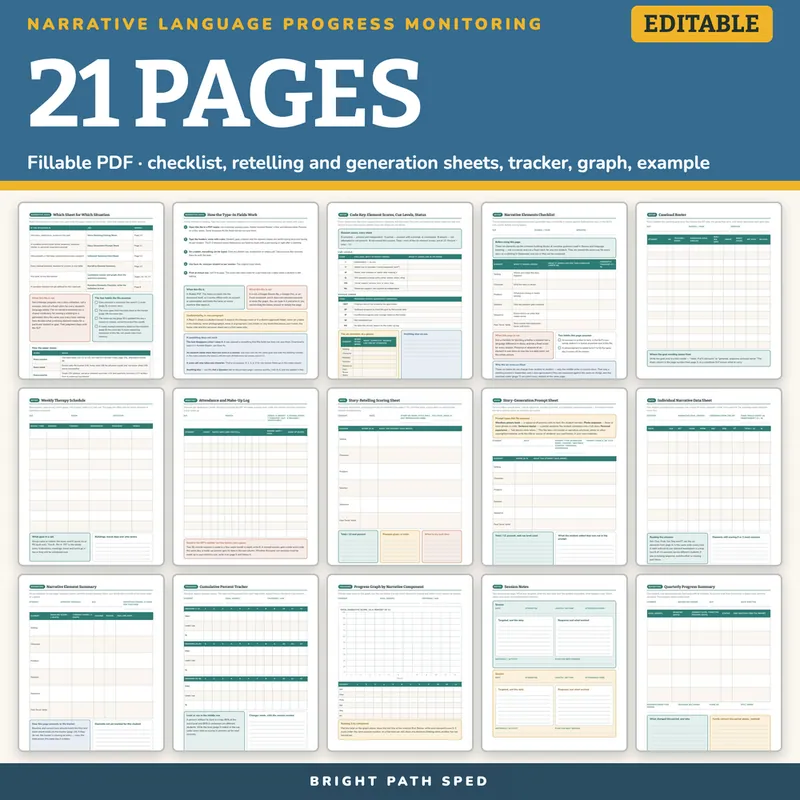
WHAT IS INCLUDED — 21 pages, 966 type-in fields
Setup
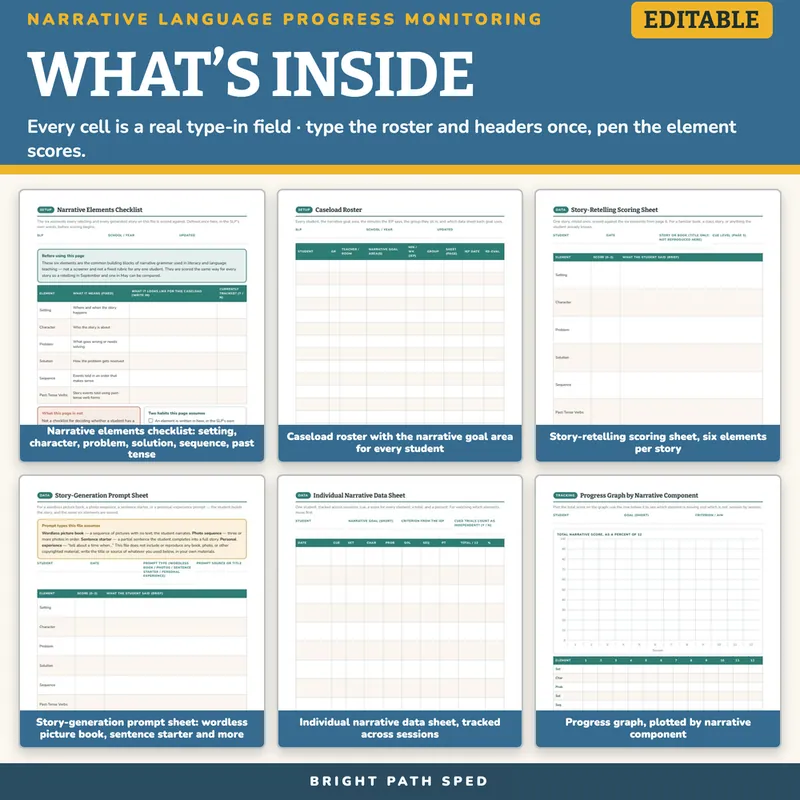
- Which Sheet for Which Situation — a chooser table matching six common situations to the sheet that answers them, plus a "How the Paper Moves" table covering the session, week and quarter workflow
- How the Type-In Fields Work — one page, so nobody emails you
- Code Key — element scores (2 complete, 1 partial, 0 absent, X not scored), six cue levels (I, V, M, Q, VIS, Mx), a reference table of the six elements, and five progress-status codes
- Narrative Elements Checklist — the six fixed elements (setting, character, problem, solution, sequence, past-tense verb use), each with a plain-language description and a write-in column for what "complete" sounds like for your own caseload
- Caseload Roster — 14 students: teacher/room, narrative goal area, minutes per week per the IEP, group, sheet page, IEP and re-evaluation dates
Attendance And Data
- Weekly Therapy Schedule — 10 time blocks across five days, push-in or pull-out
- Attendance and Make-Up Log — 13 rows, 8 date-seen cells each, missed date/code and made-up date
- Story-Retelling Scoring Sheet — the six elements scored against one known story, retold once
- Story-Generation Prompt Sheet — the same six elements scored against a wordless-picture-book, photo-sequence, sentence-starter or personal-experience prompt; a card at the top names the prompt types and states plainly that no book, photo or other copyrighted material is included
- Individual Narrative Data Sheet — 9 dated rows, cue column, a score for each of the six elements, a total out of 12, and a percent
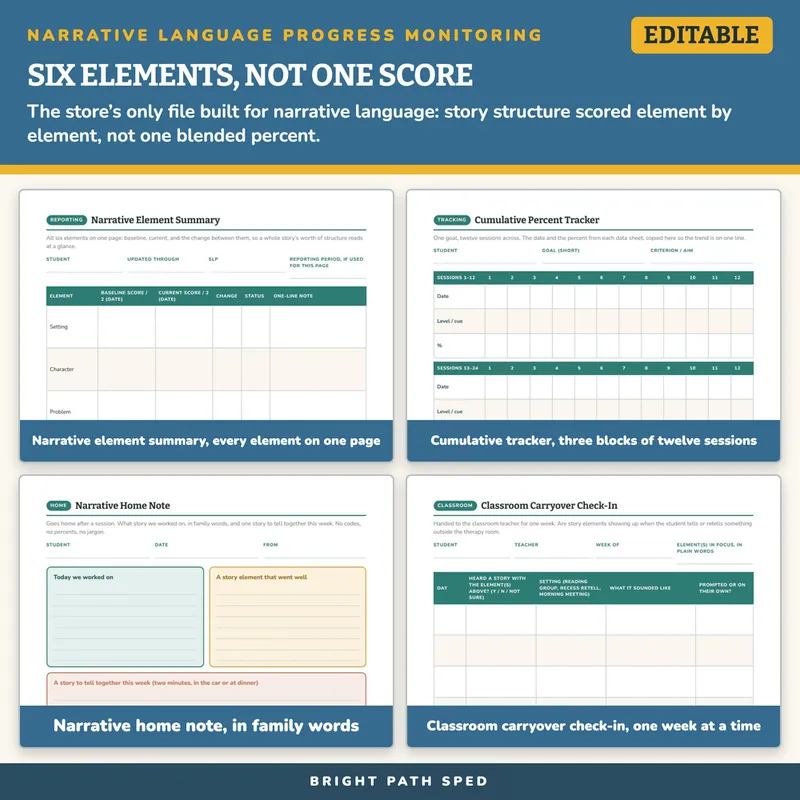
- Narrative Element Summary — all six elements on one page: baseline and current score, the change, a status code and a one-line note
Tracking, Reporting And Home
- Cumulative Percent Tracker — one goal, 36 sessions across three 12-session blocks, with the level or cue under every date
- Progress Graph by Narrative Component — the total score plotted against an aim line, plus a six-row trend table (one row per element) under the same 12 session numbers
- Session Notes — two sessions per page, data in every one
- Quarterly Progress Summary — 6 goal rows: baseline, current level from the tracker, status code, one sentence, plus sessions owed/delivered/made up/still owed
- Narrative Home Note — what story we worked on, a story element that went well, a story to tell together this week, a 7-day practice tracker
- Classroom Carryover Check-In — a 5-day table for the classroom teacher: heard a story element outside therapy, where, what it sounded like, prompted or not
- Filled-in example for an invented second grader (Priya) showing an individual narrative data sheet moving from a total of 3/12 to 10/12 across five sessions, a narrative element summary, and a session note, all cross-checked
What This Is, And What It Is Not
It is a fillable PDF. Open it in a PDF reader, click a field, type, press Tab to move on, Save As once per student. It works offline with no account or subscription. It is NOT a Google Sheets file, a Google Doc or a PowerPoint presentation.
It is not a therapy program, not a story collection, not a screener, and not a fixed rubric for every student's language ability. The six narrative elements are common building blocks of narrative grammar used in literacy and language teaching — a shared vocabulary for scoring a story the same way every time, not something these pages use to decide anything about a student on their own. No prompt, book, photo set or other copyrighted material is included or reproduced anywhere in this file; the story-generation sheet describes prompt TYPES only, and the SLP records her own source. No age, eligibility or clinical-finding claim anywhere; no health data is pre-filled, and the example student (Priya) is invented and named as such on page 20.
Who This Is For
School-based SLPs and SLPAs tracking narrative language — story retelling and story generation — as a distinct goal area from articulation or general session logistics, and the special education teachers or paraprofessionals who see a story element show up (or not) outside the therapy room.
If You Want More
Speech Therapy Data Collection Sheets Editable is the 22-page general caseload version of this store's SLP line: six data sheets, tracker, graph, home note. Bilingual Speech Therapy Data Sheets Editable is the 20-page bilingual sibling: English and first-language tracking, dominance and code-switching observation logs.