No Taxation Without Representation Reading Passages, Sort, Writing 5th-8th Grade
- 42 pages
- 5th, 6th, 7th, 8th
$2.00 $4.00 on Teachers Pay Teachers
Half the Teachers Pay Teachers price. The same PDF, sold direct.
DownloadOr get it with All-Access: pick any 20 resources a month for $7.
New here? Your first month of All-Access is half off with code TEACHERTOK
Already bought this, or a member?
Instant download. One teacher's license: colleagues need their own copy. Each file carries a license number.
Also on Teachers Pay Teachers: see the Bright Path Sped store
About this resource
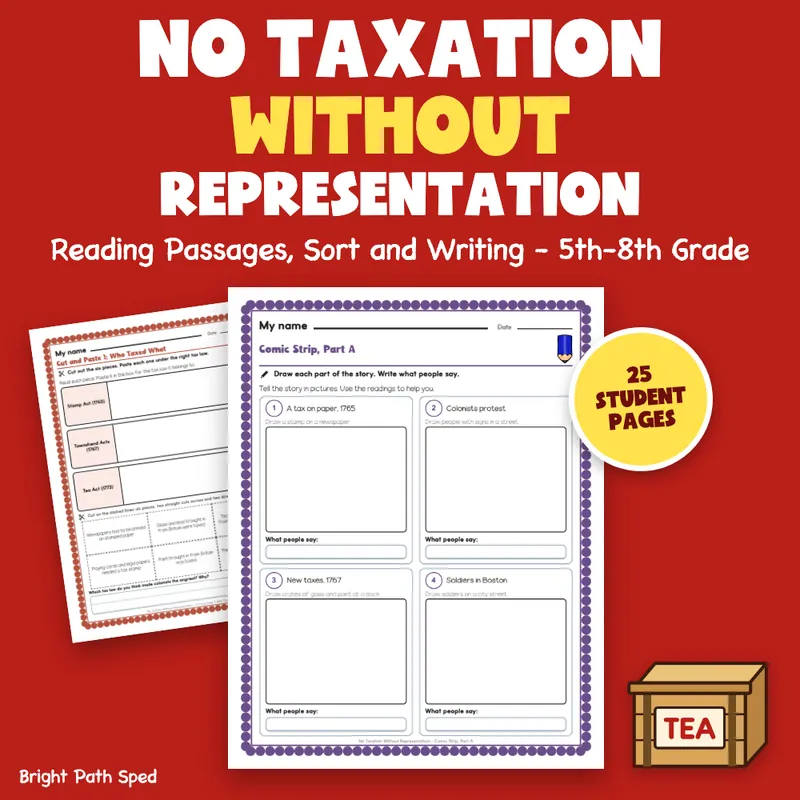
Teaching why colonists said "no taxation without representation" and need pages students can actually work on? This is a complete set for grades 5-8. Students read the story two ways, a short read of 132 words and a full read in four parts (the Stamp Act, the Townshend Acts, the Boston Massacre, the Tea Act and the Boston Tea Party), look at two source pages written for this file, sort who taxed what, match sayings to a colonist, a member of Parliament or a loyalist, put six events in order, fill in cause and effect and a who-wanted-what chart, draw an eight-panel comic strip, write in three voices and finish with a quiz and exit tickets. Answer keys give the letters and a sample for every open answer.
EVERYTHING INSIDE (42 pages)
- 25 student pages in 14 kinds of page, each with a name line and one short instruction
- 64 scored items spread over 14 scored worksheets, every answer taken from the same lists that print on the page
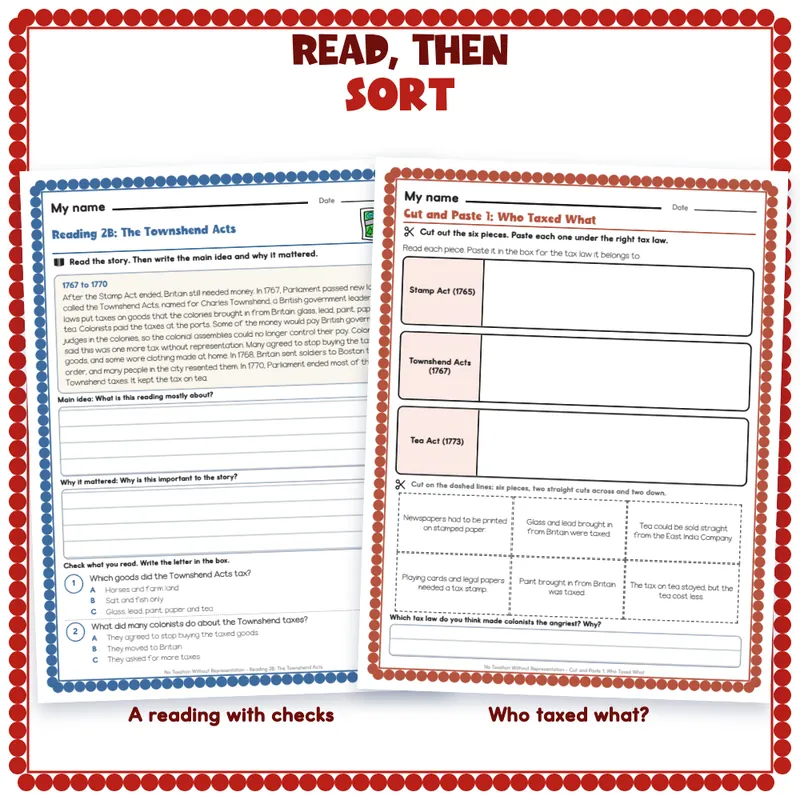
- Reading 1, a short read of 132 words with a main idea box and 3 checks; Reading 2, the full story in 4 parts (the Stamp Act, the Townshend Acts, the Boston Massacre, the Tea Act and the Tea Party) of 128 to 144 words each, with a main idea box, a why-it-mattered box and 2 checks each (11 checks across the five readings)
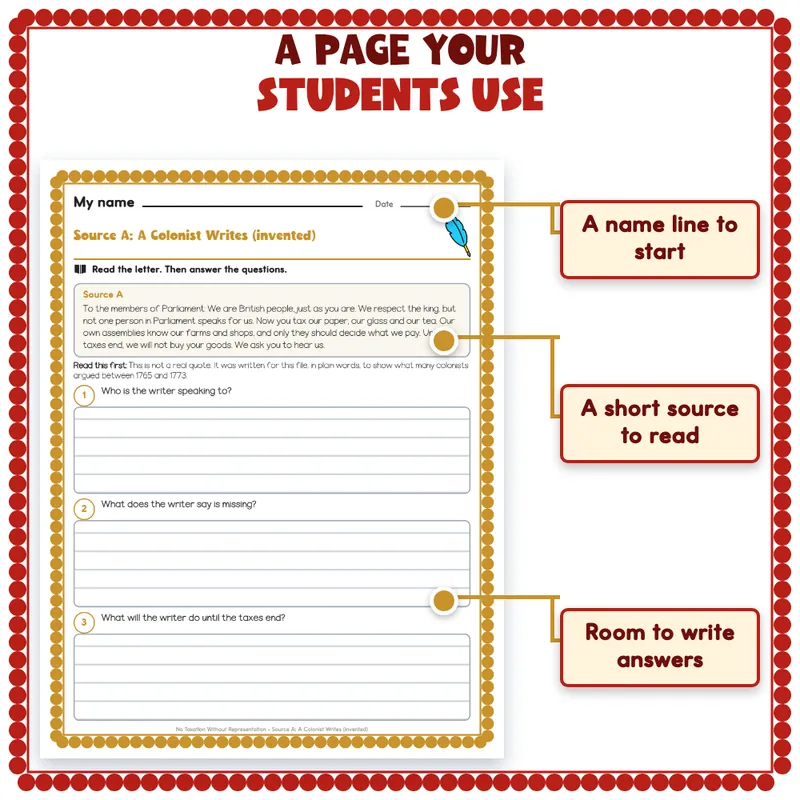
- 2 source pages (written for this file, not historical documents) with 6 questions in ruled boxes: Source A is an invented colonist's letter and Source B is an invented reply from a member of Parliament. Neither is a real quote, and each page says so
- 1 Before and After Check (5 questions, an answer box for each time) and 1 Before You Read page with 4 true-or-false items
- 1 Words to Know page: match 8 words (tax, representation, Parliament, boycott, repeal, loyalist, colonist, protest) to their meanings
- 1 timeline page: write the date for 6 events from March 1765 to December 1773
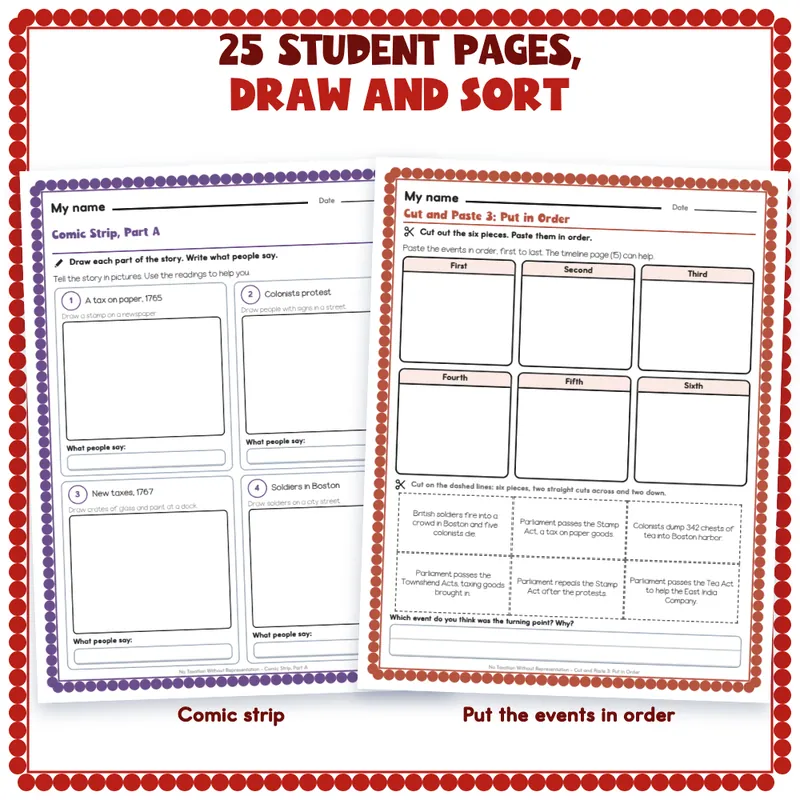
- 1 cause and effect organizer with 4 causes, 1 who-wanted-what chart for 4 groups, 1 comic strip spread across two sheets with 8 panels (a drawing box at least 2.5 inches tall and one speech line in each)
- 6 short-answer questions across two pages, 4 ruled lines each
- 2 perspective writing pages: a three-voices page (a colonist, a member of Parliament, a loyalist, each with a sentence starter and a ruled box) and an 18-line letter page
- 12-item quiz across two pages; 4 exit tickets
- 18 cut-and-paste pieces on 3 sort mats (who taxed what, who would say it, put in order), 6 pieces each in a 3 by 2 grid
- 4 answer keys with a sample for every open answer; 1 tracker, 1 class grid, 1 team note, 1 family page
- 1 filled example (an invented student), 1 phrase bank (17 starters in 6 groups)
- A binder cover with type-in teacher and class fields, and a page of divider tabs (Readings, Sources, Sorts, Keys, Records) with a spine label to cut out
- Start Here and a how-to-read-a-page page
How To Use It
1. Start with the Before and After Check (page 5) and Before You Read (page 6).
2. Read the short read (page 8) for a quick first pass, or the four-part full read (pages 9 to 12) for depth.
3. Use the source pages, timeline, cause and effect and chart (pages 13 to 17), then the comic strip and short answers (pages 18 to 21).
4. Finish with the perspective writing pages (pages 22 and 23), the quiz (pages 24 and 25), the three sorts (pages 26 to 28) and the exit tickets (page 29). Keys start on page 30.
Built For The Student Holding The Page
A "My name" line, one short instruction with a small picture cue, a plain scalloped border and big ruled boxes. Nothing on a student page is written for an adult: the keys and records are on separate teacher pages. The cut pages have six pieces in a strip-and-grid layout, edge to edge, so there are only a few straight cuts. Clip art is a teapot, coins, a map, a letter, a quill, a calendar, a book, a pencil and a child at a desk. The file prints clean in black and white.
A Short Account, Not A Full Textbook
Each reading is a plain-words summary written for this file. It covers the war debt after 1763, the Stamp Act (1765), the Stamp Act Congress, the repeal in 1766, the Townshend Acts (1767), soldiers in Boston, the Boston Massacre (March 5, 1770), the Tea Act (1773), the Boston Tea Party (December 16, 1773), the closing of Boston's port and the First Continental Congress. The pages use no long quotations, and no photos or portraits of real people appear anywhere: the two source pages are invented and say so. Check the readings against your own textbook; they are not tied to any standard. The only student in the file is an invented example, and it says so.
Type In, Or Print
The name line, every answer box, every check box and every ruled work box are type-in fields in any PDF reader: click one, type, then save. This is a fillable PDF; it is not a Google Slides or PowerPoint file.
What This Is, And What It Is Not
A set of readings and practice pages on the colonial tax protests with the record-keeping around it. It is not a timed test, a screener, a clinical tool, or a claim about any student's age or rate of progress. There is no IEP goal language or eligibility wording anywhere in the file, and no claim of alignment to any standard.
If You Want More
Causes of the American Revolution Worksheets | Reading Sort Timeline Grades 6-8; Articles of Confederation Worksheets | Sort, Match, Timeline 6th 7th 8th Grade; Constitutional Convention Worksheets | Readings Compromises Sort Grades 6-8.