One More One Less Worksheets
- 30 pages
- Kindergarten, 1st, 2nd
$2.00 $4.00 on Teachers Pay Teachers
Half the Teachers Pay Teachers price. The same PDF, sold direct.
DownloadOr get it with All-Access: pick any 20 resources a month for $7.
New here? Your first month of All-Access is half off with code TEACHERTOK
Already bought this, or a member?
Instant download. One teacher's license: colleagues need their own copy. Each file carries a license number.
Also on Teachers Pay Teachers: see the Bright Path Sped store
About this resource
Flash cards drill "what's one more than 7," but nothing teaches a child to find BOTH neighbors of
a number with real variety or checks that they are not just guessing the same answer slot every
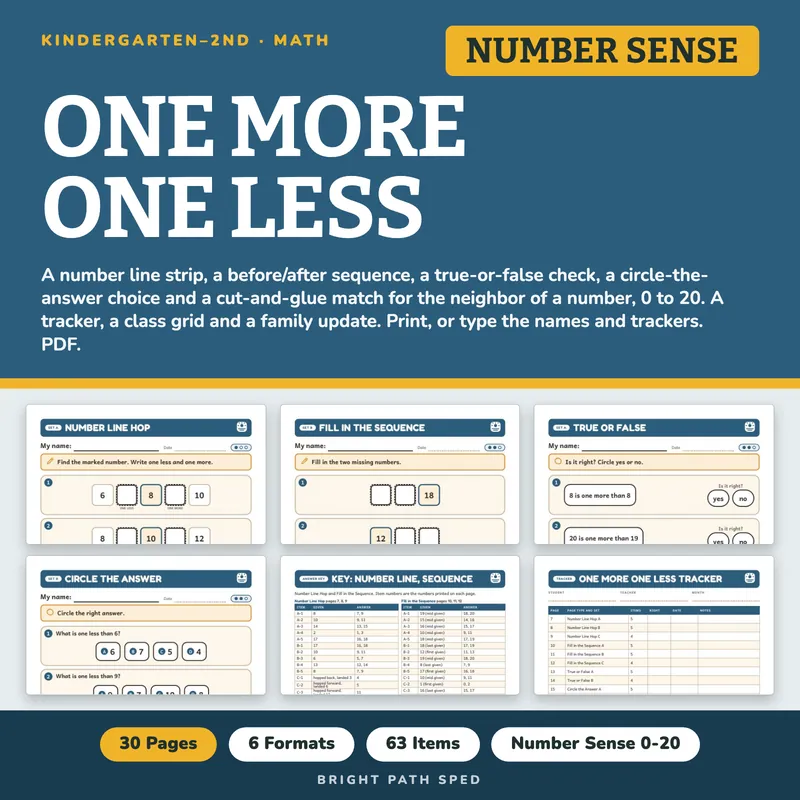
time. This is a complete kit for one more and one less, numbers 0 to 20: a number line strip, a
three-box sequence, a true-or-false check, a multiple-choice circle and a cut-and-glue match, plus
a tracker, a class grid and a family update, so nothing has to be written from scratch.
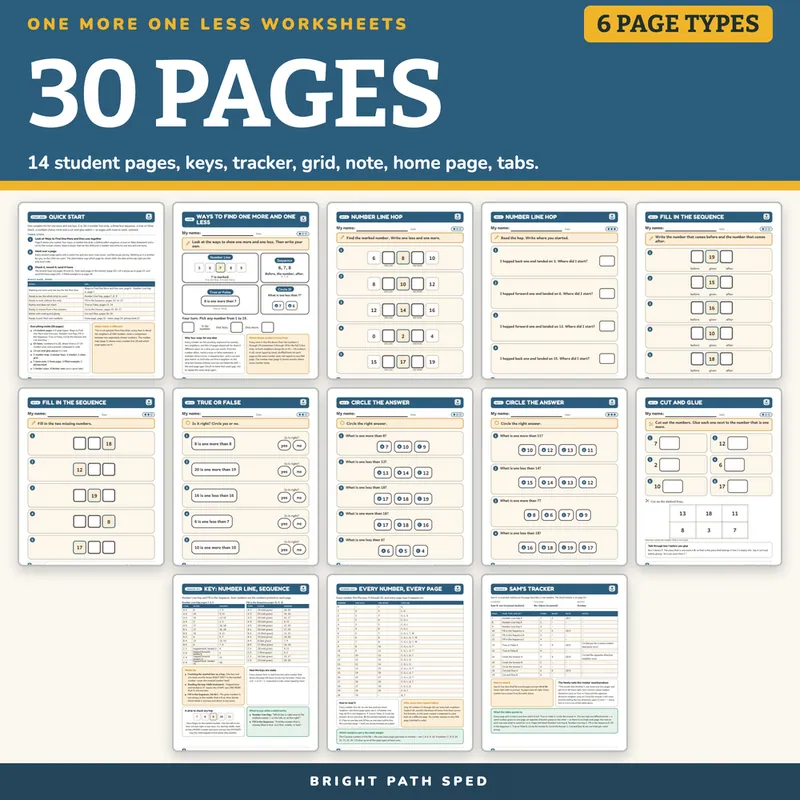
EVERYTHING INSIDE (30 pages)
- 1 Number Map page: every number 0 to 20, its one-less and one-more neighbor, and which page
types use it
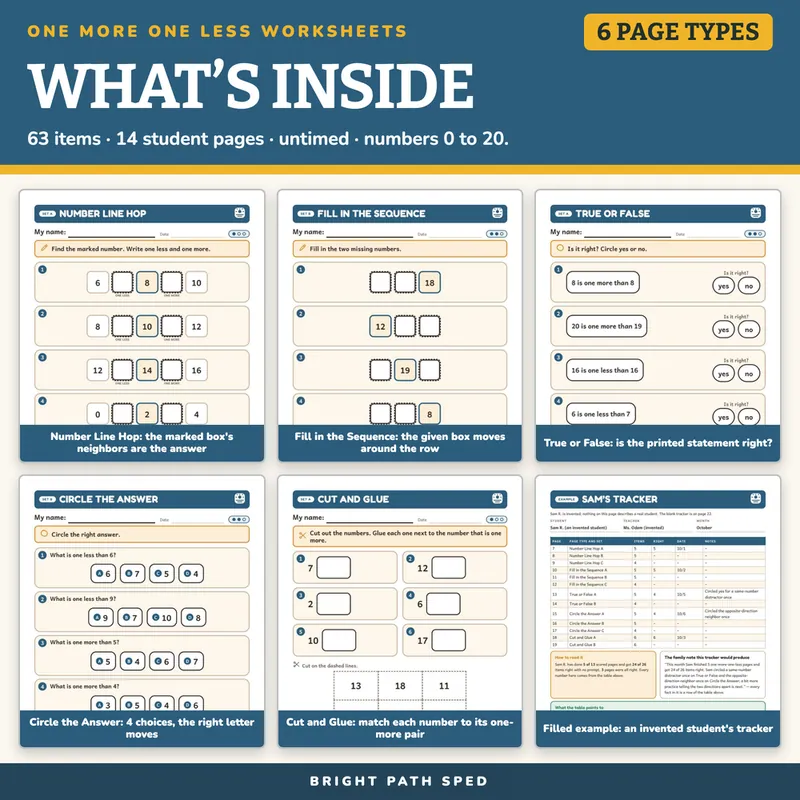
- 14 student pages in 6 page types: Ways to Find One More and One Less, Number Line Hop, Fill in
the Sequence, True or False, Circle the Answer, and Cut and Glue
- 63 items in all, every answer computed from the number that draws the page, never typed by hand
- 2 answer keys, generated from the same number data as the student pages
- 1 tracker (page, page type, items right, date) and 1 whole-class progress roll-up
- 1 team note (a hand-off page between team meetings) and 1 home page (a different setting —
counting at home, not individual seatwork)
- 1 filled example (an invented student), 1 phrase bank (16 observable-language starters), 1
binder cover, and 6 divider tabs with a spine label to cut out
- Start Here, a how-to-read-a-page page, and a number map that gives every page number
The Six Page Types, Easiest To Hardest
1. Ways to Find One More and One Less (starting) — one number shown four ways: a number line
strip, a before/after sequence, a true-or-false statement, and a circle-the-answer choice.
2. Number Line Hop (1-3 dots) — a marked number on a 5-box strip (write both neighbors); without
the strip (write both neighbors from the number alone); or a hop riddle (read where you
landed, write where you started).
3. Fill in the Sequence (1-3 dots) — three boxes in a row, one given, two blank. The given box is
always the middle one at the easiest level; at the building and stretch levels its position
moves (first, middle or last), checked in code so it never lands in the same spot three times
running.
4. True or False (2-3 dots) — a printed one-more/one-less statement; circle yes or no, and (at the
harder level) write the right number if it is wrong. Every wrong statement shows either the
SAME number or the OPPOSITE-direction neighbor, never an unrelated number.
5. Circle the Answer (1-3 dots) — 3 or 4 choices; circle the letter next to the right one. The
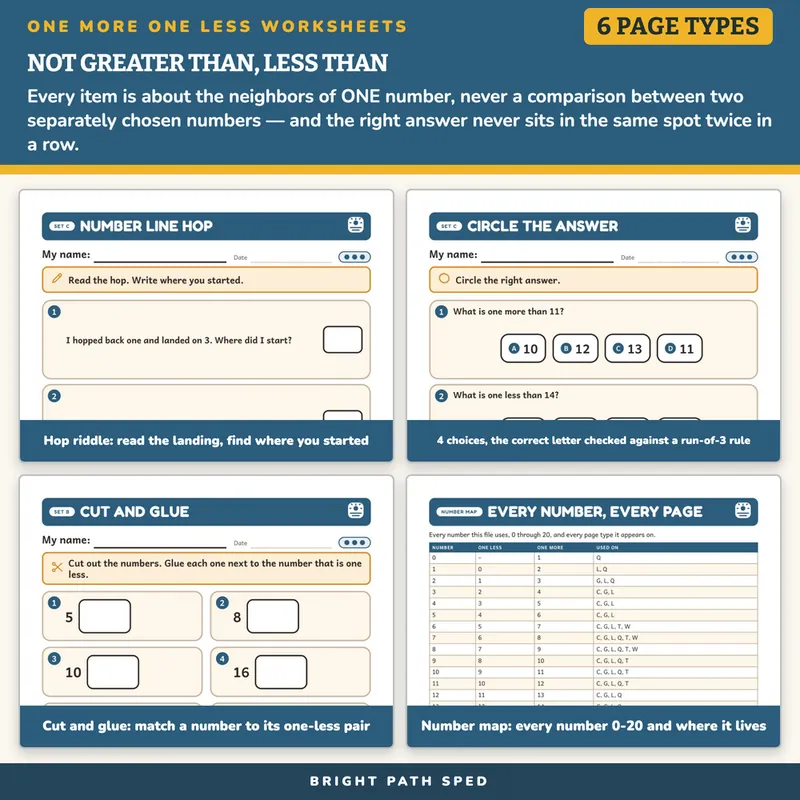
correct letter's position is seeded per item and checked so it is never the same slot three
times in a row and never sits still for the whole page.
6. Cut and Glue (1 or 3 dots) — 6 pieces, 3 cuts; match each printed number to its one-more (Set
A) or one-less (Set B) pair.
Built For The Child Holding The Page
A big "My name" line, one short instruction, large rounded letters, real room to write or circle,
and dots (not words) to show which level a page is. Nothing on a student page is written for an
adult.
Not Greater Than / Less Than
Every item here is about the neighbors of ONE number. Nothing compares two separately chosen
numbers or asks which is bigger — that is a different skill, sold separately.
Type In, Or Print
The name line and every answer box are type-in fields in any PDF reader: click one, type, then
save — the same goes for the tracker, the class grid, the team note and the home page. This is a
fillable PDF; it is not a Google Slides or PowerPoint file.
Who This Is For
Kindergarten through 2nd grade classrooms, self-contained and resource rooms, and any teacher
building number sense into a math block or center.
What This Is, And What It Is Not
A number-sense worksheet set with the record-keeping around it. It is not a timed test, a
screener, a clinical or diagnostic tool, or a claim about any student's age or rate of progress.
There is no IEP goal language or eligibility wording anywhere in the file.