Oral Motor Exercises
- 30 pages
- Not Grade Specific
$1.75 $3.50 on Teachers Pay Teachers
Half the Teachers Pay Teachers price. The same PDF, sold direct.
DownloadOr get it with All-Access: pick any 20 resources a month for $7.
New here? Your first month of All-Access is half off with code TEACHERTOK
Already bought this, or a member?
Instant download. One teacher's license: colleagues need their own copy. Each file carries a license number.
Also on Teachers Pay Teachers: see the Bright Path Sped store
About this resource
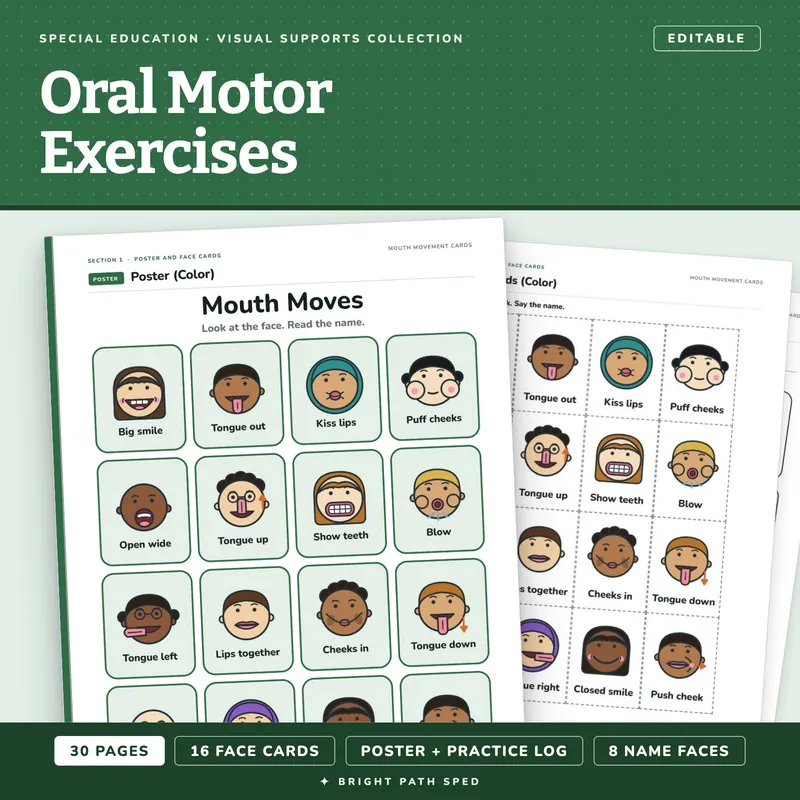
Oral motor exercises picture cards: 16 drawn faces, each making one mouth move, with the move's name and nothing else. A practice log, a family page and two blank pages for the child's own therapist to write the instructions. Print and go, or type into the fillable pages.
EVERYTHING INSIDE — 30 pages
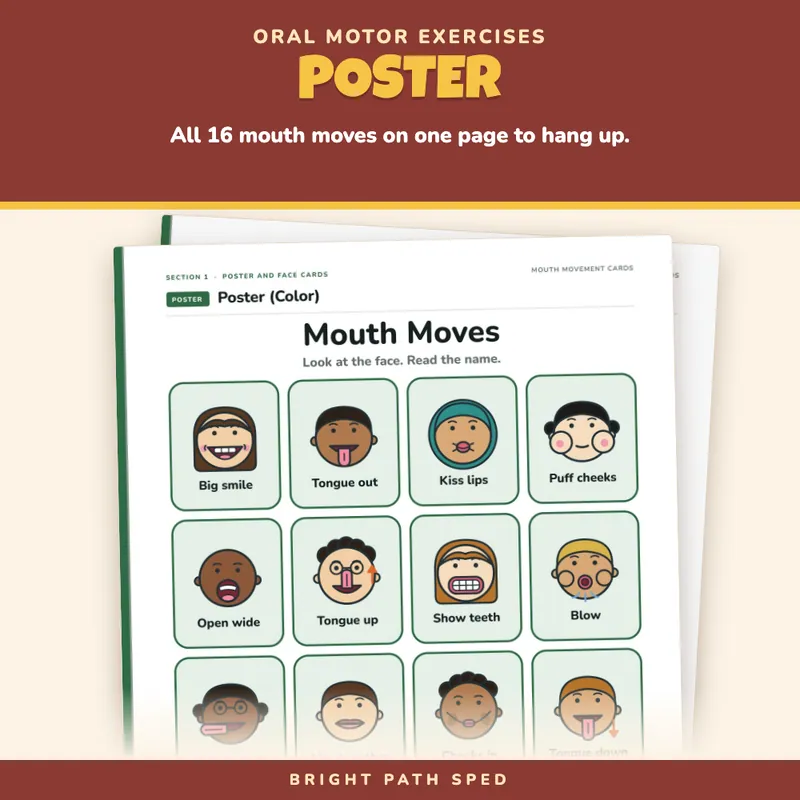
- A Mouth Moves poster of all 16 faces, with each name (color page and black-and-white ink-saver page)
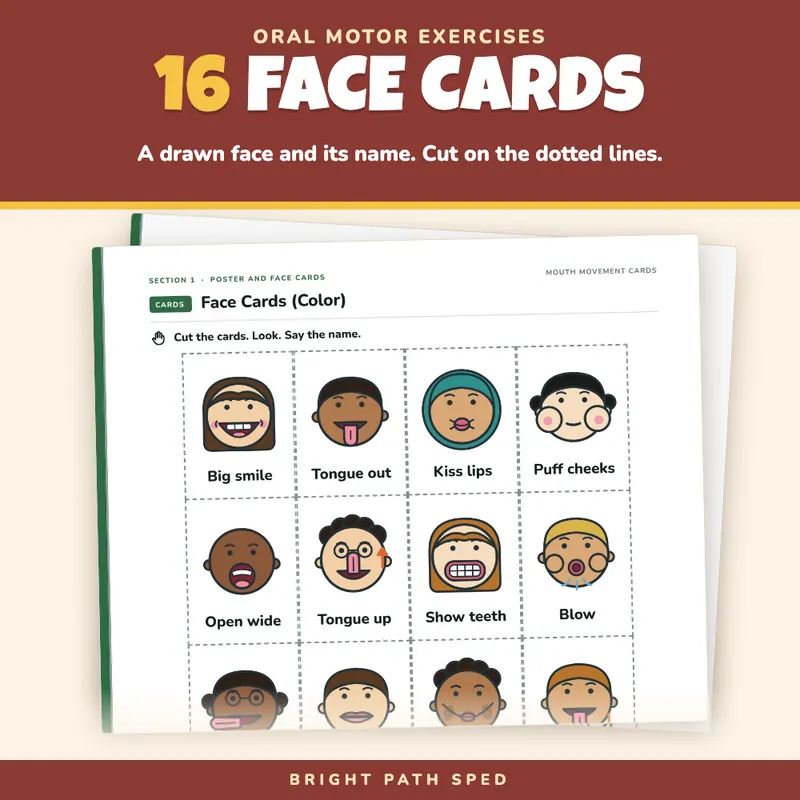
- 16 mouth movement cards to cut, 4 across and 4 down, cut on the dotted lines: big smile, tongue out, kiss lips, puff cheeks, open wide, tongue up, show teeth, blow, tongue left, lips together, cheeks in, tongue down, buzz lips, tongue right, closed smile and push cheek. The faces are drawn with different skin tones, hair, head scarves and glasses
- The same 16 cards in black-and-white ink-saver
- 16 blank face cards: the student draws a face and writes its name
- A glue mat: 12 numbered boxes for the cards you pick
- A mirror page: look, draw my mouth, write my card
- Which Name? 8 faces on 2 pages: the student looks at the face and circles the right name
- Draw the Mouth: 4 blank faces to draw a mouth on and name
- My Stars: 15 stars (5 days, 3 a day) to color each time the student tries a card
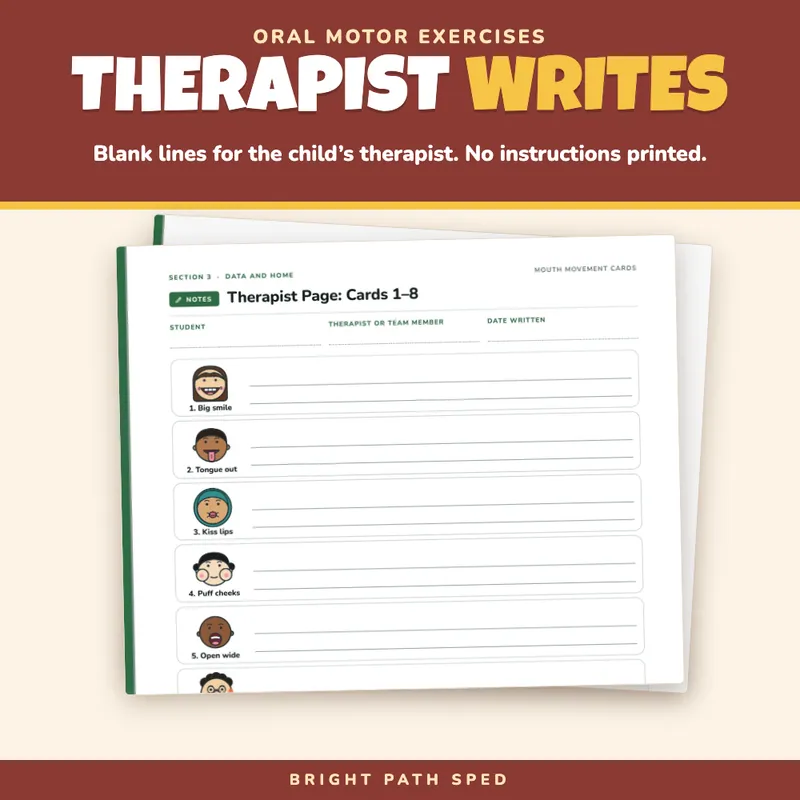
- Two blank therapist's pages: all 16 cards, each with blank lines for the child's therapist or team to write what to do, how and when, in their own words
- A how-to page and an answer key, with a space for the therapist's own names for the cards
- A practice log (20 rows: date, when, card, tried it Y/N, initials)
- A weekly roll-up (8 weeks) with a percent graph
- A filled example: an invented child, one week on the log, three weeks on the roll-up and the cards that came up across all three
- A family page with 6 small cards to cut apart and a note that says the therapist decides what to practice
- A hand-off page so a paraprofessional or another classroom uses the same cards the same way
- A phrase bank: 23 lines in 6 groups (lines to get the cards out, and written starters for the log, the roll-up and the note home)
- A storage and binder label sheet: 12 labels and a spine strip
- Start Here, a contents page that maps every page, and a "what's next" back page
The Student Pages
Every student page has a "My name" line, one short instruction with a picture, big faces and big rounded words, and room to draw, circle, color or write. The child in the filled example is invented.
The Cards
Each card shows one drawn face making one mouth move, and its name. That is all. The cards do not say how to do a move, how many times, or how often. Use them on a poster, a glue mat or a ring, in a small group or one on one, or hand a child two or three at a time. Tongue left and Tongue right show the move as you look at the card.
What This Is, And What It Is Not
It is a fillable PDF: type into the name lines, the therapist's pages, the log, the roll-up, the family page, the hand-off page and the blank cards, or print and use a pen. It works offline with no account or subscription. It is NOT an editable online slideshow or word-processor document.
It is picture cards, a poster, student pages and a tally. It is NOT therapy guidance, a treatment plan or a clinical procedure: it does not tell anyone how to do a mouth move, how often, or for whom, and it makes no promise about results. What a child practices, and how, is for the child's own speech-language pathologist, therapist or team. The therapist's pages are blank on purpose, and the family page says so.
Who This Is For
Speech-language pathologists, special education teachers, occupational therapists and paraprofessionals who want clear picture cards for mouth moves and a place to log them, and the families who get the home page. No grade level: use it wherever a picture card helps.
More In The Collection
This set is in the Visual Supports Collection, alongside the Speech Therapy Session Routine visual schedule cards and the Breathing Exercise Visual Cards. Free to try first: Visual Supports Starter Set FREE.
Pictures drawn for this product.