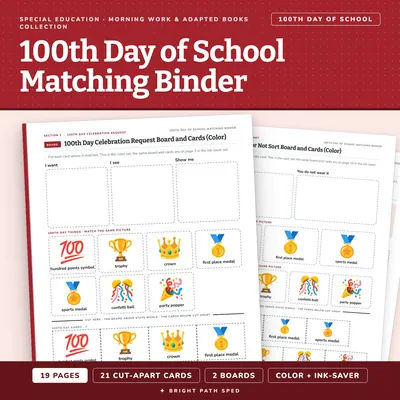
Personal Information and Safety Matching Binder
- 20 pages
- PreK, Kindergarten, 1st, 2nd
$5.00
DownloadOr get it with All-Access: pick any 20 resources a month for $7.
New here? Your first month of All-Access is half off with code TEACHERTOK
Already bought this, or a member?
Instant download. One teacher's license: colleagues need their own copy. Each file carries a license number.
Also on Teachers Pay Teachers: see the Bright Path Sped store
About this resource
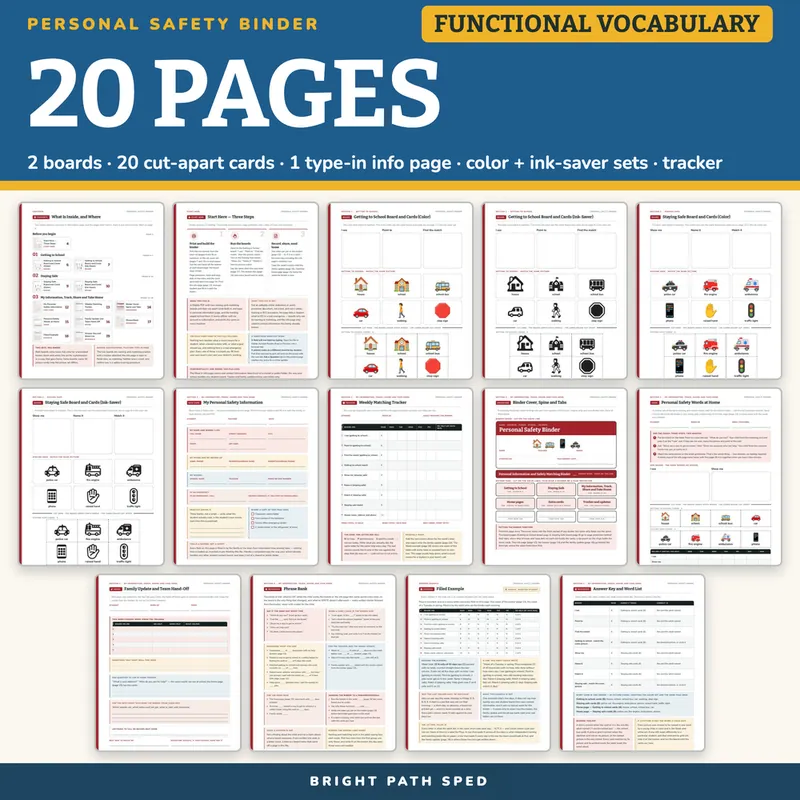
EVERYTHING INSIDE — 20 pages, 138 type-in fields
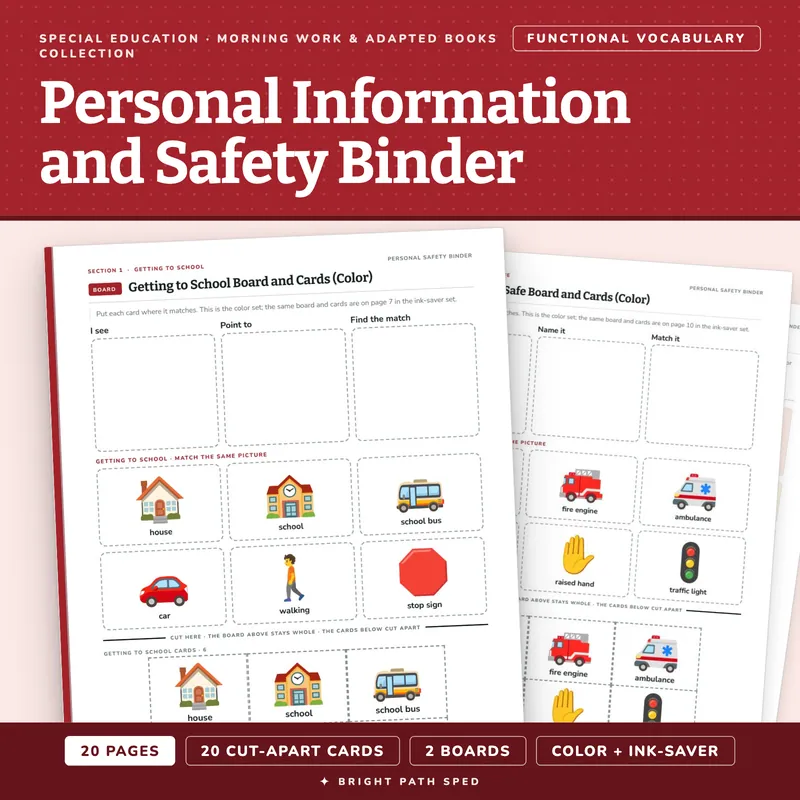
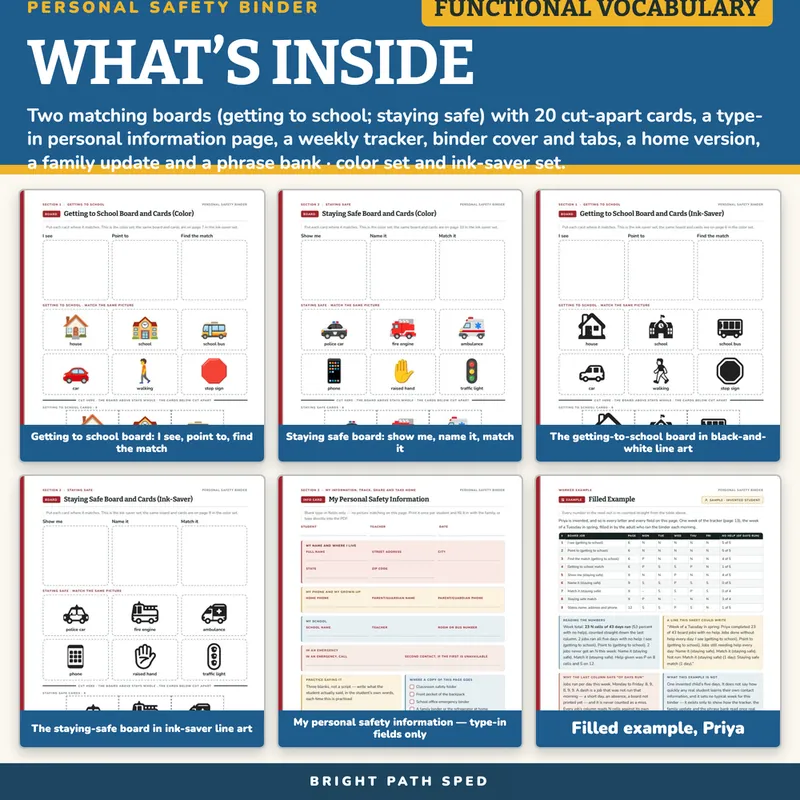
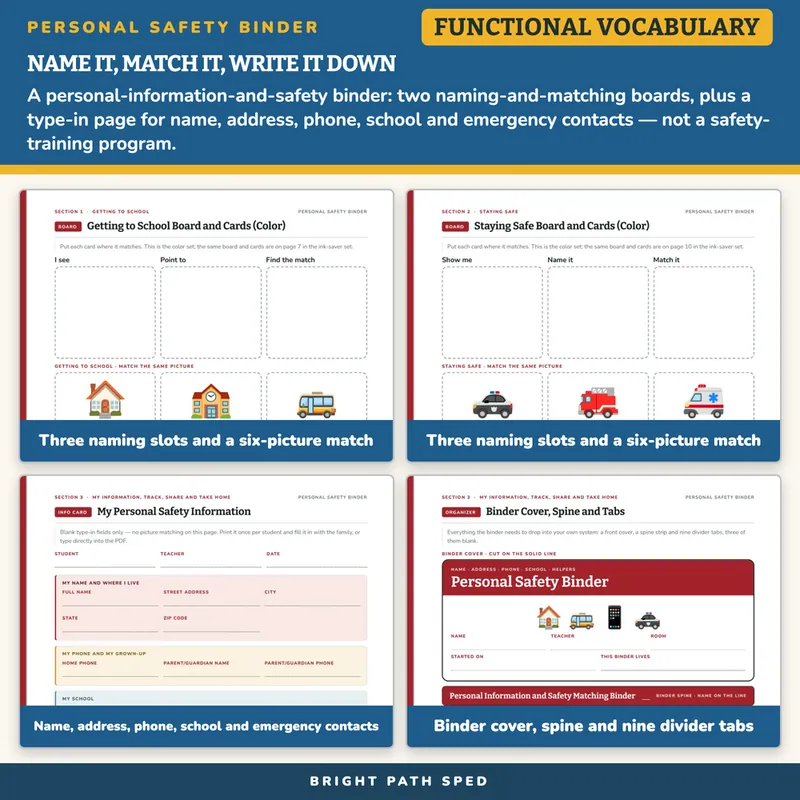
- A Getting to School board: three naming slots (I see, Point to, Find the match) and a six-picture match — with its own 6 cut-apart cards on the same sheet
- A Staying Safe board: the same three naming slots and a six-picture match — with its own 6 cut-apart cards
- Both boards twice: a full-color set for a laminated binder and a black-and-white ink-saver set for the photocopier
- 20 cut-apart picture cards in all, counting the color set and the home page once
- A type-in-only "My Personal Safety Information" page: 13 blank contact fields in 4 groups (name and address, phone and grown-up, school, emergency contacts), a 3-line practice-saying-it space, and a checklist of where a completed copy goes — no picture matching on this page
- A weekly tracker: 9 rows down (8 board jobs plus the info page's recitation row), Monday to Friday across, one letter per cell (no help / pointed once / said the words / not run), a "no help" count per row and a week total
- A binder organizer: a front cover, a spine strip and nine divider tabs (three of them blank)
- A home version: a smaller set of the same naming-and-match cards (8 cards) for the kitchen table, with a seven-day "we did it" row
- A family update with a team hand-off block for the next adult who runs the binder
- A phrase bank: 24 lines in 6 groups (spoken lines for running the boards, written starters for the note afterward)
- A filled example — an invented student, one week, every count re-counted from its own row
- An answer key listing every board, the cards it takes and what correct looks like, plus the full word list (classroom set and home set)
- Start Here, a contents page with page thumbnails, and a "what's next" back page
A personal-information-and-safety vocabulary binder: two naming-and-matching boards for the pictures a student sees on the way to school and the vehicles/people who help in a community, plus a blank, type-in page for the contact information a family already knows. This is a picture-and-word recognition and information-card tool, not a safety-training program and not a 911 or emergency-response procedure — no page tells a student what to DO in a real emergency, on a real road, or near a real vehicle, and no field is pre-filled with a real student's information.
The Boards
- Getting to School (page 6 in color, page 7 in ink-saver) — the board stays whole above a cut line; the card band below cuts apart. Three naming slots, and a six-picture match (house, school, school bus, car, walking, stop sign): the child matches the identical card onto its picture.
- Staying Safe (page 9 in color, page 10 in ink-saver) — the same three naming slots, and a six-picture match (police car, fire engine, ambulance, phone, raised hand, traffic light).
The Info Page
Page 12, type-in fields only: full name, street address, city, state, ZIP code; home phone, parent/guardian name and phone; school name, teacher, room or bus number; and two blank emergency-contact lines ("In an emergency, call" and a second contact) for the family or district to fill in — never a printed phone number or a printed procedure. A practice space for saying the information aloud, and a checklist for where a completed copy should live (classroom safety folder, backpack, school office, home).
The Words
- Getting to School cards (6): house, school, school bus, car, walking, stop sign
- Staying Safe cards (6): police car, fire engine, ambulance, phone, raised hand, traffic light
- Home page — a smaller subset: 4 getting-to-school cards, 4 staying-safe cards
Every picture was chosen to be named in one word by a young child, in color AND in the black-and-white set, and its real Fluent High Contrast name checked before use — not assumed from the emoji name. (The one prior trap in this collection, "hospital," was checked again for this product and stayed excluded: its High Contrast picture is a medical bag and a bench, not a building.)
What This Is, And What It Is Not
It is a fillable PDF: type into the info page, the tracker, the organizer, the home page and the family update, or print and use a pen. The board pages print on cardstock or plain paper; the card band cuts off the bottom and the board stays whole. It works offline with no account or subscription. It is NOT an editable online slideshow or word-processor document, it is not a test of anything, and it is not a safety-training program or a 911/emergency-response procedure — nothing on any page tells a student what to do in a real emergency, on a real road, or near a real vehicle.
It carries no prompt hierarchy, fading schedule or mastery rule, and it does not decide what a count means for a student or when a board is done with. The tracker counts naming, matching and recitation practice, and nothing else.
Who This Is For
Special education teachers and paraprofessionals running functional-vocabulary or personal-safety-information practice with early, pre-reading or low-verbal students, case managers who need that practice to show up as data, and the families who fill in the info page and get the home page.
A Note On The Info Page
Every field is filled in by the family or the team from information they already have — nothing is looked up, guessed at or pre-filled by this file. A completed copy carries real contact information: keep it the way your school already keeps any other student contact record, out of a shared or public folder.
More In The Collection
This binder is part of the Morning Work & Adapted Books Collection; more matching binders are being added to the collection regularly, all on the same boards-plus-tracker shape.
Pictures (color pages): Noto Emoji by Google, Apache License 2.0. Pictures (ink-saver pages): Fluent Emoji, Copyright (c) Microsoft Corporation, MIT License.