Personal Space Ring Cards for Special Education
- 19 pages
- Not Grade Specific
$3.50
DownloadOr get it with All-Access: pick any 20 resources a month for $7.
New here? Your first month of All-Access is half off with code TEACHERTOK
Already bought this, or a member?
Instant download. One teacher's license: colleagues need their own copy. Each file carries a license number.
Also on Teachers Pay Teachers: see the Bright Path Sped store
About this resource
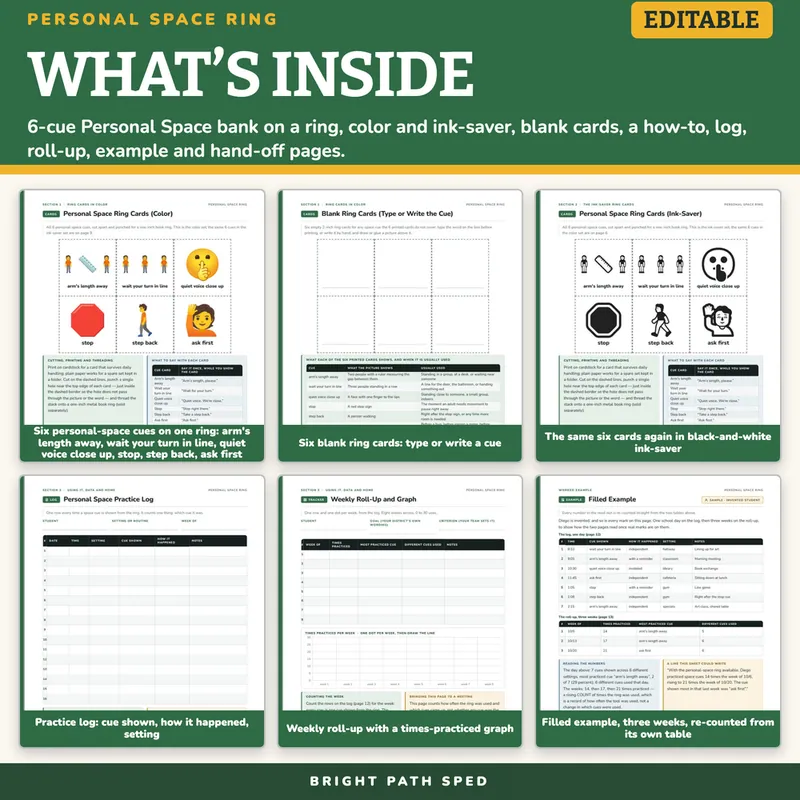
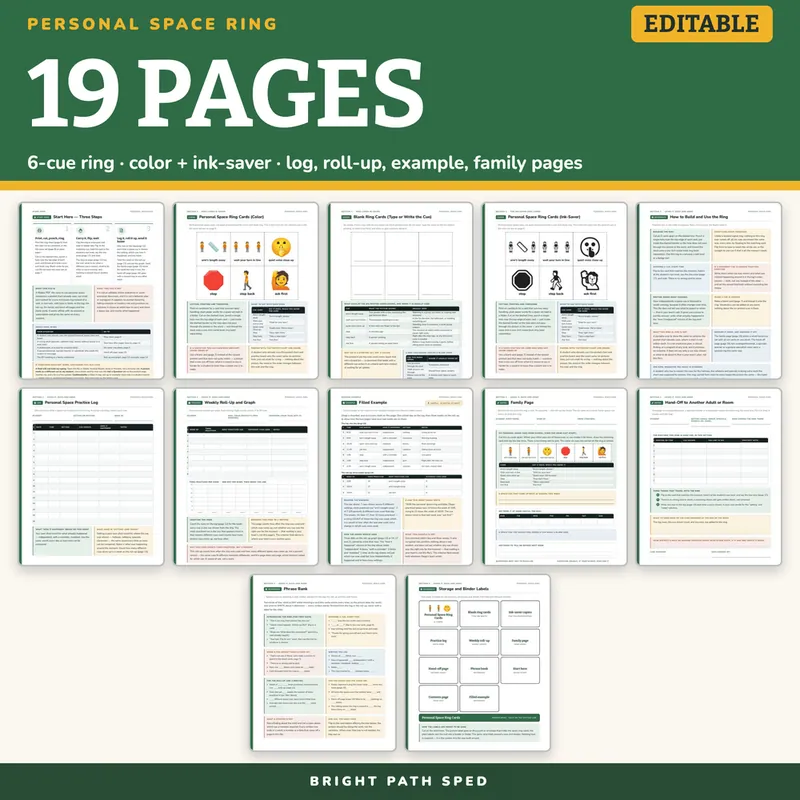
EVERYTHING INSIDE — 19 pages
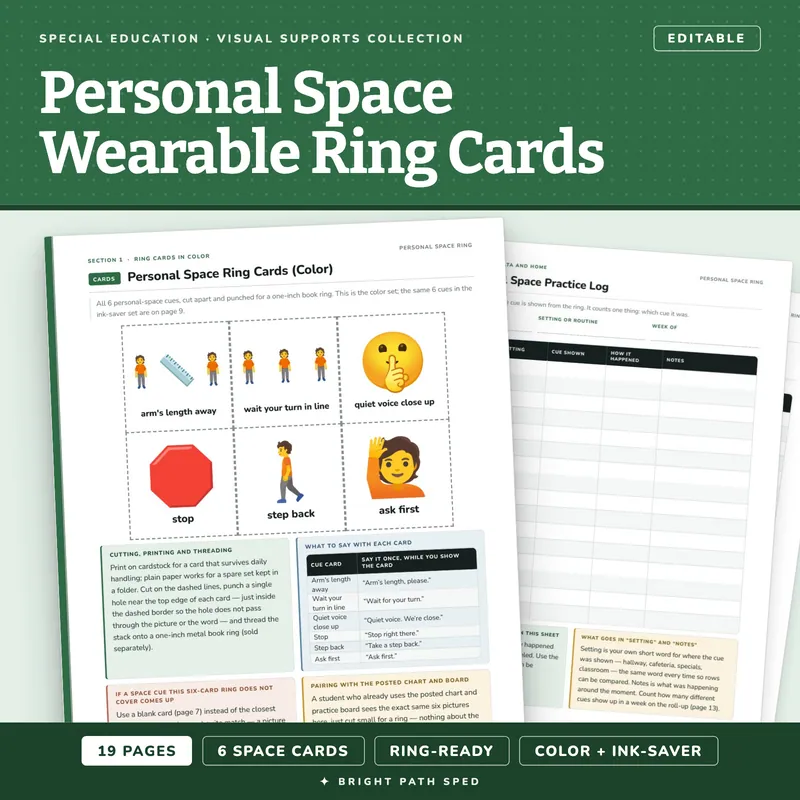
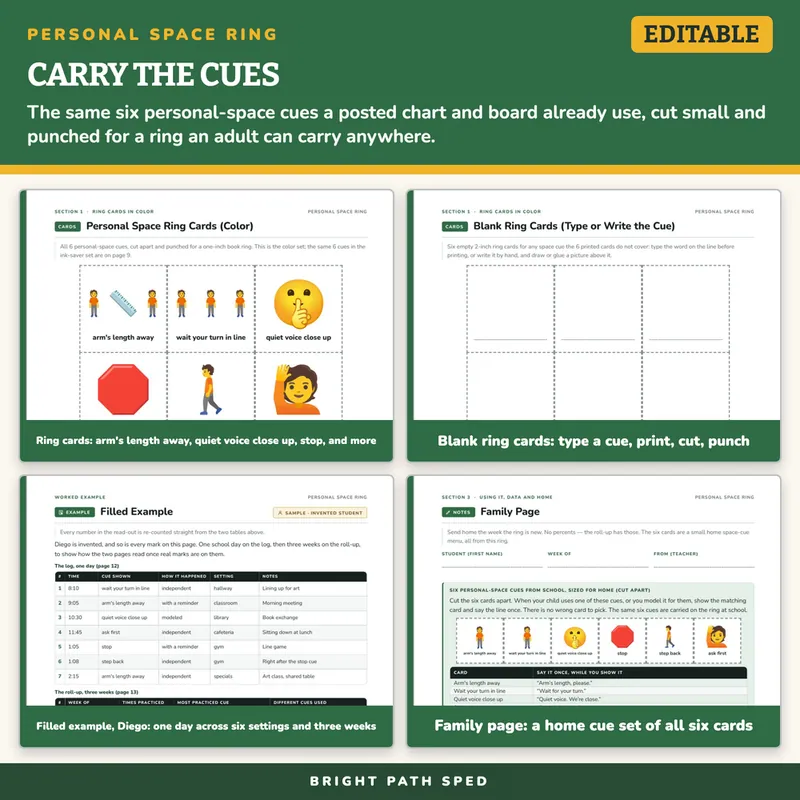
- 6 cut-apart ring cards, 2 inches square: arm's length away, wait your turn in line, quiet voice close up, stop, step back and ask first — the same six cues the posted Personal Space chart and practice board use, punched for a one-inch book ring
- Every card twice: a full-color set for the ring and a black-and-white ink-saver set for a spare ring or a second adult
- A "what to say with each card" reference and a cutting/printing/threading note printed right on the ring sheet
- 6 blank ring cards with a type-in word line, plus a reference table showing what each of the six printed cards depicts and when it is usually used, for any cue the printed set does not cover
- A how-to page: building the ring, why every card stays threaded, showing a cue, what to do when a different cue is chosen than expected, writing down what changes, adding a missing cue, what this ring is and is not, sending it home and handing it off
- A Personal Space Practice Log (16 rows: date, time, setting, cue shown, how it happened, notes)
- A weekly roll-up (8 weeks) with a times-practiced graph — a count of use, not a percent, matching the base chart's own non-evaluative framing
- A filled example — an invented student, one day across six settings and three weeks on the roll-up, every number re-counted from its own row
- A family page with all six cards, a "say it" reference table, and a week of home tries to initial
- A hand-off page so a paraprofessional, a specials teacher or a substitute carries a second ring the same way
- A phrase bank: 24 lines in 6 groups (spoken lines for showing a card, written starters for the log, the roll-up and the note home)
- A storage and binder label sheet: 11 labels and a spine strip
- Start Here, a contents page with page thumbnails, and a "what's next" back page
The posted Personal Space chart and practice board (a wall poster, a full-size board, two desk-size boards, and cut-apart cards) stay where they are posted. This file prints no chart and no board at all: the same six cues, cut small, punched near the top edge and threaded onto a one-inch book ring, so the whole six-cue vocabulary travels clipped to a lanyard, a belt loop or a badge reel — into the hallway, the cafeteria, specials, a fire-drill line, or any room without a posted chart. It is the wearable companion to that chart and board, not a second copy of them: the exact same pictures and words, cut small enough to carry.
THE CARDS (reused verbatim from the posted chart, same words and pictures)
1. Arm's length away
2. Wait your turn in line
3. Quiet voice close up
4. Stop
5. Step back
6. Ask first
Every card stays threaded on the ring and is shown the same way, every time — flip to the matching picture, hold it at the student's eye level, say the line once, and wait.
What This Is, And What It Is Not
It is a fillable PDF: type into the log, the roll-up, the family page, the hand-off page and the blank cards, or print and use a pen. The card sheet prints on cardstock or plain paper, cuts along dashed lines, and punches near the top edge for a one-inch book ring (sold separately). It works offline with no account or subscription. It is NOT an editable online slideshow or word-processor document.
It is a way for an adult to carry the same six personal-space cues a posted chart already uses, so the vocabulary travels from room to room, and to write down which cue was shown and how it happened. It is not a behavior plan, a clinical finding, or a program of any kind, and it promises no outcome. It does not say why a cue was chosen or what to do about it, and it supplies no prompt hierarchy, fading schedule or mastery rule.
Who This Is For
Special education teachers, paraprofessionals, specials teachers and families who already use (or are about to introduce) the Personal Space chart and practice board and need the same six cues to travel beyond the wall — plus the case managers who need that use to show up as data.
More In The Collection
This single sits alongside Personal Space Visual Cue Cards (the posted chart-and-board version of the same six cues), Lanyard Cue Cards for Special Education (the same ring mechanic for an interchangeable calm-down cue bank), and AAC Needs Ring Cards for Special Education (the same ring mechanic forked onto a seven-word AAC needs vocabulary); more picture-card sets — schedule cards, routine strips, choice boards — are being added to the collection regularly, all on the same cards-plus-data shape.
Pictures (color pages): Noto Emoji by Google, Apache License 2.0. Pictures (ink-saver pages): Fluent Emoji, Copyright (c) Microsoft Corporation, MIT License.