Phonological Awareness Progress Monitoring Probes
- 35 pages
- PreK, Kindergarten, 1st, 2nd
$4.50
DownloadOr get it with All-Access: pick any 20 resources a month for $7.
New here? Your first month of All-Access is half off with code TEACHERTOK
Already bought this, or a member?
Instant download. One teacher's license: colleagues need their own copy. Each file carries a license number.
Also on Teachers Pay Teachers: see the Bright Path Sped store
About this resource
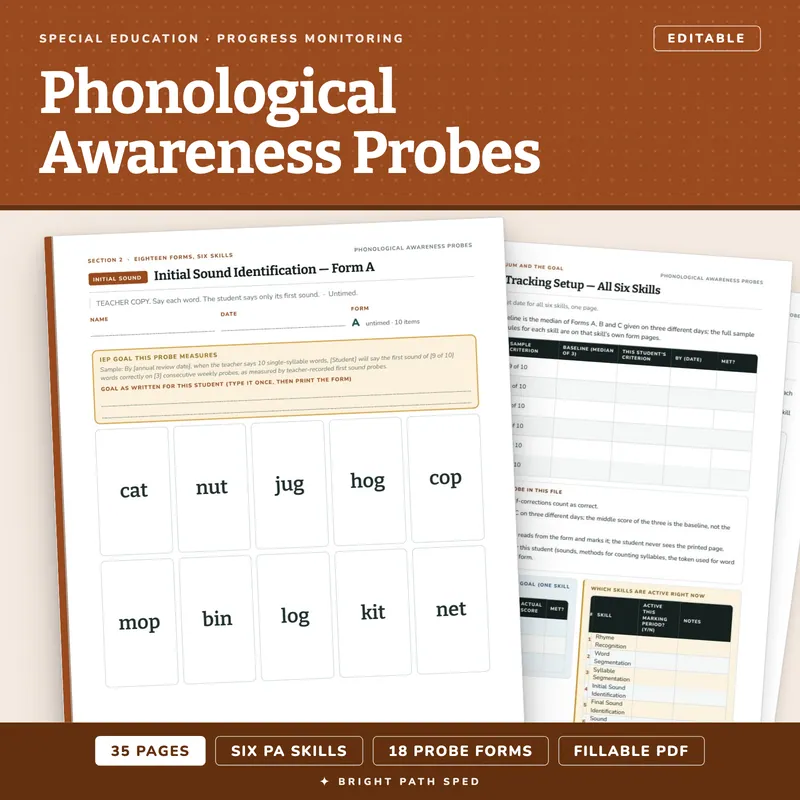
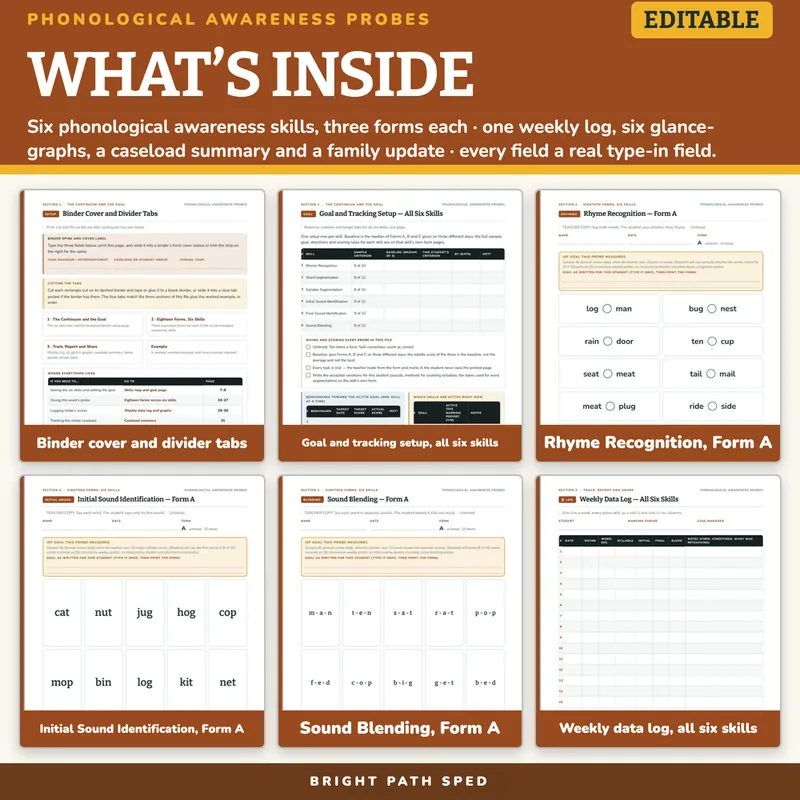
The whole phonological awareness continuum, one purchase. Rhyming, word segmentation, syllable segmentation, initial sound identification, final sound identification and sound blending — three probe forms each, a shared goal and tracking setup, one weekly log and one glance-page of graphs for all six skills, a caseload summary, a family update and a phrase bank for the progress note.
Every task in this file is oral: the teacher reads from the form and the student answers out loud. Every form is ten items and untimed, and no item repeats across a skill's own three forms.
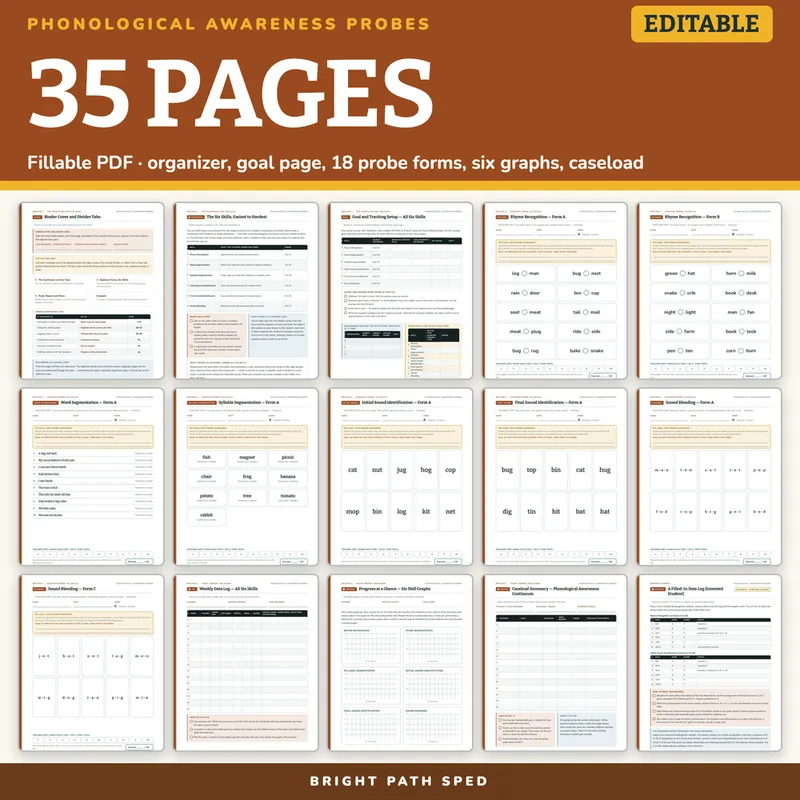
WHAT IS INCLUDED — 35 pages, 18 probe forms across 6 skills, 359 type-in fields, a binder cover and divider tabs
The Continuum And The Goal
- A one-page map of the six skills, ordered from the largest sound unit a student manipulates (a word inside a sentence) to the smallest (one phoneme), with what each skill measures and its page range
- A combined goal and tracking setup page: one row per skill with the sample criterion, a baseline column, this student's criterion, a target date and a met column; shared directions for giving and scoring every probe in the file; a benchmarks table; an "active this marking period" checklist table for the six skills
Eighteen Probe Forms, Six Skills, Three Forms Each (A, B, C)
- Rhyme Recognition: the teacher says two words, the student says whether they rhyme; five rhyming and five non-rhyming pairs a form
- Word Segmentation: the teacher says a short sentence (3 to 6 words), the student marks one token per word; the word count is a teacher-only answer key printed on the form
- Syllable Segmentation: the teacher says a word, the student claps, taps or counts the syllables; each form mixes one-, two- and three-syllable words
- Initial Sound Identification: the teacher says a word, the student says only its first sound
- Final Sound Identification: the teacher says a word, the student says only its last sound
- Sound Blending: the teacher says a word broken into separate sounds, the student blends it back into one word
- Every form carries the goal it measures: a sample goal in brackets, plus a type-in box for the goal as written for this student
- A teacher scoring strip, 1 to 10, and a Correct ___ / 10 box at the foot of every form
Track, Report And Share
- A weekly data log: one row per visit, one column per skill, so a student on two active skills gets two entries most weeks
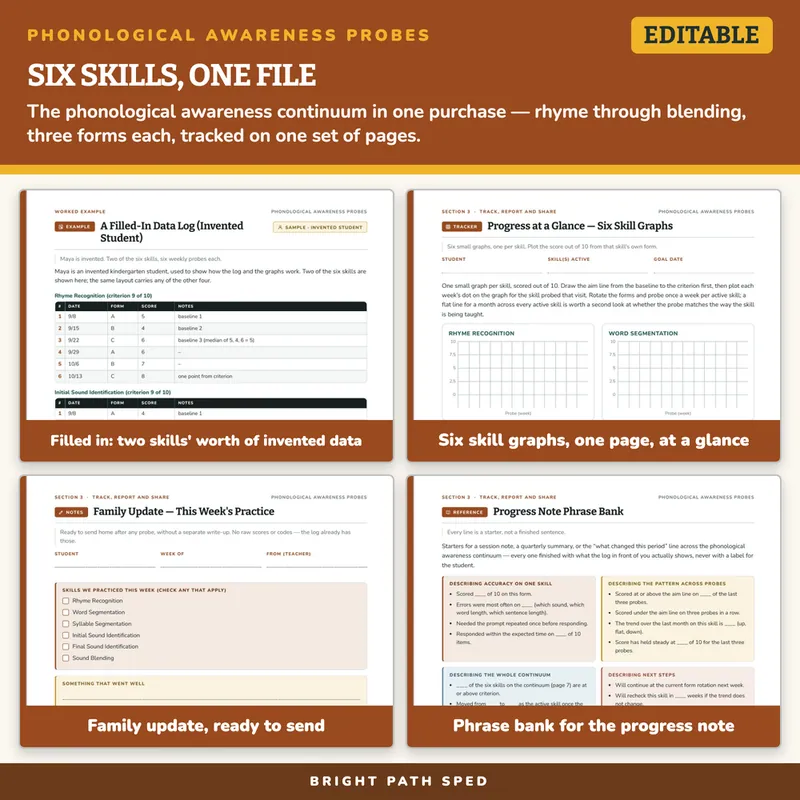
- Six small graphs on one page, one per skill, each scaled 0 to 10 over the probe rotation, so the whole continuum is visible at a glance
- A caseload summary: one row per student-skill pair, baseline, most recent score, trend and a decision column
- A family update, ready to send home: a checklist of which skills were practiced, a line for something that went well, a five-minute home activity, and the week's scores in plain words (no raw numbers or codes)
- A phrase bank of observable-language starters for a session note, a quarterly summary, or a line describing the whole continuum — every starter ends in a blank pulled from the log, never a finished clinical sentence
- A filled-in example: an invented kindergarten student, two of the six skills, six weekly probes on each, the baseline taken as a median, and the progress-report sentence the data produces
What This Is, And What It Is Not
It is a fillable PDF. The goal and tracking page, the weekly log, the caseload summary and the six-graph page are type-in fields: open the file in a PDF reader, click a line or cell, type, and Save As once per student. The eighteen probe forms are meant to be printed; every task on them is oral, so the student never reads or writes on the form itself. It works offline with no account or subscription. It does not calculate percents or draw the graphs for you.
It is not a norm-referenced instrument and not a clinical finding. No page sets an eligibility criterion, states a typical age or rate, or names a condition. Every sample goal is invented in brackets; your team sets the real criteria from the baseline and the student's IEP.
Who This Is For
Early literacy and special education teachers and case managers writing phonological awareness goals across the continuum, kindergarten and first-grade intervention and Title teachers, reading interventionists, and the paraprofessionals who give the weekly probe.
If You Want More Practice On Just One Skill
This file trades depth for breadth: three forms of all six skills instead of six forms of one. Three of these skills also sell as their own single-skill probes with six forms each — First Sound Identification Progress Monitoring Probes, Phoneme Segmentation Probes and Data Sheets Editable, and Rhyme Recognition Progress Monitoring Probes — for a student who needs more practice at just one skill than the three forms here give.