Plant Life Cycle Worksheets
- 37 pages
- 1st, 2nd, 3rd
$2.00 $4.00 on Teachers Pay Teachers
Half the Teachers Pay Teachers price. The same PDF, sold direct.
DownloadOr get it with All-Access: pick any 20 resources a month for $7.
New here? Your first month of All-Access is half off with code TEACHERTOK
Already bought this, or a member?
Instant download. One teacher's license: colleagues need their own copy. Each file carries a license number.
Also on Teachers Pay Teachers: see the Bright Path Sped store
About this resource
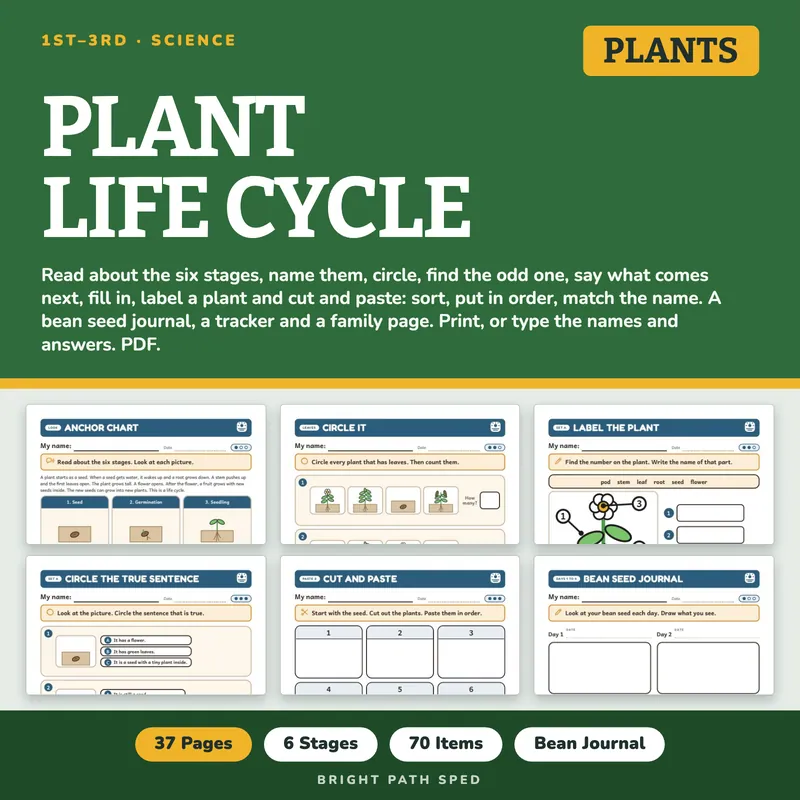
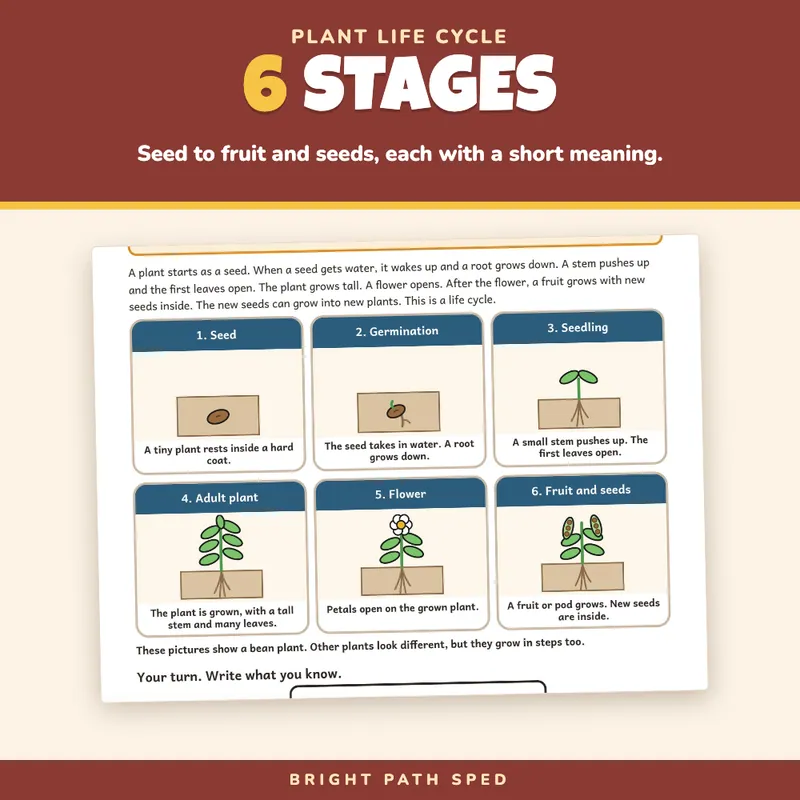
How does a bean seed become a plant with new seeds? This is a complete kit for one idea: the life cycle of a plant. It starts with an anchor chart of six stages, seed, germination, seedling, adult plant, flower, and fruit and seeds, each with a simple picture, a short meaning and a short reading. Children then name the stages, circle every plant with leaves, find the one that does not belong, say what comes next, fill in words, choose the true sentence, label the parts of a plant, read a short story and answer, write a short response and cut and paste. A four-page bean seed journal lets them draw and measure a real seed as it sprouts. It comes with a tracker, a class grid and a family page, so nothing has to be written from scratch.
EVERYTHING INSIDE (37 pages)
- 21 student pages in 13 page types: Anchor Chart, Plant Cycle Mat, Name the Stage, Circle It, Which One Does Not Belong?, What Comes Next?, Fill It In, Circle the True Sentence, Label the Plant, Read and Answer, Short Response, Cut and Paste and Bean Seed Journal
- 70 scored items on 14 pages, every answer read from the plant data, never typed by hand
- The 6 stages: seed, germination, seedling, adult plant, flower, and fruit and seeds
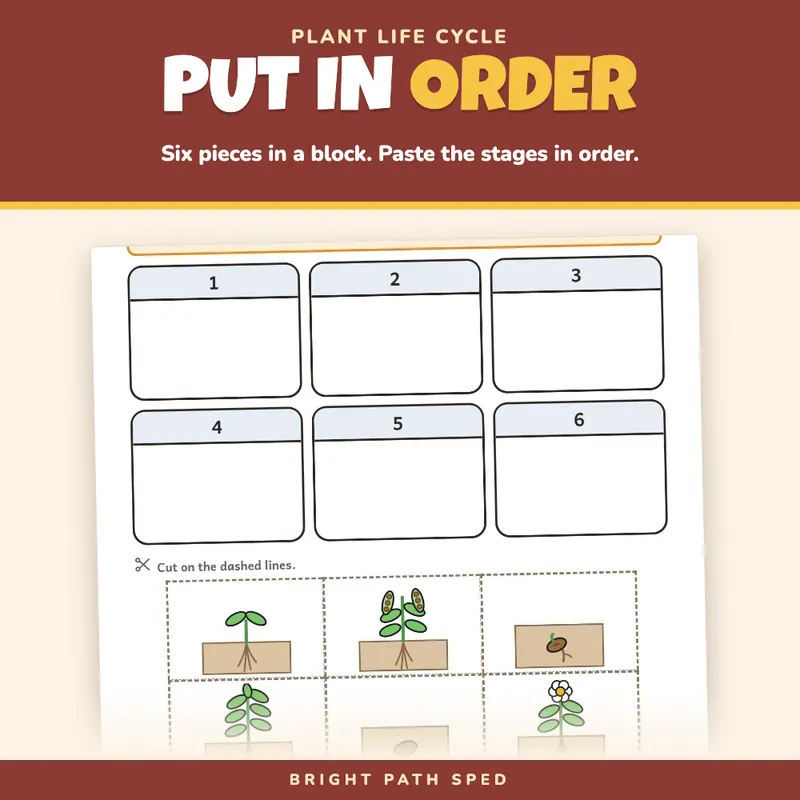
- 18 cut-and-paste pieces on 3 mats: sort 6 plants by leaves, put the 6 stages in order, and paste each name under its plant
- 3 answer keys, generated from the same data as the student pages
- 1 tracker (page, page type, items right, date) and 1 whole-class progress grid
- 1 team note (a hand-off page between team meetings) and 1 home page
- 1 filled example (an invented student), 1 phrase bank (16 observable-language starters), 1 binder cover and 6 divider tabs with a spine label to cut out
- Start Here and a how-to-read-a-page page
The Page Types, Easiest First
1. Anchor Chart (starting): the six stages with a picture and a short meaning each, a short reading, and two lines for the child to finish.
2. Plant Cycle Mat (starting): the six stages numbered 1 to 6 to keep beside the child, a line to finish, and a big box to draw a plant and name its stage.
3. Name the Stage, 2 pages (1 or 3 dots): look at a plant and write the name of its stage. Set A has a box of eight words; Set B has none.
4. Circle It, 2 pages (1 or 2 dots): four rows of four plants. Circle every plant with leaves (or every picture where the plant is all under the soil), then write how many.
5. Which One Does Not Belong?, 1 page (2 dots): four plants, three have leaves. Circle the one with no leaves and write its number.
6. What Comes Next?, 1 page (3 dots): three stages in a row and a question mark. Write the name of the next stage.
7. Fill It In, 2 pages (2 or 3 dots): Set A reads a clue and writes the stage from a box of eight; Set B finishes a sentence from a box of eight words (three are not used).
8. Circle the True Sentence, 1 page (3 dots): a plant picture and three sentences; exactly one is true.
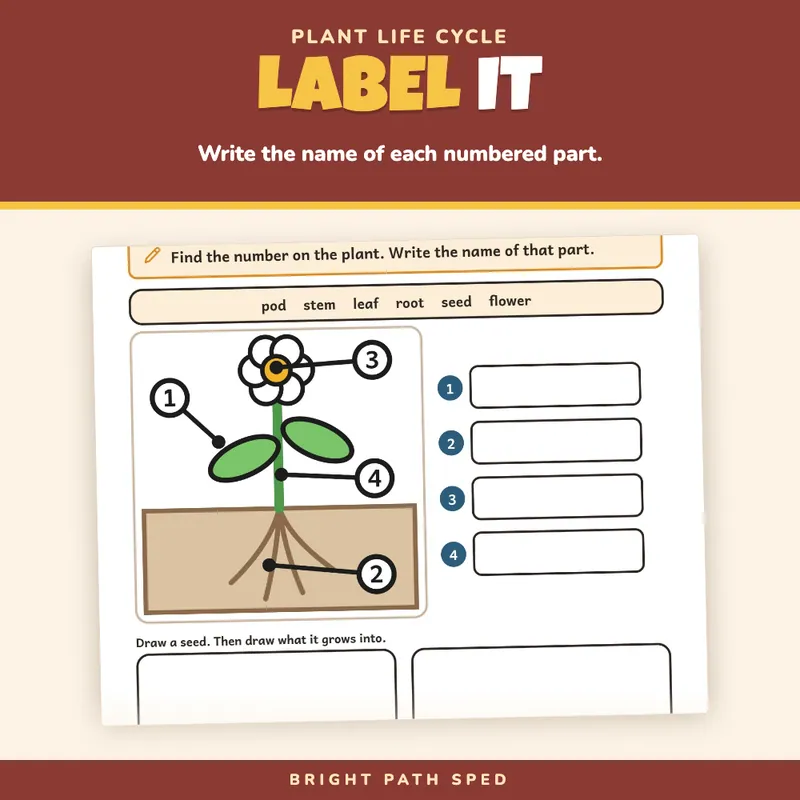
9. Label the Plant, 1 page (2 dots): a plant with four numbers. Write the name of each numbered part from a box of six words.
10. Read and Answer, 1 page (2 dots): a short story about planting a bean and five questions with lettered choices.
11. Short Response, 1 page (3 dots): three written answers and one drawing with a fact.
12. Cut and Paste, 3 pages (1, 2 or 3 dots): a block of 6 pieces that touch edge to edge, so cutting is a few straight lines. Paste 1 sorts plants into no leaves and has leaves; Paste 2 puts the six stages in order; Paste 3 pastes each name under its plant.
13. Bean Seed Journal, 4 pages: set up a bean seed in a bag with a grown-up, draw and measure for eight days, then look back and finish the sentences.
Drawn For The Page
Every plant is a simple vector drawing of a bean plant with a dark outline: a seed under the soil, a seed with a root and a tiny shoot, a short stem with two leaves, a tall plant with many leaves, the same plant with a flower, and the plant with pods and no flower. What each picture shows is written down once, and every circle, odd-one-out and true-sentence page is checked against that table, so a page never disagrees with its own picture. No clip art or photographs.
Built For The Child Holding The Page
A big "My name" line, one short instruction, large rounded type, big answer boxes, and dots (not words or colors) to show which level a page is. Nothing on a student page is written for an adult. The drawing boxes are about two inches tall so there is room to work. The file prints clean in black and white.
No Guessing The Answer
Wherever a child picks among printed spots (which plants in a row match, which one is the odd plant, which lettered sentence is true, which lettered answer is right, where a word sits in the box, the order of the pieces on the cut strip), the position of the right answer is checked so it does not sit in the same spot three times in a row. Every word box has extra words that are never an answer, so a child has to read and think, not just cross words off.
Type In, Or Print
The name line and the answer boxes are type-in fields in any PDF reader: click one, type, then save. The same goes for the tracker, the class grid, the team note and the home page. This is a fillable PDF; it is not a Google Slides or PowerPoint file.
Who This Is For
Elementary classrooms, self-contained and resource rooms, and any teacher building a plant unit into a center, a small group or a morning work folder. The reading is written at about a grade 1-2 level, and the teacher can read each page aloud.
What This Is, And What It Is Not
A plant life cycle worksheet set with the record-keeping around it. It is not a timed test, a screener, a clinical tool, or a claim about any student's age or rate of progress. There is no IEP goal language or eligibility wording anywhere in the file.