Preschool Language Screener
- 33 pages
- PreK, Kindergarten
$2.25 $4.50 on Teachers Pay Teachers
Half the Teachers Pay Teachers price. The same PDF, sold direct.
DownloadOr get it with All-Access: pick any 20 resources a month for $7.
New here? Your first month of All-Access is half off with code TEACHERTOK
Already bought this, or a member?
Instant download. One teacher's license: colleagues need their own copy. Each file carries a license number.
Also on Teachers Pay Teachers: see the Bright Path Sped store
About this resource
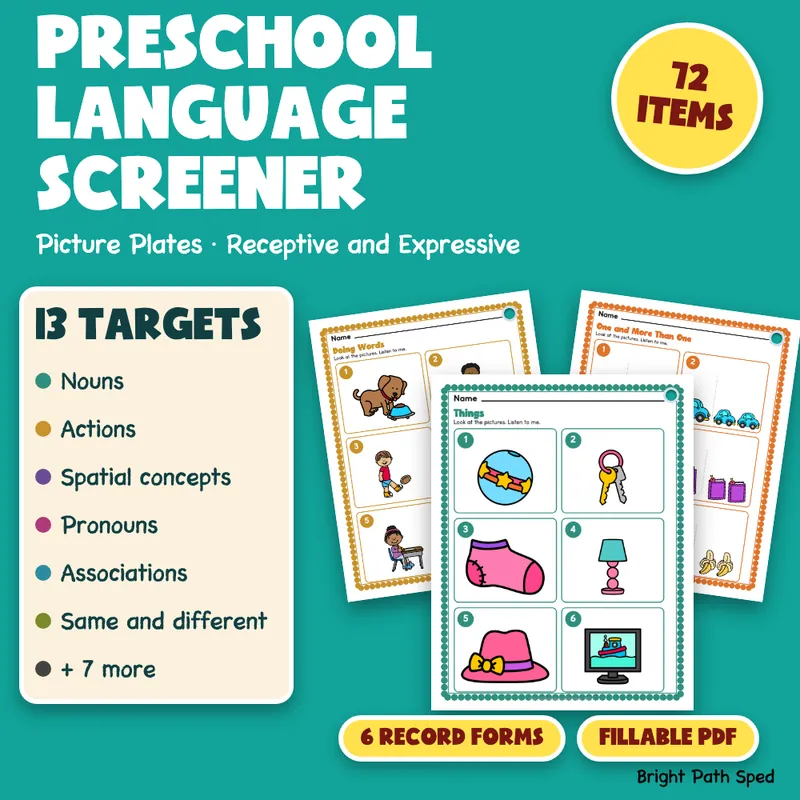
A picture-plate preschool language screener you can print today: 12 plates, one for each target, each with 6 big numbered pictures, plus a language sample page. That is 13 targets and 72 items. Every picture is an item with a receptive line (you say it, the child points) and an expressive line (you ask, the child says it). A 6-page record form has a Point box, a Say box and a notes box for all 72 items. This is a screening record: it writes down what happened, and you decide what it means.
The 13 Targets
Nouns, actions, object functions, categories, spatial concepts, adjectives, plurals, WH questions, pronouns, associations, same and different (similarities and differences), quantity, and a language sample.
EVERYTHING INSIDE (33 pages)
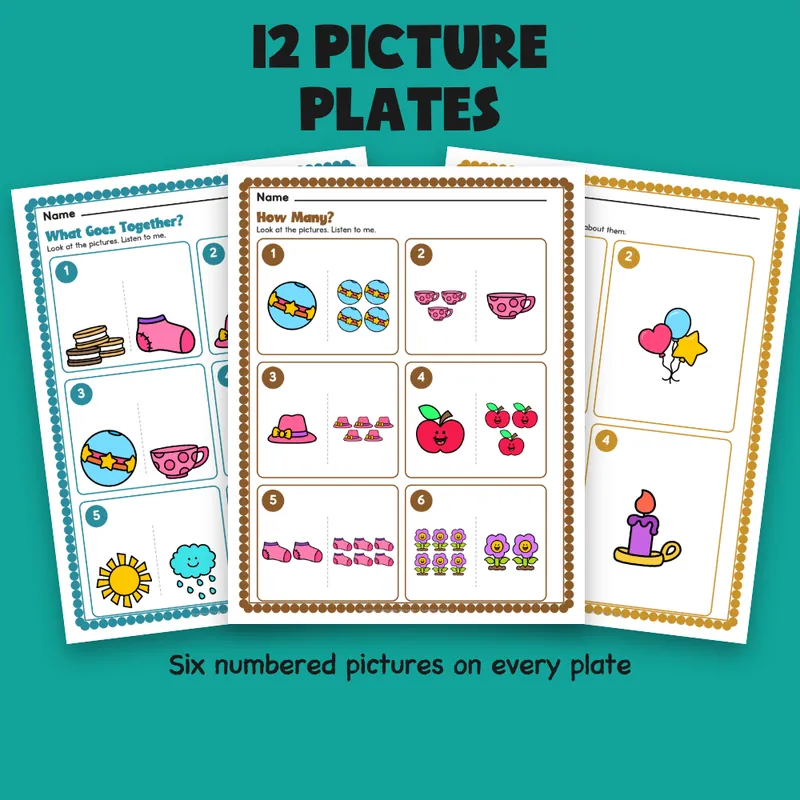
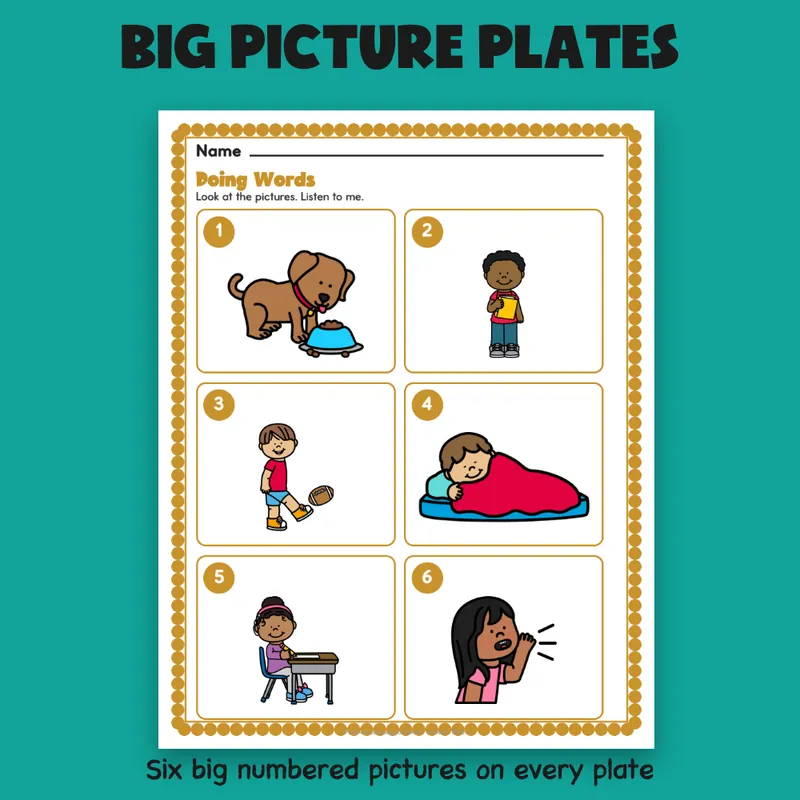
- 12 picture plates, one page each, 6 numbered pictures to a plate.
- Pronoun plate: he, she, they, him and her, with a boy, a girl, two kids, a queen and a king. Association plate: milk and cookies, key and lock, bat and ball and more. Same and different plate: pick the two that are the same, pick the one that is different. Quantity plate: more, fewer, many, one, a lot, a few.
- Spatial plate built from one ball, one box and one table moved around (in, on, under, next to, behind, in front of). Adjective plate of 6 opposite pairs. Plural plate of 6 one-and-two pairs.
- A party picture for free talk and a blank plate for your own pictures.
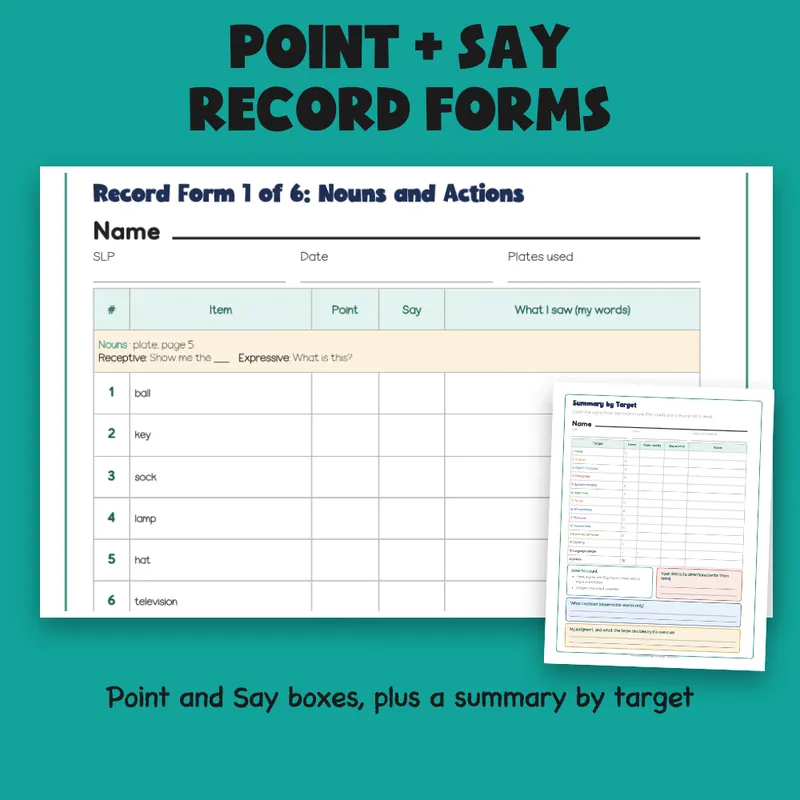
- A 6-page record form, two targets a page, 12 items a page: 72 rows, each with a Point box, a Say box and a notes box. The receptive and expressive lines are printed above each target.
- A language sample page: 12 rows for what the child said, word for word, and a place for your own counts.
- A summary by target with a row for each of the 13 targets and a total row, and blank lines for your district's own directions and your own judgment.
- A page of plain words for the notes column, with a table for your own.
- A filled-in form from an invented child: 12 items (nouns and actions) with the counts worked out from the table.
- A family note and team handoff page, a caseload page for 18 children with a column for each of the 13 targets, and a binder cover with 6 divider tabs.
- Start Here, a plates-at-a-glance page, terms of use, a What's Next page and a credits page.
How To Use It
Print the plates and slip them into sheet protectors. Show one plate. Say the receptive line and the child points; mark the Point box. Then point to one picture and ask the expressive line; mark the Say box. Use all 12 plates or only the targets you need. Copy the marks to the summary. Type into the boxes in any PDF reader, or print the pages and write by hand. Print at 100 percent with fit-to-page turned off.
Built For The Child Looking At The Plate
A big picture and a big number, one plate at a time, with one short line: "Look at the pictures. Listen to me." No clinical words on the page the child sees.
Type In, Or Print
This is a fillable PDF. It is not a Google Slides, Google Docs or PowerPoint file. The boxes work in Adobe Acrobat Reader, Preview and browser PDF viewers, offline.
Who This Is For
Speech-language pathologists in schools and clinics, and special education teams who work with an SLP. Preschool and kindergarten pictures. Looking for a type-in record form with no pictures? The store's Language Screener Editable is that one; this file is the picture plates.
What This Is, And What It Is Not
An informal screening record with picture plates. It is not a standardized test. It has no age norms, no scores to compare against, no cut scores, no milestones and no eligibility rules, and it does not label any child. It does not replace an evaluation by a licensed speech-language pathologist. Your own training, your district's directions and your team's rule decide what the record means; there are blank lines for them.