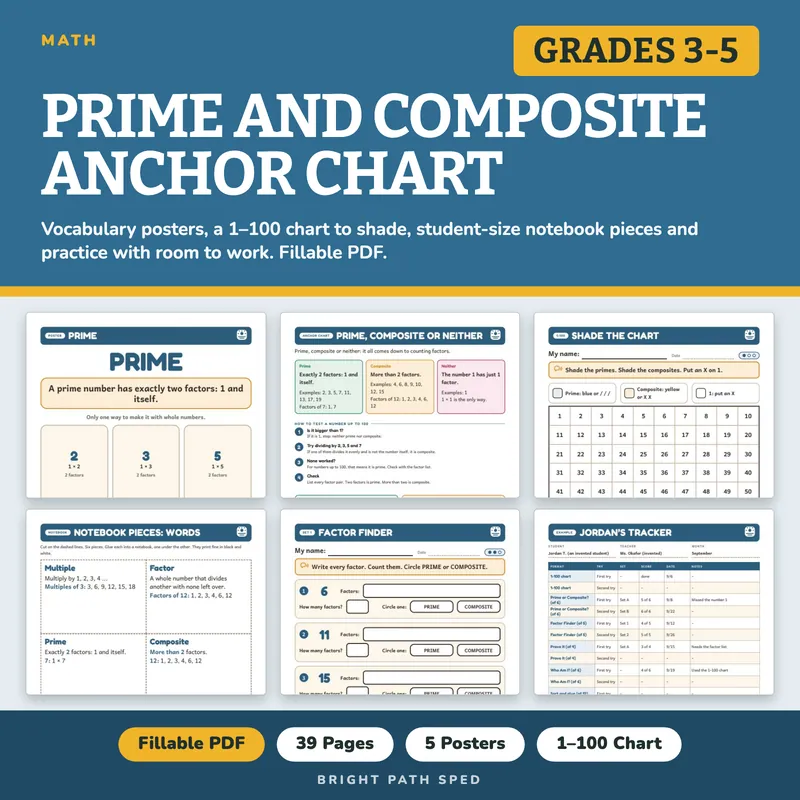
Prime and Composite Anchor Chart
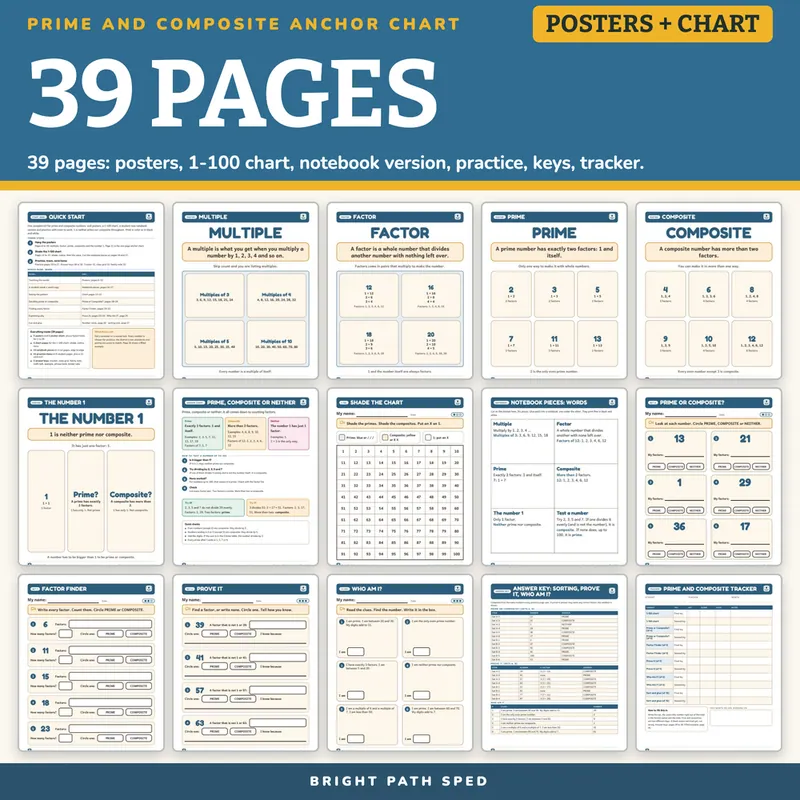
- 39 pages
- 3rd, 4th, 5th
$2.00 $4.00 on Teachers Pay Teachers
Half the Teachers Pay Teachers price. The same PDF, sold direct.
DownloadOr get it with All-Access: pick any 20 resources a month for $7.
New here? Your first month of All-Access is half off with code TEACHERTOK
Already bought this, or a member?
Instant download. One teacher's license: colleagues need their own copy. Each file carries a license number.
Also on Teachers Pay Teachers: see the Bright Path Sped store
About this resource
Teach prime and composite numbers with the whole kit: wall posters for the vocabulary, a 1-100 chart to shade, student-size pieces for a math notebook, and practice pages where a child has room to work. The number 1 is called neither prime nor composite everywhere, with the reason (it has only one factor).
EVERYTHING INSIDE (39 pages)
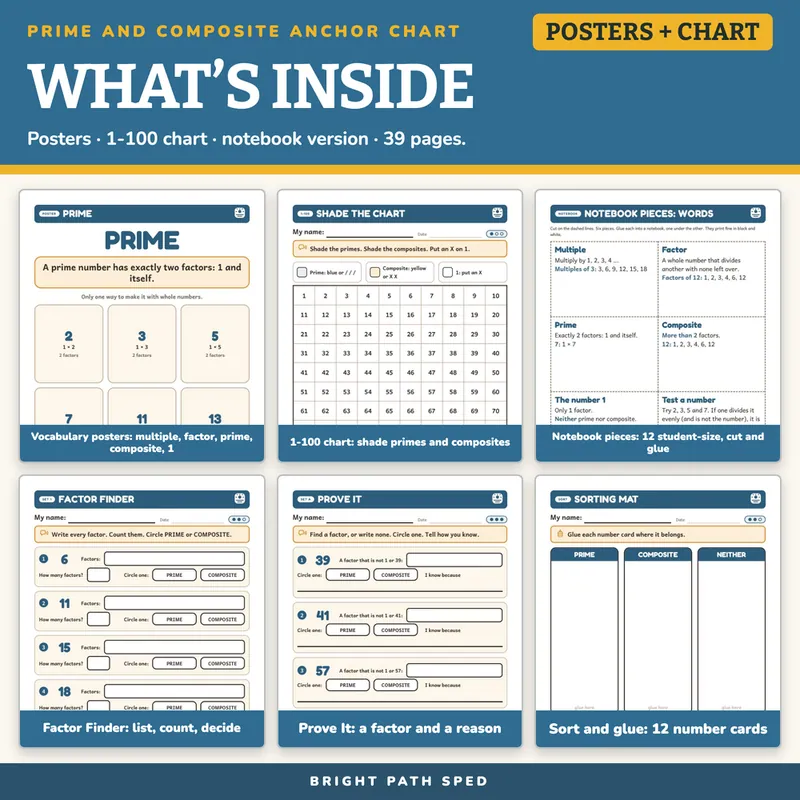
- 5 vocabulary posters: Multiple, Factor, Prime, Composite, and The Number 1, each with examples worked from the factors
- 1 one-page anchor chart: prime, composite, neither, a four-step way to test a number up to 100, two worked tries (29 and 51) and quick checks
- 1 factor table for the numbers 1 to 30: every factor, how many, and the kind
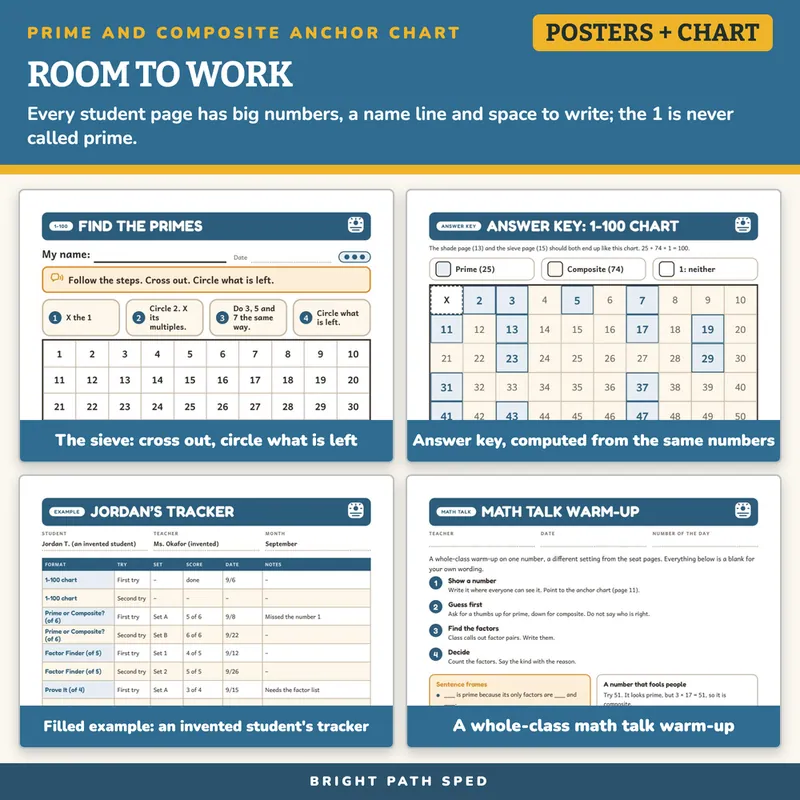
- 3 chart pages: shade the 1-100 chart (primes, composites, an X on 1), a "What do you notice?" response page, and the sieve (cross out multiples of 2, 3, 5 and 7, circle what is left)
- 2 notebook pages with 12 student-size pieces to cut and glue, edge to edge, printable in black and white
- 13 student pages in all, with 53 practice items: Prime or Composite? (2 sets, 12 numbers), Factor Finder (3 sets, 15 numbers), Prove It (2 sets, 8 numbers), Who Am I? (6 clue cards), and Sort and Glue (12 number cards and a 3-column mat)
- 3 answer keys, computed from the same numbers as the pages, including a shaded 1-100 key
- 1 tracker (by format, first and second try), 1 class grid, 1 family note, 1 whole-class math talk warm-up
- 1 filled example (an invented student), 1 phrase bank (12 starters), 1 binder cover and 6 divider tabs with a spine label
- Start Here, how to read a page, and a contents page with every page number
The Practice, Easiest To Hardest
1. Prime or Composite? (one dot): circle PRIME, COMPOSITE or NEITHER for six numbers a page.
2. Factor Finder (two dots): write every factor, count them, decide.
3. Prove It and Who Am I? (three dots): find a factor and explain, or use clues to find one number.
4. Sort and Glue (two dots): cut 12 number cards and glue them on a three-column mat.
Built For The Student Holding The Page
A big "My name" line, one short instruction, large rounded numbers, and real room to write on every page. The student pages carry no adult directions and no scores. Pieces to cut touch edge to edge, so there are few cuts.
Color Or Black And White
Posters and keys look good in color and print clean in black and white. On the chart, students can shade with two colors or two patterns, so crayons are not required.
Every Student Is Invented
The filled example names an invented student and says so on the page. There is no IEP goal language, no eligibility wording and no claim about a real child. The kit is practice, not a screener, and it does not claim to match any particular set of standards.
Type In, Or Print
The name and date lines, the tracker, the class grid, the family note and the math talk page take typing in any PDF reader. Students write in pencil. This is a fillable PDF; it is not a Google Slides, Docs or PowerPoint file.