Prime and Composite Numbers Anchor Chart
- 28 pages
- 4th, 5th
$2.00 $4.00 on Teachers Pay Teachers
Half the Teachers Pay Teachers price. The same PDF, sold direct.
DownloadOr get it with All-Access: pick any 20 resources a month for $7.
New here? Your first month of All-Access is half off with code TEACHERTOK
Already bought this, or a member?
Instant download. One teacher's license: colleagues need their own copy. Each file carries a license number.
Also on Teachers Pay Teachers: see the Bright Path Sped store
About this resource
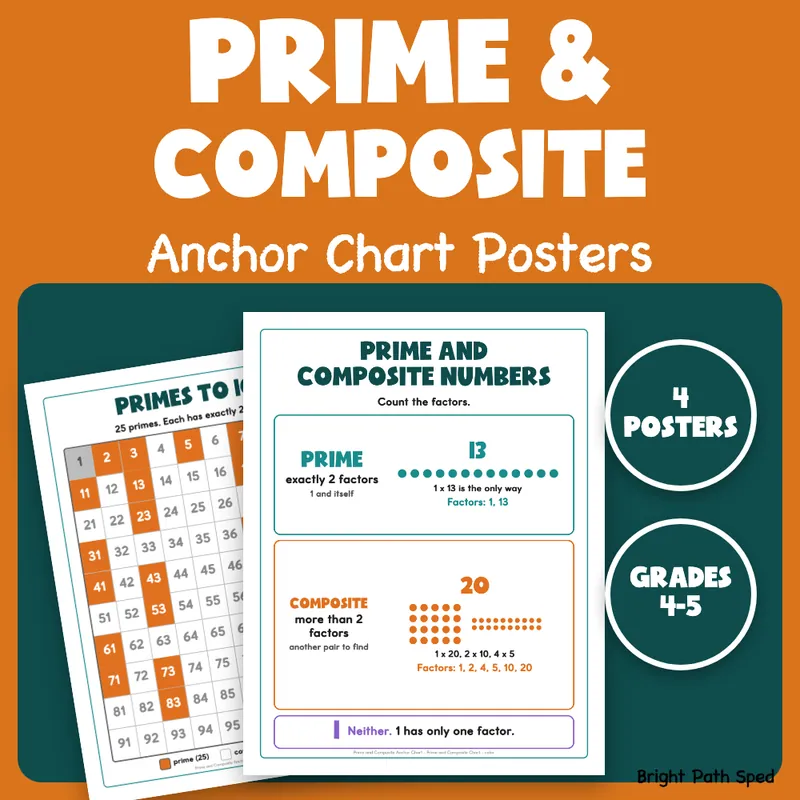
A prime number has exactly two factors. A composite number has more than two. Children need to see why 13 and 20 are different before the words stick. This Prime and Composite Numbers Anchor Chart set gives you a definition poster, factor T-charts for 13 and 20, a primes-to-100 chart and a how-to-check poster for the wall, then notebook-size charts to cut, student notes, a cut-and-sort and practice pages children can work on by themselves. It is a 28-page fillable PDF for grades 4 and 5.
WHAT IS INCLUDED (28 pages)
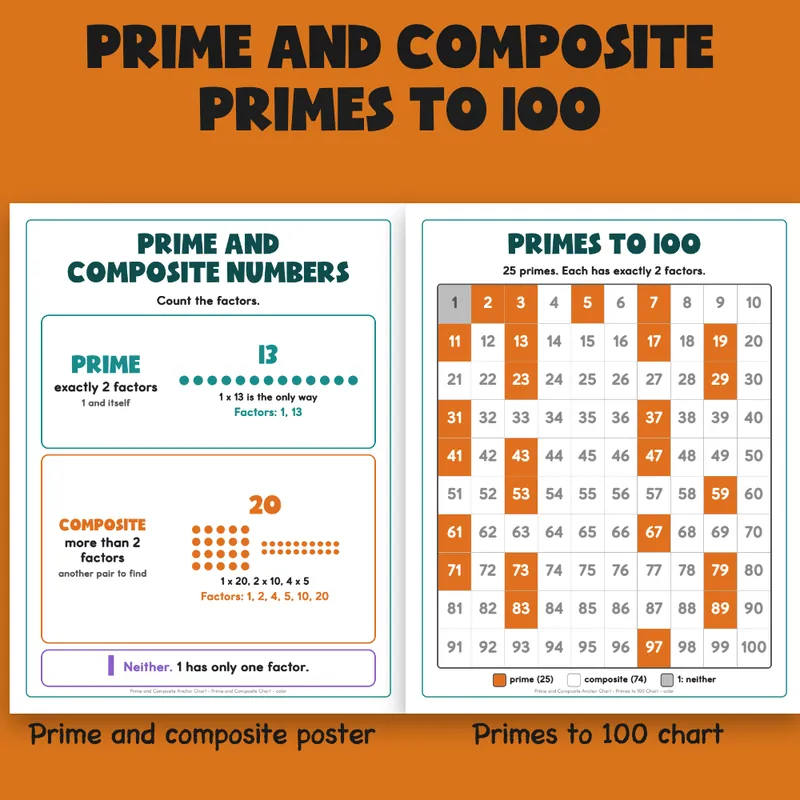
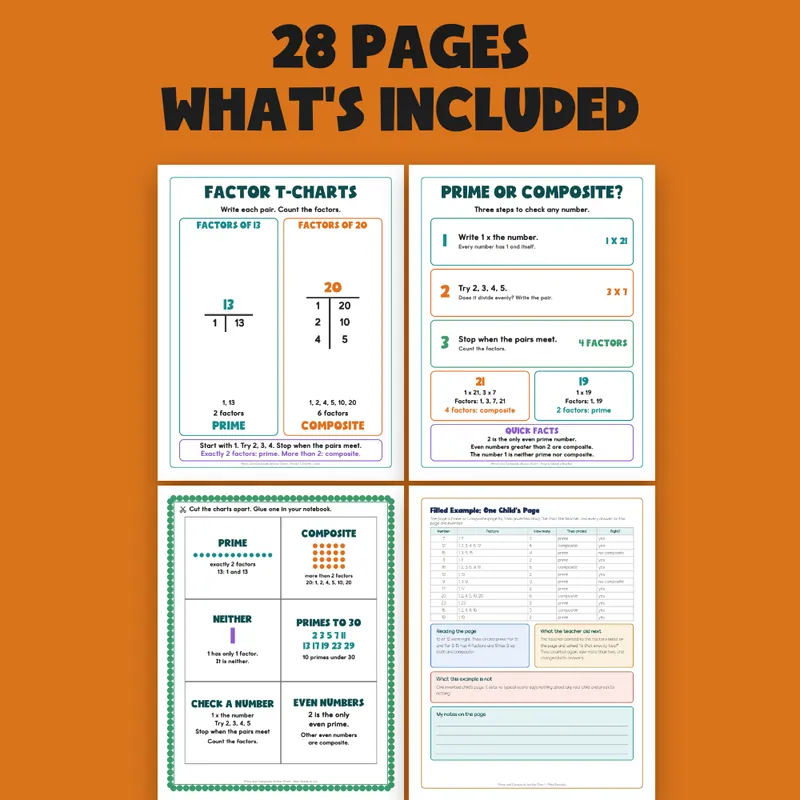
- 4 posters on 7 sheets for the wall: Prime and Composite (13 shown as one array and the factors 1 and 13, 20 shown as arrays and the factors 1, 2, 4, 5, 10 and 20, and the number 1 as neither), Factor T-Charts (13 beside 20), Primes to 100 (all 25 primes marked on a 1-100 chart) and Prime or Composite? (three steps to check any number, with 21 and 19 worked out). The first three posters each come with an ink-saver copy, which is why 4 posters take 7 sheets.
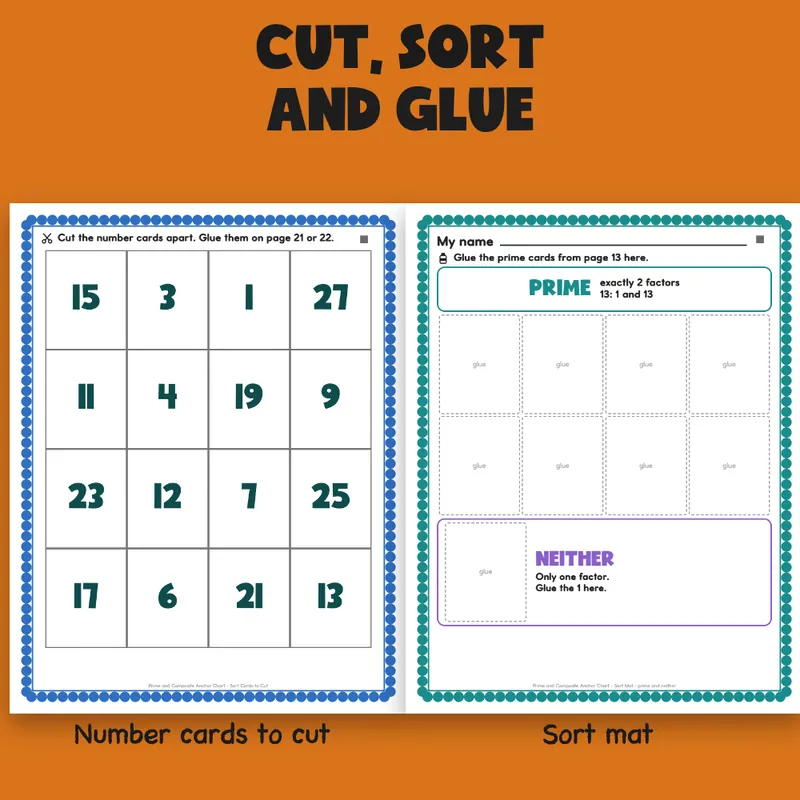
- 22 pieces to cut on 2 cut sheets, set edge to edge so every cut is one straight line: 6 notebook-size mini charts (prime, composite, neither, primes to 30, check a number, even numbers) and 16 sort cards (7 prime, 8 composite and the number 1).
- 9 student pages, each with a big "My name" line, one short direction with a picture and room to work: My Notes (fill-in notes and two T-charts), Color the Primes (a blank 1-100 chart), Prime or Composite (12 numbers with the factors shown), Factor T-Charts (4 numbers), Arrays and Factors (6 numbers shown as arrays), Number Riddles (6 clues, each with exactly one answer from 1 to 100), Prove It (pick a number and explain it) and 2 Sort Mats to glue the cards on.
- Three steps on the practice pages, marked with small shapes, not numbers: factors shown, write the T-chart, and riddles and proofs.
- Teacher pages: Start Here with a which-page-when table, how to teach it in 5 short routines, a filled example (an invented child; every answer invented), 2 answer keys, a note home, a phrase bank of 20 starters in 5 groups, and a What's Next page.
- Terms of use and a thank-you page.
How To Use It
Hang the Prime and Composite poster and compare 13 and 20 on the T-chart poster: 13 has 2 factors, 20 has 6. Color the primes on the blank chart and check it against the poster. Use the how-to-check poster to test any number: write 1 x the number, try 2, 3, 4 and stop when the pairs meet. Hand out the notebook charts for children to glue in, then the sort cards and mats, then the practice pages. Answers are on 2 key pages.
Built For The Child Holding The Page
Every student page has a big "My name" line, one short direction with a picture, and room to circle, write, color or glue. Numbers, arrays and charts are big and plain, drawn flat and clear. The cutting sheets put the pieces edge to edge, and every cut sheet has at least 5 pieces. Every page reads in black and white too, and the first three posters come with an ink-saver copy.
Type In, Or Print
The name lines, the answer blanks on the practice pages, the note home and every notes area are type-in fields in any PDF reader. The posters and the cut pages are print pages. You can also print any page and write by hand. Print at 100 percent with fit-to-page turned off. This is a fillable PDF for printing and typing; it is not a slide or word processor file.
Who This Is For
Teachers of grades 4 and 5, resource rooms and self-contained classrooms who want a prime and composite numbers anchor chart for the wall and practice that children can see, count and check for themselves.
What This Is, And What It Is Not
Classroom posters and working paper for factors, prime numbers and composite numbers. It is not a full math curriculum, an assessment or a therapy program, and it makes no health claims. Your school decides what a child should be able to do and when.
More For Your Math Block
Pair it with Array City, Break Apart Multiplication and Multiplication Chart 1-12 from Bright Path Sped.