Reinforcement Survey Editable
- 16 pages
- Not Grade Specific
- PDF, fillable
$3.00
DownloadOr get it with All-Access: pick any 20 resources a month for $7.
New here? Your first month of All-Access is half off with code TEACHERTOK
Already bought this, or a member?
Instant download. One teacher's license: colleagues need their own copy. Each file carries a license number.
Also on Teachers Pay Teachers: see the Bright Path Sped store
About this resource
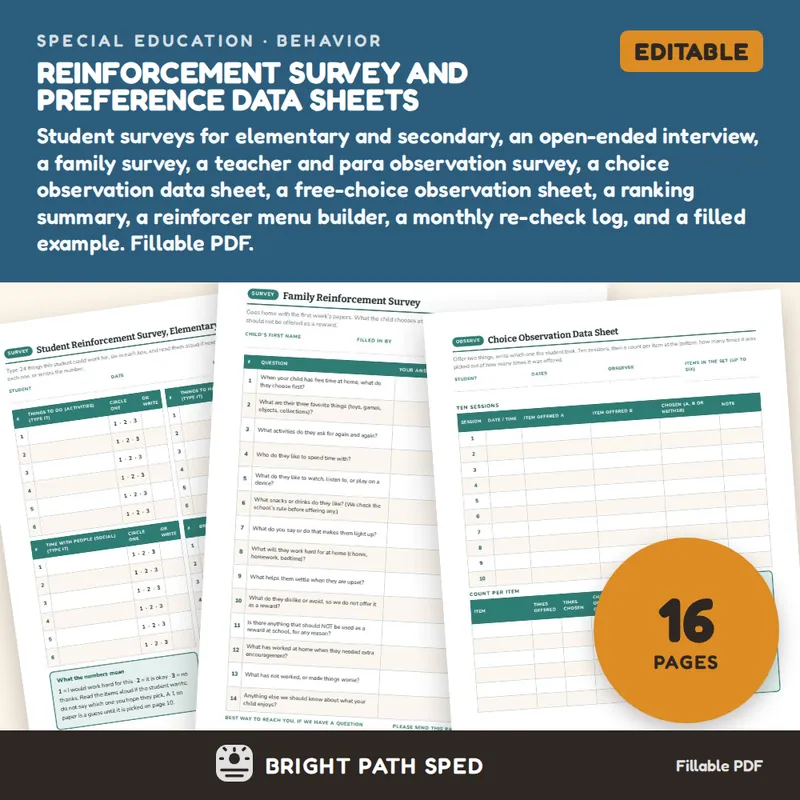
Find out what a student will actually work for, write it down, and re-check it every month. One fillable PDF: two student reinforcement surveys (elementary and secondary), an open-ended student interview, a family survey, a teacher and para observation survey, a choice observation data sheet, a free-choice observation sheet, a preference ranking summary that puts all four sources side by side, a reinforcer menu builder with what earns each reward and what it costs, a monthly re-check log, and a filled-in example whose every count can be re-counted from its own rows. Type the survey items and the menu once, Save As per student, circle and count with a pen.
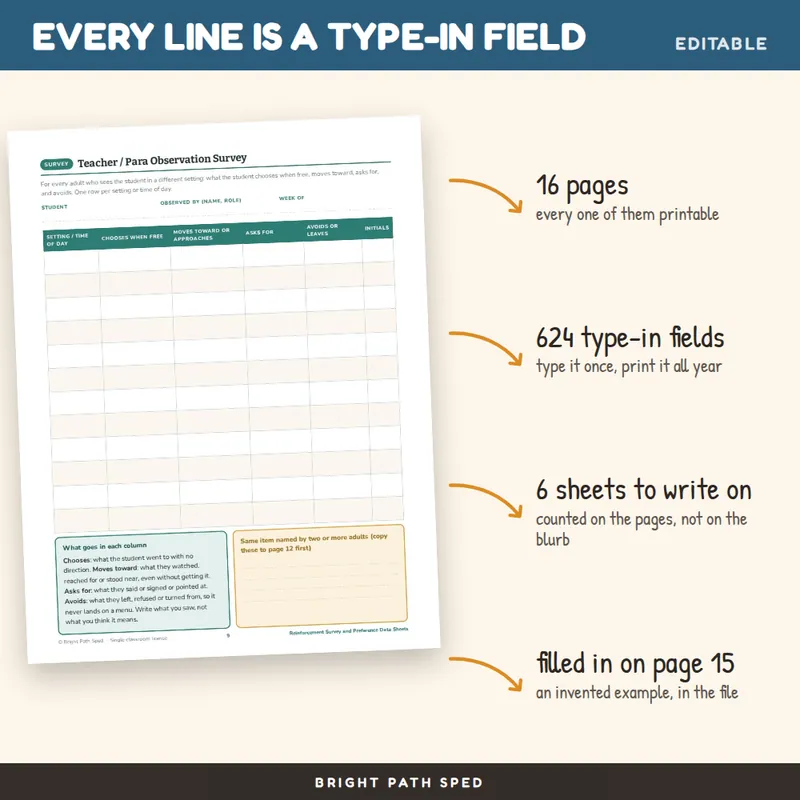
WHAT IS INCLUDED - 16 pages, 624 type-in fields
Setup
- How to Find Out What a Student Will Work For - a chooser that matches the student (can answer questions, reads few words, does not answer or picks something else, new to the building, the family knows more, stops wanting the same thing, the team needs one list) to the page, the one rule that preferences change, what the file is not, and how the paper moves in the first week, the second week and monthly
- How the Type-In Fields Work - one page, so nobody emails you
ASK
- Student Reinforcement Survey, Elementary - 24 items the teacher types, six each under things to do, things to have, time with people, and breaks; the student circles 1, 2 or 3 or writes the number; a key and a top-three box
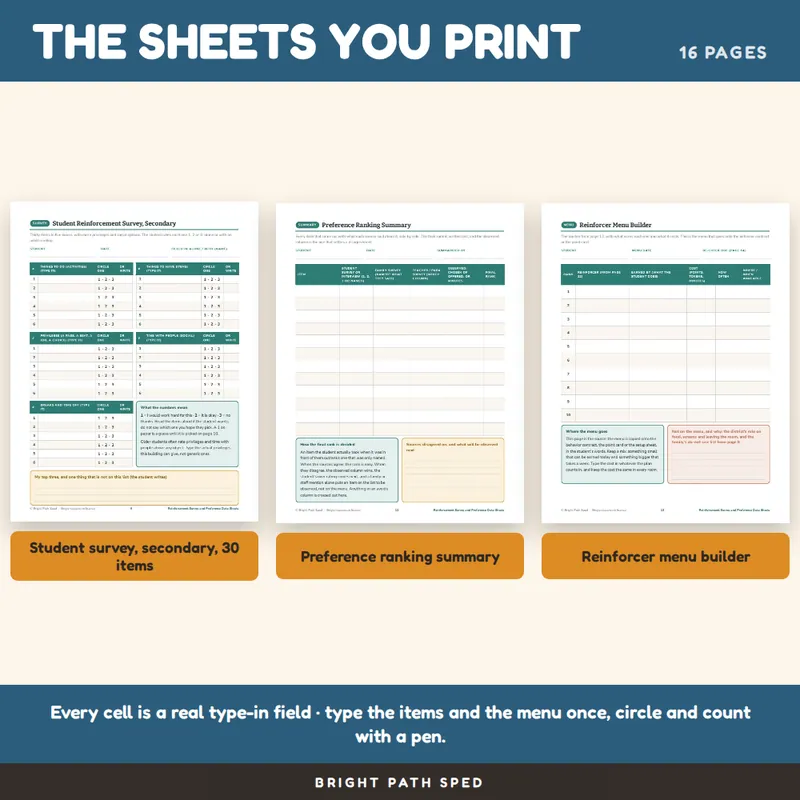
- Student Reinforcement Survey, Secondary - 30 items in five boxes (activities, items, privileges, social, breaks and time off), the same 1, 2, 3 rating, a top-three box with a line for something not on the list
- Open-Ended Student Interview - 12 printed questions (what do you like to do at school, at home, who do you like to work with, what is boring, what would make a hard day better) with a column for the student's words
- Family Reinforcement Survey - 14 printed questions (what the child chooses first at home, favorite things, what they ask for, what motivates them, what should not be used as a reward) with an answer column, a contact line and a return-by date
- Teacher / Para Observation Survey - 12 rows by setting or time of day: chooses when free, moves toward, asks for, avoids or leaves, initials; a card defining each column
Watch
- Choice Observation Data Sheet - 10 sessions: item offered A, item offered B, chosen, note; then a count-per-item table (6 rows: times offered, times chosen, chosen of offered) and a how-to-count card; no procedure beyond offer two and record the choice
- Free-Choice Observation Sheet - 12 rows: date, time, options available, what the student went to, how long engaged, note; minutes added per item
Rank And Use
- Preference Ranking Summary - 12 items by four source columns (student survey or interview, family survey, teacher / para survey, observed) and a final rank; the rule for settling a disagreement written on the page
- Reinforcer Menu Builder - the top ten with earned by, cost (points, tokens, minutes), how often, and where or when available; a note on where the menu goes (the behavior contract or the point card) and a box for the district's rule on food, screens and leaving the room
- Monthly Re-Check Log - 12 rows: student, month, top three on the menu now, still works, new this month, dropped this month, next re-check
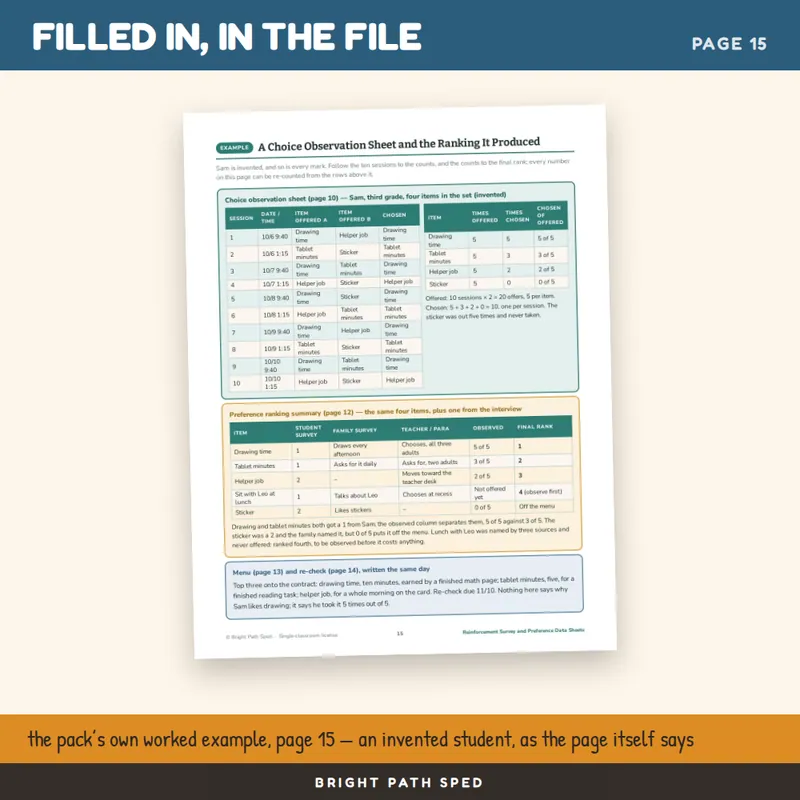
- A filled-in example for an invented third grader: a choice observation sheet with ten sessions and four items, the count per item, the ranking summary those counts produced, and the menu written from it
What This Is, And What It Is Not
It is a fillable PDF. Open it in a PDF reader, click a line, a box or a cell, type, press Tab to move on, and Save As once per student. It works offline with no account or subscription. It is NOT a Google Sheets file, a Google Doc or an Excel workbook, and it does not count the choices for you.
It is not a lesson on why rewards work and not a named assessment procedure. It does not say why a student likes a thing; it records what the student circled, what the family wrote, what the student took when two things were on the table, and how long they stayed with it. Whether food, screens or leaving the room may be offered as a reward is your district's rule, and there is a line to write it on.
Who This Is For
Special education teachers and case managers writing a behavior contract or a point card, the paraprofessionals and behavior staff who run the observations, counselors and school psychologists who want the same sheet used the same way in every room, and general education teachers whose reward system stopped working in October.