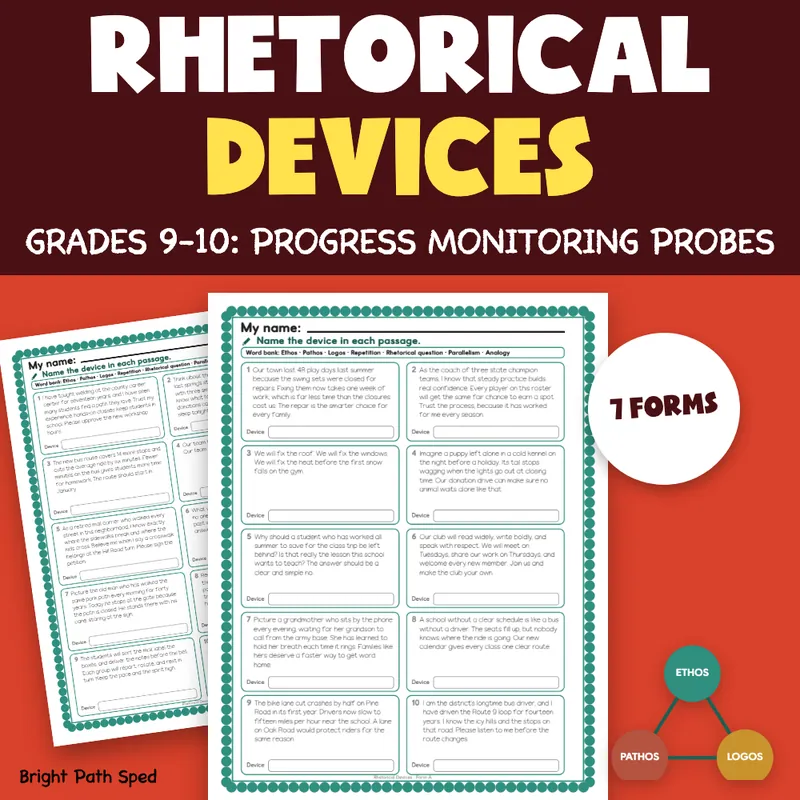
Rhetorical Devices Progress Monitoring Probes
- 26 pages
- 9th, 10th
$2.50 $5.00 on Teachers Pay Teachers
Half the Teachers Pay Teachers price. The same PDF, sold direct.
DownloadOr get it with All-Access: pick any 20 resources a month for $7.
New here? Your first month of All-Access is half off with code TEACHERTOK
Already bought this, or a member?
Instant download. One teacher's license: colleagues need their own copy. Each file carries a license number.
Also on Teachers Pay Teachers: see the Bright Path Sped store
About this resource
Can your ninth or tenth grader name the rhetorical device an author chose? This is a weekly probe for that one skill: ethos, pathos, logos, repetition, rhetorical question, parallelism and analogy, each one named in a short invented passage. Write the goal, take a baseline, give one probe a week, and graph the score.
WHAT IS INCLUDED - 26 pages, seven probe forms with 70 passages in all, 462 type-in fields, a three-page answer key, a goal page, a data log and graph, a caseload summary, a filled-in example, a family update and team handoff page, a page for the general education ELA teacher, a progress note phrase bank, a binder cover and ten divider tabs
The Probe Forms (Pages 9-15)
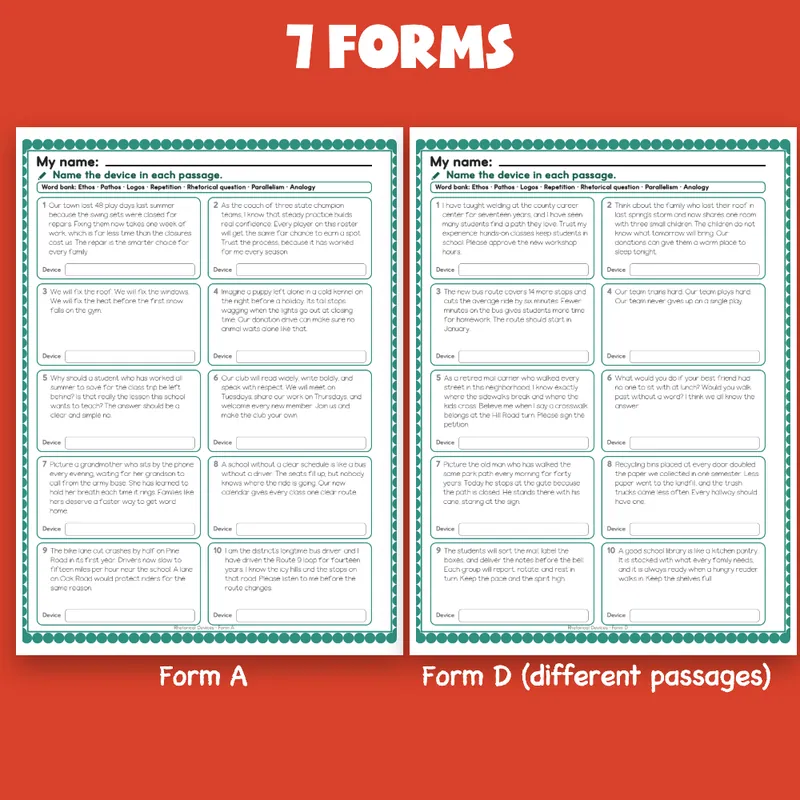
- Six untimed forms, A to F, with ten passages each: 60 passages, each three sentences, all original and invented
- A one-minute quick form of ten more passages, a separate measure with its own log
- No passage repeats across the seven forms, and every form has the same mix of devices: two ethos, two pathos, two logos, and one each of repetition, rhetorical question, parallelism and analogy
- A word bank of the seven device names at the top of every student form, a My name line, and one short instruction with a pencil picture
- A practice page (page 7) with three shapes, one per level, so a student can start where the skill is
The Teacher Pages
- Start Here (page 3): the three steps, and a table that says which page to use for each job
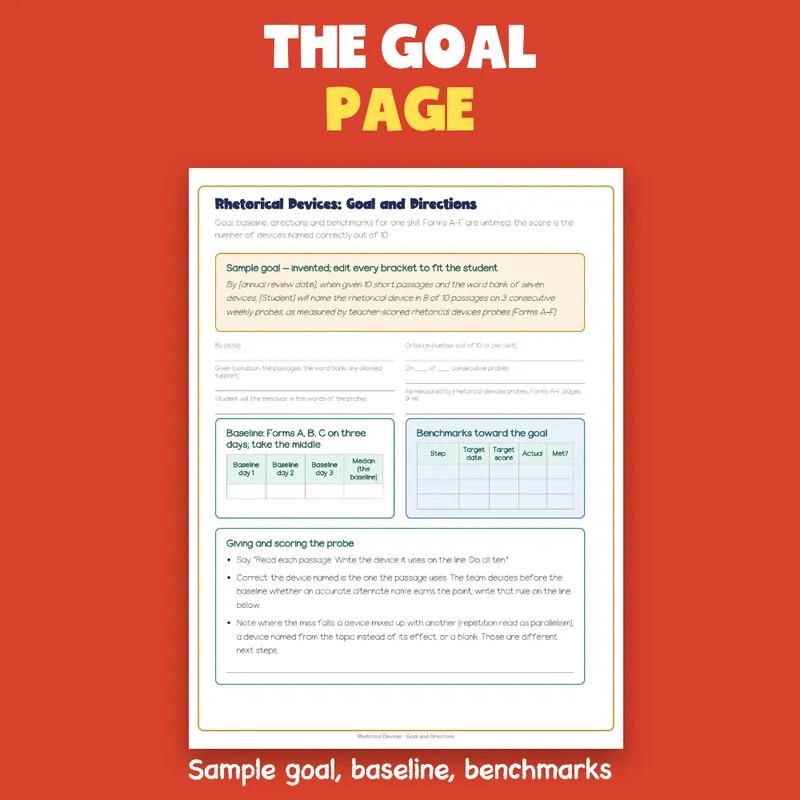
- A goal page (page 6) with a sample goal you edit, a baseline table, benchmark rows and the directions for scoring
- Teach the Seven Devices (page 8): what each device does, the words that show it, and the pair students mix up most, repetition and parallelism
- Three answer key pages (pages 16 to 18): the device for every passage, with a mark box for each item and a Correct ___ / 10 box under each form
- Reading the Misses (page 19): what a wrong answer can show and where to look next
The Roll-Up And The Communication Pages
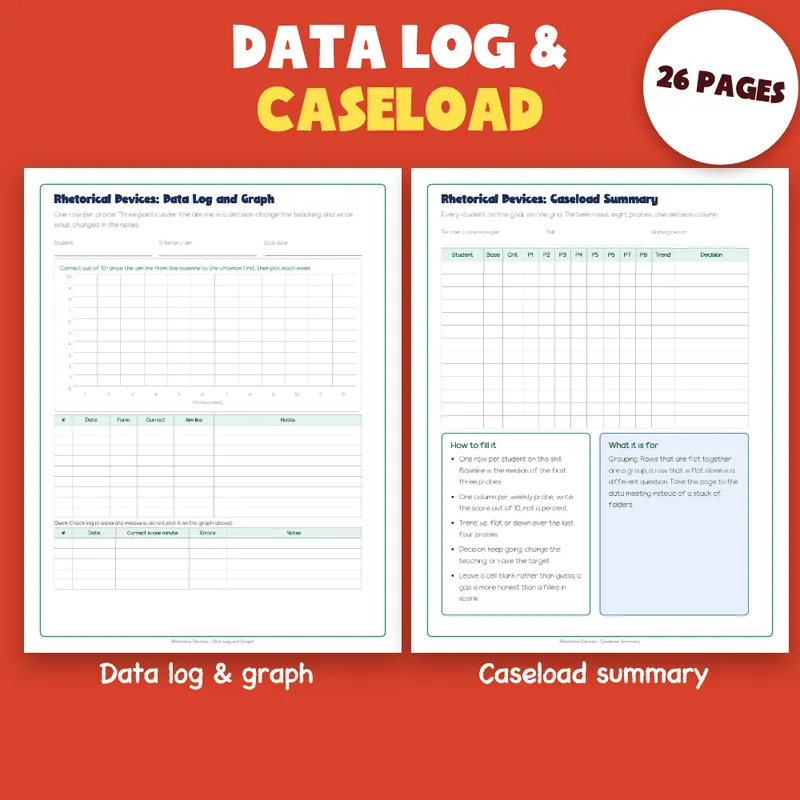
- A data log and graph (page 20): a y-axis scaled 0 to 10, twelve probe columns, the aim line, a log with a row for each probe, and a one-minute log
- A caseload summary (page 21): thirteen student rows, a baseline and criterion column, eight probe columns, a trend column and a decision column
- A filled-in data log for an invented student (page 22): three baseline days, ten weekly probes, the aim line, the change three points under it forced, and the progress-report sentence the log produces
- A family update and team handoff page (page 23) with blanks for your own wording
- A card for the general education ELA teacher (page 24), so the class knows what the student is working on without using the probe passages as class work
- A progress note phrase bank (page 25): starters in observable words, every blank filled from the log
The Binder
- A binder cover and spine label (page 4) with student, case manager, school year, goal and review date fields, and team contact fields
- Ten divider tabs (page 5), print, cut and label: start here, goal and practice, probe forms, quick check, answer keys, reading the misses, data log and caseload, filled-in example, family and team, and ELA teacher and progress notes
What This Is, And What It Is Not
It is a fillable PDF of probes, a key, a graph and a goal page. The goal page, data log, caseload page, family update page, team contact fields and the mark boxes on the answer key are type-in fields: open the file in a PDF reader, click a line or a box, type, and Save As once per student. The probe forms print clean, and the student writes on paper. It is not a Google Slides, Docs or PowerPoint file.
It is not a lesson, a slideshow or a norm-referenced test, and it carries no benchmark score or "typical" rate. It does not teach the devices step by step; the teacher page shows what each one looks like, and the probe measures whether the student can name it. The sample goal is in brackets because your team sets the criterion from the baseline. The six untimed forms stay the same condition all year, and the one-minute form is kept on its own log. Your district's own rules for goals and scoring go on the blank lines provided.
Who This Is For
Ninth and tenth grade special education teachers and case managers writing ELA goals, general education ELA teachers who share the goal, and the paraprofessionals who give the weekly probe.