S Blends Articulation Picture Cards
- 18 pages
- Not Grade Specific
$2.00 $4.00 on Teachers Pay Teachers
Half the Teachers Pay Teachers price. The same PDF, sold direct.
DownloadOr get it with All-Access: pick any 20 resources a month for $7.
New here? Your first month of All-Access is half off with code TEACHERTOK
Already bought this, or a member?
Instant download. One teacher's license: colleagues need their own copy. Each file carries a license number.
Also on Teachers Pay Teachers: see the Bright Path Sped store
About this resource
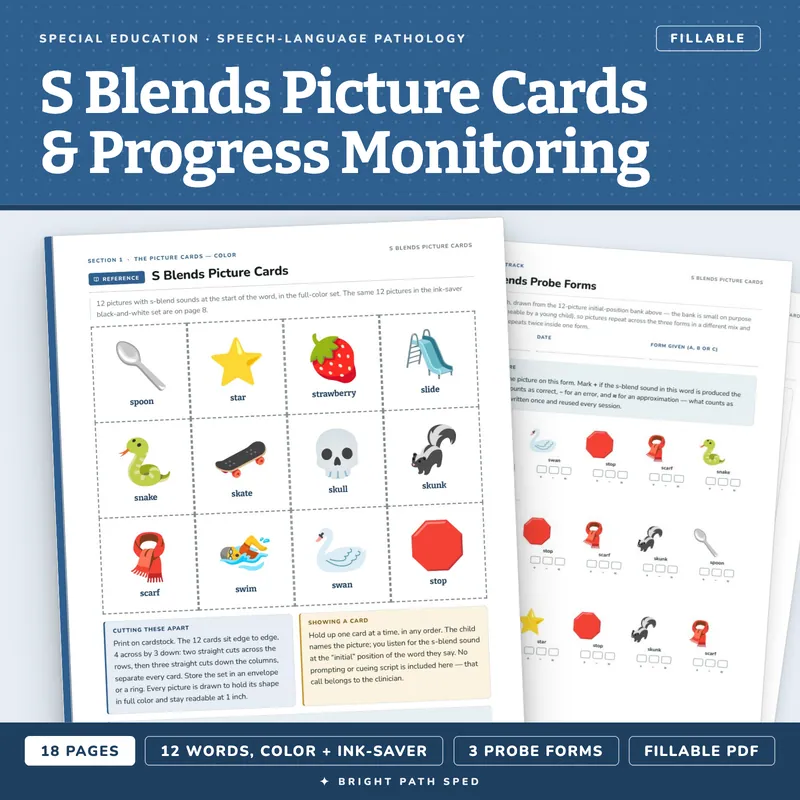
Words that start with s-blends: "spoon," "stop," "swim." A child who cannot yet read a word list has nothing to look at — this file puts a picture under every word. Twelve s-blend words, in color and ink-saver black and white, three probe forms that test them, and a log scaled to the probe. One picture-card deck that fits a grade-school hand, printed once and reused all year.
Every form is six pictures and untimed, so a score of 4 means the same thing on every form, and the student is never scored on speed. What counts as a correct production is your call, not this page's — you write that rule once, and it holds constant probe to probe.
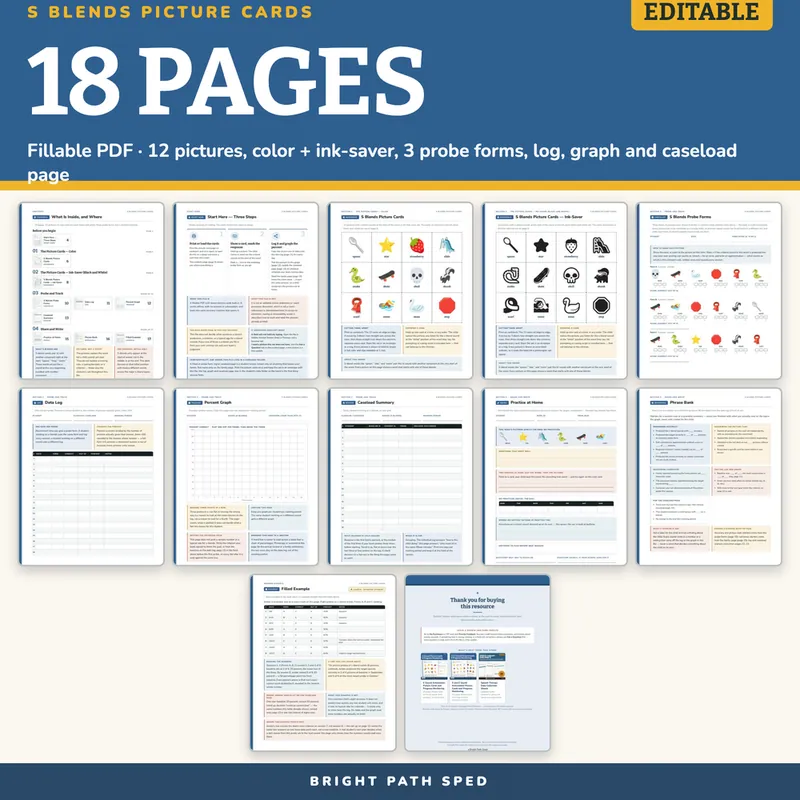
WHAT IS INCLUDED - 18 pages, 279 type-in fields, three probe forms
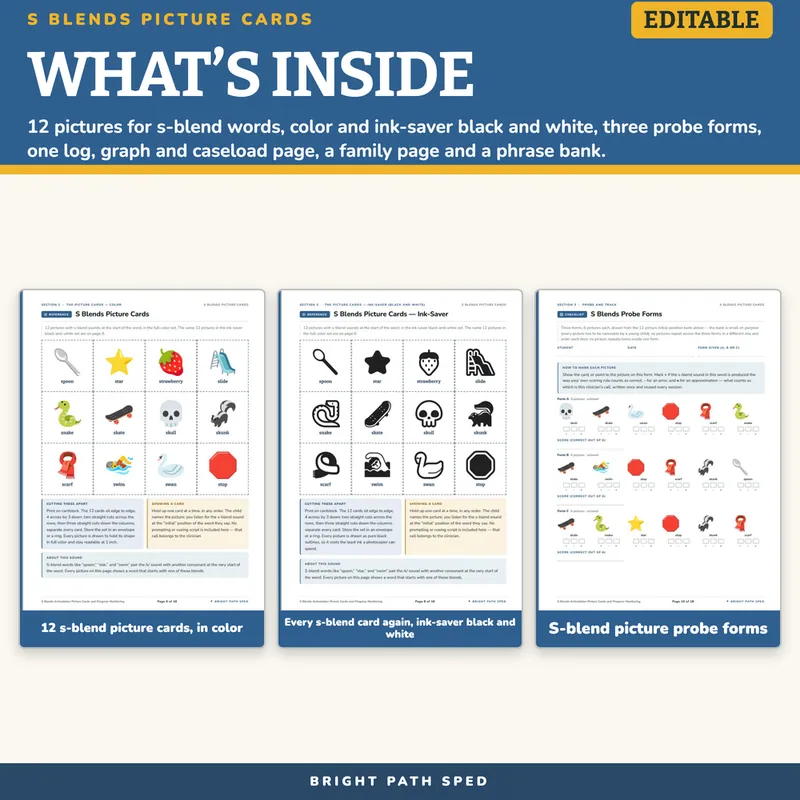
The Picture Cards
- Twelve s-blend words, each with one large picture: spoon, star, strawberry, slide, snake, skate, skull, skunk, scarf, swim, swan, stop
- Two full card sets: one in full color (Noto Emoji), one in ink-saver black and white (Fluent Emoji High Contrast)
- Each card is a cut-apart piece, labeled with its word in a rounded-font label that reads aloud clearly to a PreK-2 child
- Directions for printing on cardstock, cutting, and storing in an envelope or ring
The Three Probe Forms
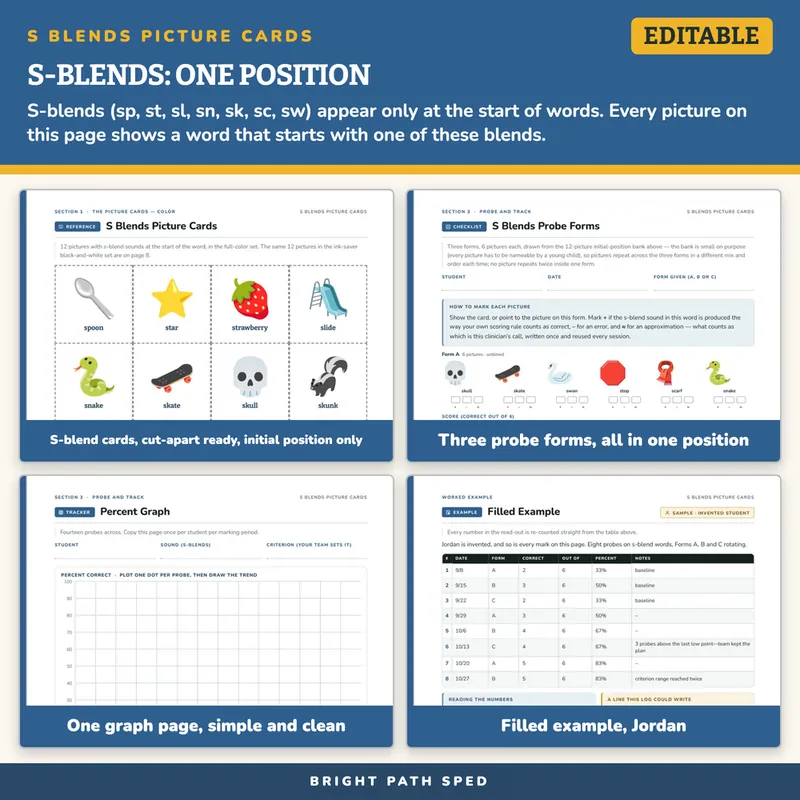
- Six pictures each, drawn from the twelve-word bank in a different shuffle per form (Forms A, B and C)
- Each picture carries three marking boxes: correct (+), error (−), and approximation (≈)
- A score line at the bottom: Correct ___ out of 6
- No cueing script, no marking rule built in — that is the clinician's judgment, written once on the goal page and reused
The Data Log And Graph
- A y-axis scaled 0 to 100, one mini graph across 14 probe slots
- A sixteen-row log: date, form, correct, out of (always 6), percent, and notes
- A percent formula on the page: correct divided by 6, times 100
- The instruction to write the criterion your team agrees on before the first probe
The Caseload Summary
- Sixteen student rows, baseline percent, current percent, trend (up / flat / down) and decision
- For the data meeting: a quick read of where each student is on s-blends
A Practice Page For Home
- The six pictures from the week's session, printed so a family recognizes the practice set
- A two-minute at-home routine: point, student says the word, no correcting mid-word
- A tracking table (Mon–Sun) so families can initial the days they practiced
- Space for feedback, what went well and what to flag
A Phrase Bank
- Observable-language starters for session notes: accuracy (produced the sound with ____ accuracy), the picture task (named all pictures independently), carryover (family reported practicing ____ times), and data entries (baseline was ____ of ____, current is ____ of ____)
- Every line finishes with a blank from the log or graph in this file, never a label for the child
A Worked Example
- Jordan is invented, and so are all eight probes. Forms A, B, C rotating, out of 6.
- Sessions 1–3 scored 2, 3, 2: baseline sits at 2 of 6 (33 percent). By session 8, Jordan scored 5 of 6 (83 percent) — a 50 percentage-point rise from baseline.
- The read-out line quotes the baseline and last two probes, both straight from the log above.
- The caseload row shows baseline 33 percent, current 83 percent, trend up, decision "continue current plan."
What This Is, And What It Is Not
It is a fillable PDF. The data log, caseload, and practice page are type-in fields: open the file in a PDF reader, click a line or a cell, type, and Save As once per student. The picture cards are meant to be printed on cardstock and cut apart; the student says the words aloud and writes nothing. One student copy of each form in a sheet protector lasts the year. It works offline with no account or subscription. It does not calculate percents or draw the graph; you write the numbers straight from the count.
It is not a norm-referenced or diagnostic assessment. It carries no benchmark score or "typical" rate for s-blends, and it contains no elicitation, cueing or error-type script — that is a clinical decision for the clinician, not this page's. The pictures are drawn in full color and in black and white to hold their shape on a photocopier; the pictures work on screen too (tablet, phone) if you do not print.
Who This Is For
Speech-language pathologists, SLPAs and paraprofessionals monitoring students working on s-blend sounds (sp, st, sl, sn, sk, sc, sw) at the start of words. One sound, one position, one picture per word: start here if your student is working on early sound blends and cannot yet read a word list.
Read This Before You Buy
The picture cards show the word spelled out in text underneath. This file assumes a student who can see a picture and name it aloud, even if they cannot read the word yet. If your student cannot name pictures independently, this file still gives you the probe forms (you would say the word and show the picture, rather than holding up the picture alone), the log, graph and caseload page, but you would adjust how you present each picture and write that on the directions line so every probe is given the same way.
If You Want Another Sound
This is s-blends only, initial position. We have the S and Z Sound picture cards (33 pages, 60 pictures, all three positions), the K Sound picture cards (24 pages, 36 pictures, three positions), the R, L and other sound picture-card decks covering all three positions, and word-list probes for every sound if your student can read.