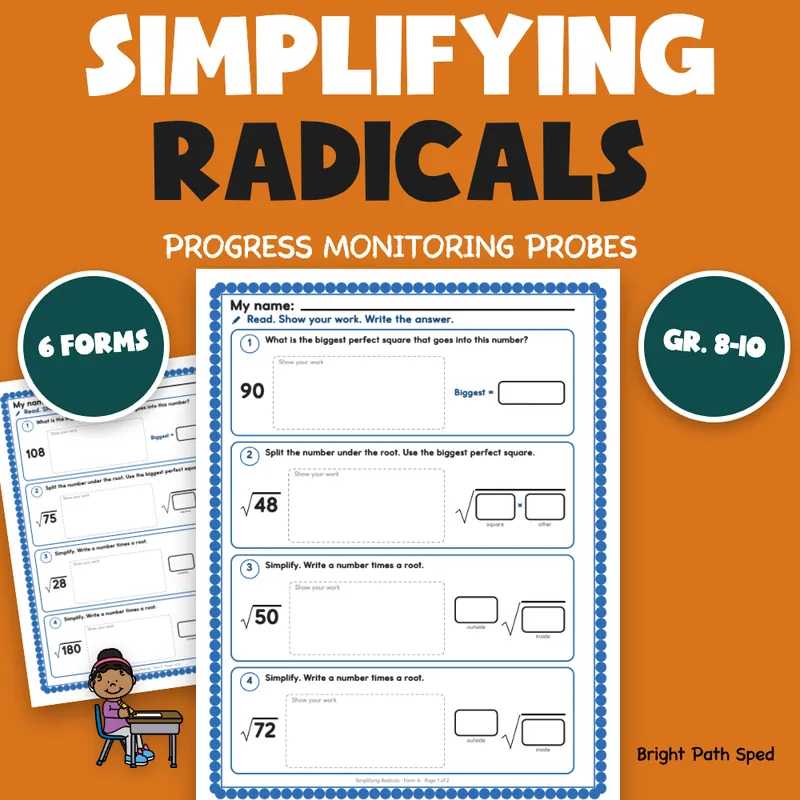
Simplifying Radicals Progress Monitoring Probes
- 28 pages
- 8th, 9th, 10th
$2.00 $4.00 on Teachers Pay Teachers
Half the Teachers Pay Teachers price. The same PDF, sold direct.
DownloadOr get it with All-Access: pick any 20 resources a month for $7.
New here? Your first month of All-Access is half off with code TEACHERTOK
Already bought this, or a member?
Instant download. One teacher's license: colleagues need their own copy. Each file carries a license number.
Also on Teachers Pay Teachers: see the Bright Path Sped store
About this resource
One skill, start to finish. A simplifying radicals IEP goal, six equivalent probe forms that measure it, an answer key and a data log with a graph. Baseline on Monday, goal written by Tuesday, first data point on Friday.
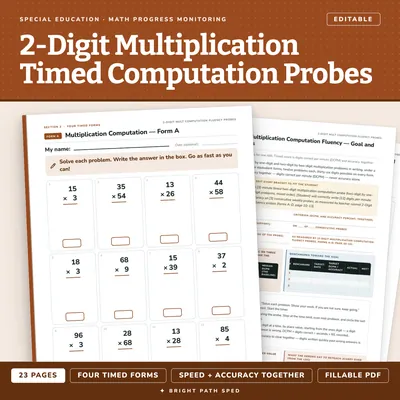
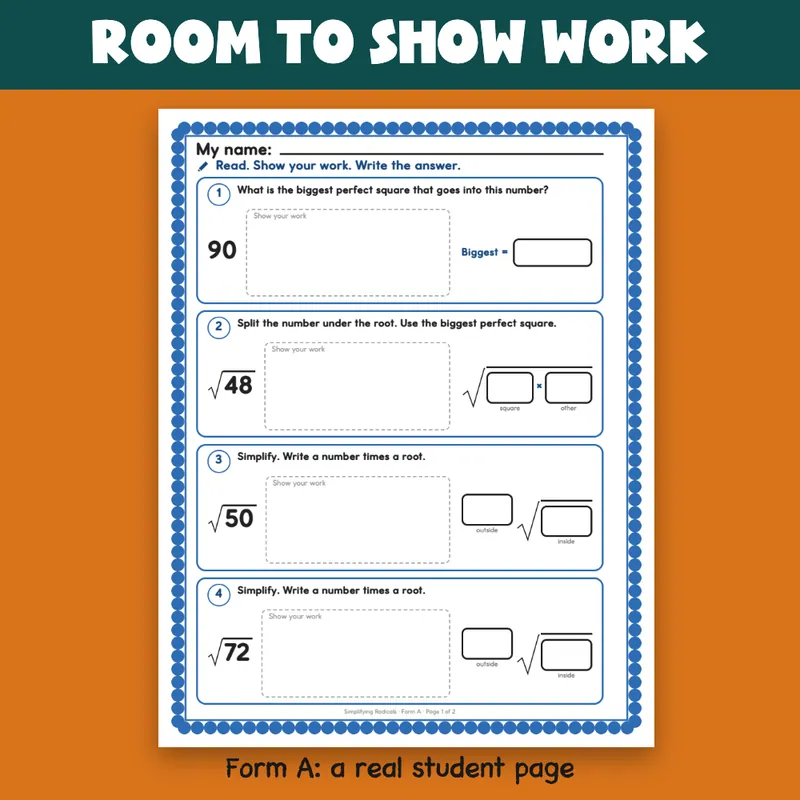
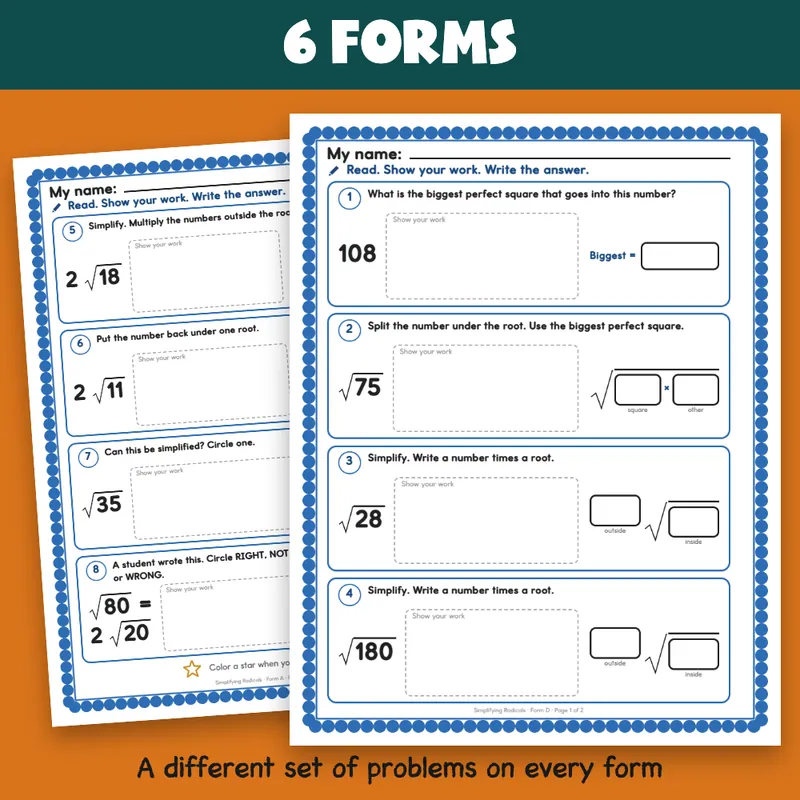
Every form has eight problems over two student pages, four problems a page, each with a work box and answer boxes: two on perfect-square factors, two on simplifying a square root to a number times a root, two on the number outside the root, and two that check an answer, in the same places on every form, so the score means the same thing on Form A and on Form F. Every answer is a whole number, a number times a root, or a choice you circle; none is a decimal. All numbers are invented.
WHAT IS INCLUDED - 28 pages in all: six probe forms of eight problems each (48 problems, none repeated), twelve student form pages, a step-by-step student page, a two-page answer key, a directions page, a teacher notes page, a perfect squares and steps reference page, a binder cover with 10 divider tabs, a family update page
Start Here And The Goal
- A one-page quick start: six steps and which page is for which job
- A goal page with a sample goal (every bracket meant to be edited), the goal frame as type-in fields, a baseline table and three benchmark rows
- Lines for your district's own rules, this student's scoring rules and the supports the IEP allows
Six Probe Forms, A Through F
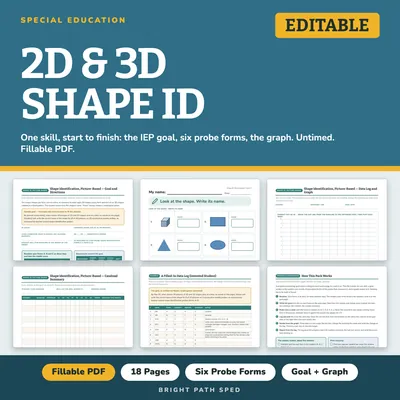
- A big My name line, one short instruction with a pencil picture, and a "Show your work" box and answer boxes for every problem
- Factor problems (the biggest perfect square in a number, then split the number under the root), simplify problems (a smaller number and a larger one), outside-number problems (start with a number already outside the root, then put a number and root back under one root) and check problems (can it be simplified, then a student's answer to mark RIGHT, NOT DONE or WRONG)
- No answers, goal text or scoring strip on a student sheet. The square root sign is drawn on the page, so the problems print the same on any computer
Step By Step
- One student page with two radicals and the steps laid out as boxes: the biggest perfect square, the number split in two, the square root of the square, the answer, then a check by multiplying back
Directions, Answer Key And Teacher Notes
- A directions page: what to say, what is on every form, how each kind of problem is placed
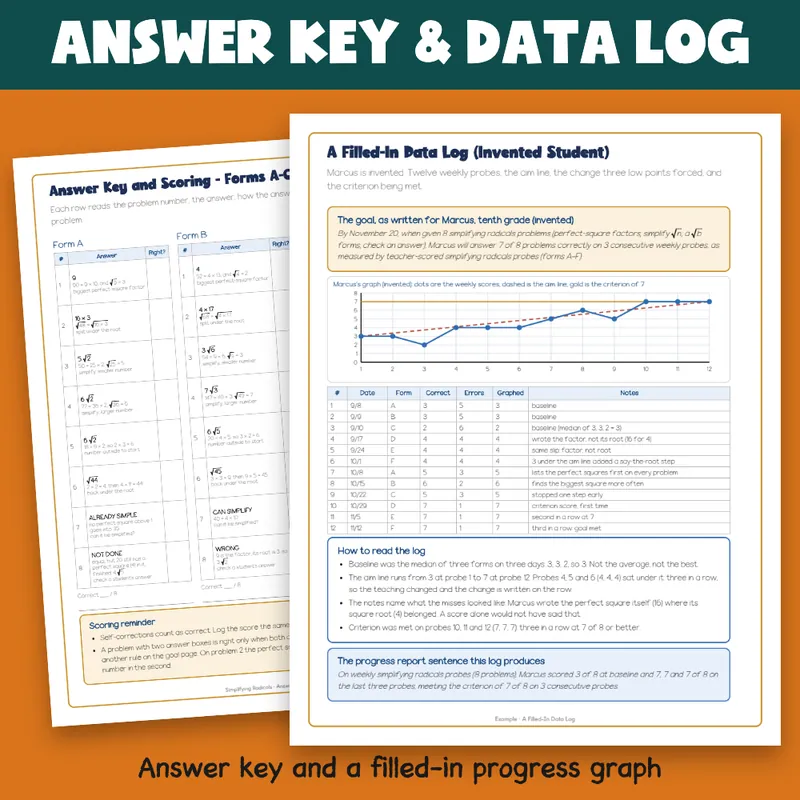
- A two-page answer key with a mark box per problem, how each answer comes out and the kind of problem named
- Reading the misses: the perfect square written outside instead of its root, stopping one step early, a miss that clusters on one kind of problem
- A reference page with the perfect squares from 1 times 1 to 12 times 12, the steps, a worked example and its check, to print as a chart if the student's IEP allows one
Binder Cover And Divider Tabs
- A binder cover and spine label with type-in fields, ten divider tabs to print and cut (Start Here, Goal and Directions, Forms A-C, Forms D-F, Answer Keys, Teacher Notes, Reference and Steps, Graph and Log, Caseload and Example, Family Update) and a short setup list
Data Log, Graph And Caseload
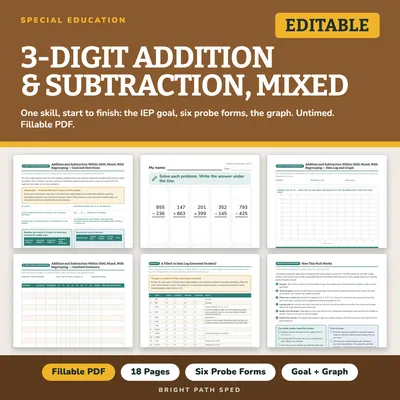
- A graph scaled 0 to 8 with twelve probe columns and a ten-row log
- A caseload summary grid, a filled-in example with a plotted graph (Marcus, invented) and a family update and team handoff page
What This Is, And What It Is Not
It is a fillable PDF. The goal page, data log, caseload page, family update page, binder cover fields and the mark boxes on the answer key are type-in fields: open the file in a PDF reader, click a line or a cell, type, and Save As once per student. The probe forms print: the student writes on paper.
It is not a norm-referenced assessment and it carries no benchmark score or "typical" rate. The criteria in the sample goal are in brackets because your team sets them from the baseline and the student's IEP. Whether the probe is timed is your team's call; there is a line for it. Your district's own rules for goals and scoring go on the blank lines provided.
Who This Is For
Eighth, ninth and tenth grade special education teachers and case managers writing simplifying radicals goals, math intervention teachers, and the paraprofessionals who give the weekly probe.