Snowflake Bentley Activities
- 18 pages
- Kindergarten, 1st, 2nd, 3rd
$2.00 $4.00 on Teachers Pay Teachers
Half the Teachers Pay Teachers price. The same PDF, sold direct.
DownloadOr get it with All-Access: pick any 20 resources a month for $7.
New here? Your first month of All-Access is half off with code TEACHERTOK
Already bought this, or a member?
Instant download. One teacher's license: colleagues need their own copy. Each file carries a license number.
Also on Teachers Pay Teachers: see the Bright Path Sped store
About this resource
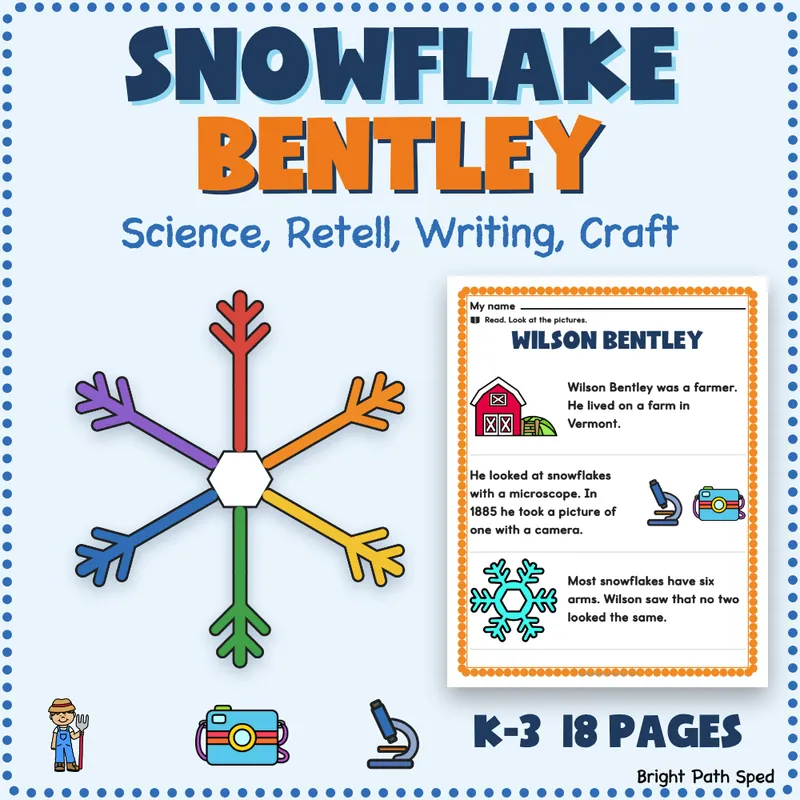
A farmer in Vermont, a camera on a microscope, and snowflakes with six arms: Wilson Bentley's story is a perfect fit for a K-3 winter week. This pack gives you a short reading page of its own, then the words, a retell, six-arm symmetry drawing, a cut-and-glue snowflake and writing at three levels, so a classroom, including a self-contained special education room, can use it all week.
Children read "Wilson Bentley" (three short paragraphs, each with a picture): he was a farmer in Vermont, he looked at snowflakes with a microscope, in 1885 he took a picture of one with a camera, most snowflakes have six arms, and he saw that no two looked the same. Then they circle the answers, cut and trace words, put his story in order, finish and draw six-armed snowflakes, glue a Six-Arm Snowflake and write.
Works with any Snowflake Bentley read-aloud. The reading, the words and the pictures are all new and original to this pack; it has no book text and no book art, and it uses a generic farmer picture, not a portrait. This resource is not affiliated with or endorsed by the author, illustrator or publisher of any book about Wilson Bentley. Use your own copy of the book.
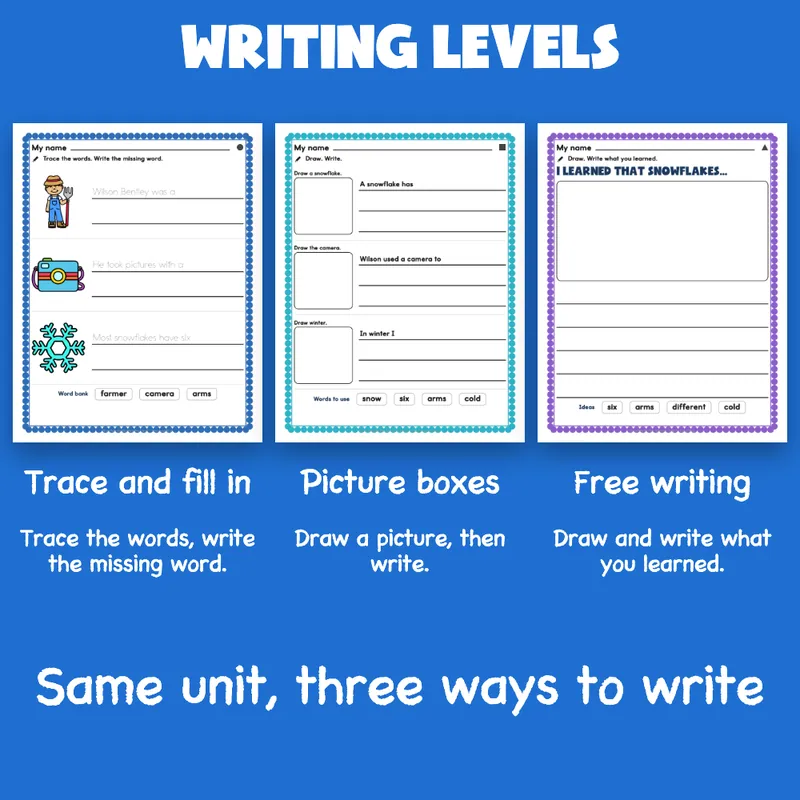
Three writing levels, so every child can do the same unit:
- Level 1: trace and fill in. Three sentences, a word bank, and a blank for the missing word.
- Level 2: three picture boxes (draw a snowflake, the camera and winter) with a sentence starter and writing lines beside each.
- Level 3: free writing. "I learned that snowflakes..." is printed; the child draws and writes in their own words.
Every student page has a name line and one short instruction with a picture, so a paraprofessional can run the center from it too.
WHAT'S INSIDE (18 pages)
- Start Here: a five-day plan, the three writing levels, the facts used on the pages, ways to make it easier or harder, and prep
- Read "Wilson Bentley": three short paragraphs with pictures
- Check your reading: three circle-the-answer questions, then draw a snowflake and write one fact
- 6 vocabulary cards to cut (snowflake, crystal, microscope, camera, farmer, winter) and a trace-and-write page for the same 6 words
- Retell in order: 4 glue boxes (First, Next, Then, Last) and 5 pictures to cut (4 steps plus 1 that does not belong), with a sentence line for each
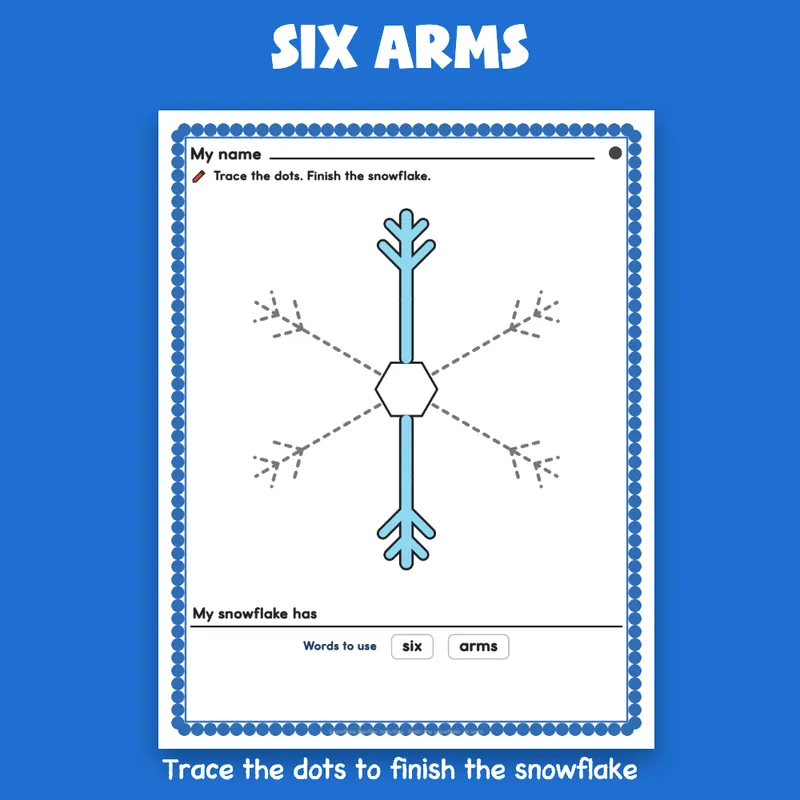
- Finish the snowflake: trace the dots to make the same arm on all 6 arms of a snowflake
- Draw your own snowflake: draw branches on 6 arms, with a model arm to look at
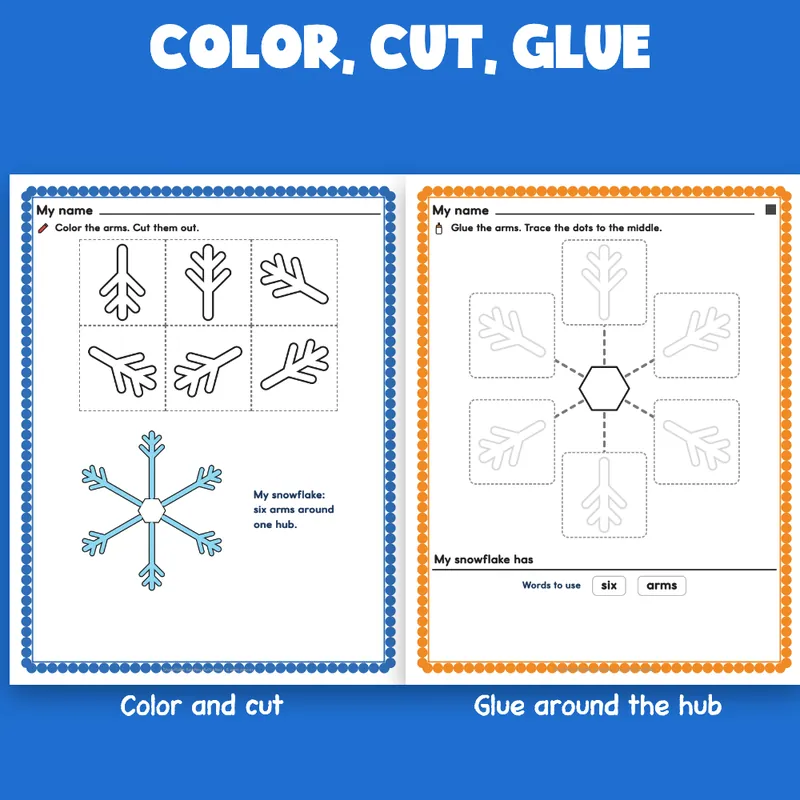
- The Six-Arm Snowflake craft: 6 arm pieces to color and cut, then glue each on its faint twin around a hub, trace the dots to the middle and write "My snowflake has", with a finished snowflake shown
- Three writing pages, one for each level
- Compare two snowflakes: a Snowflake A and a Snowflake B to look at, with a word bank and sentences to finish
- A family letter to send home, with a draw-and-return box
- A "Who Did What This Week" data page with the answer key
- A credits page (art and font licenses)
Cutting Built For Small Hands
Every cutting page has 5 or more big pieces, lined up in a grid edge to edge so each cut is one straight line. 17 pieces to cut in all (6 word cards, 5 story pictures, 6 arm pieces). Every glue box is the same size as the piece that goes in it.
Who This Is For
Kindergarten to 3rd grade classrooms, self-contained special education classrooms and paraprofessionals who want a winter science, reading and writing unit with real retelling, drawing, symmetry and three levels of writing, ready to print.
What This Is, And What It Is Not
A printable PDF (print and cut). It is not Google Slides, Docs or PowerPoint, and it has no fillable fields. Print on paper; card stock suits the arm pieces. The facts are kept to a few simple ones, and the Start Here page tells you which, so you can check them against your own book. It is not a claim about any student's age or rate of progress.