Stuttering Data Collection Sheets Editable
- 26 pages
- Not Grade Specific
- PDF, fillable
$2.50 $5.00 on Teachers Pay Teachers
Half the Teachers Pay Teachers price. The same PDF, sold direct.
DownloadOr get it with All-Access: pick any 20 resources a month for $7.
New here? Your first month of All-Access is half off with code TEACHERTOK
Already bought this, or a member?
Instant download. One teacher's license: colleagues need their own copy. Each file carries a license number.
Also on Teachers Pay Teachers: see the Bright Path Sped store
About this resource
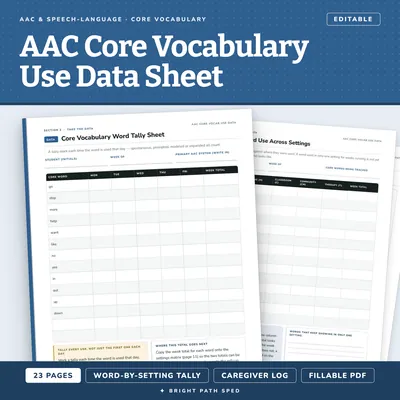
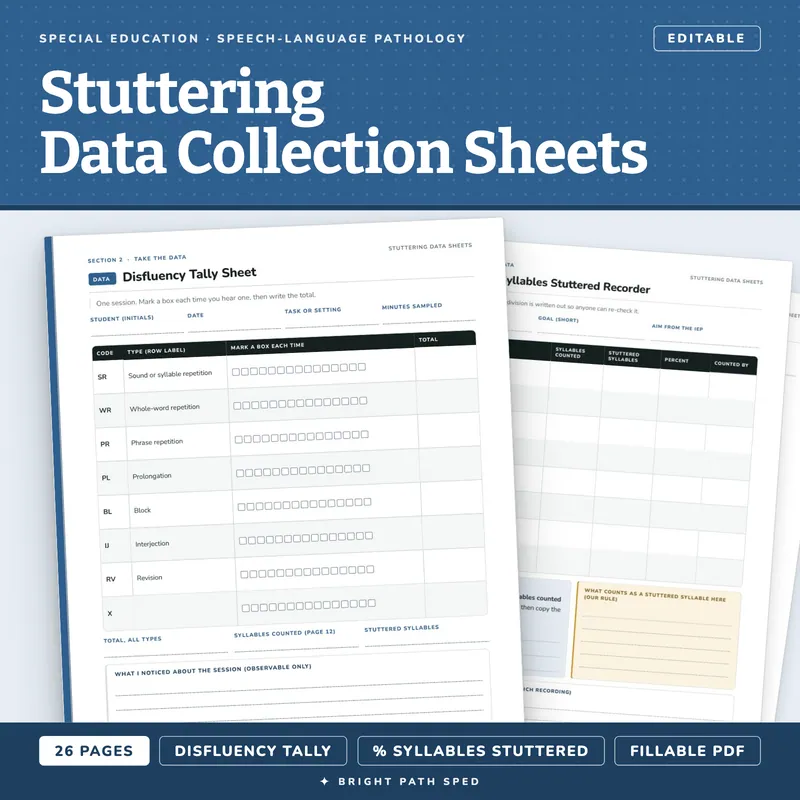
Stuttering data collection sheets for the school SLP, in one fillable PDF: a disfluency tally by type, a tally by speaking task, a percent-syllables-stuttered recorder with the division written out, a 100-syllable count grid, a group tally, an everyday-talking log, two pages the student fills in with faces, a session log and graph, a caseload summary, a family update, a classroom-teacher check-in, a phrase bank and a worked example. It records what you hear and count. It does not tell you what to count or what to do about it.
WHAT IS INCLUDED - 26 pages
Set Up The Caseload
- Type Key and Counting Rule - 8 type rows (7 labeled, 1 you name) with a blank for your own definition and a blank for whether your team counts it toward percent stuttered, 6 speaking-task codes, and a space for your own counting rule
- Caseload Roster - 14 rows
- Binder Cover, Spine and Divider Tabs - a binder cover, a spine label and 8 divider tabs carrying the real page numbers
Take The Data
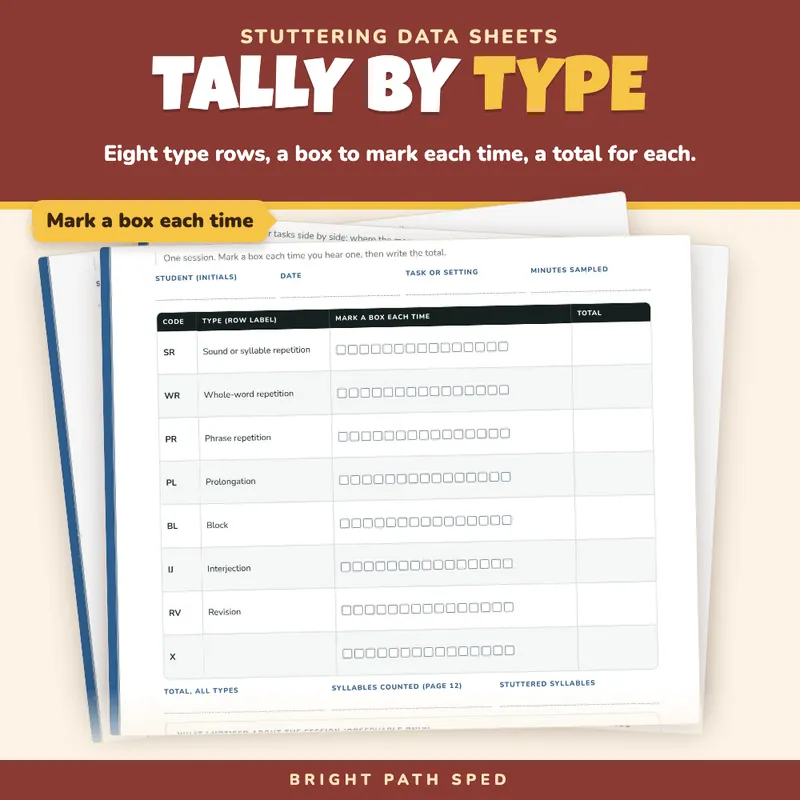
- Disfluency Tally Sheet - 8 type rows, 15 boxes to mark in each, a total for each type, syllables counted and stuttered syllables, and a notes area
- Tally by Speaking Task - the same 8 types across 4 tasks side by side, with a total row and a syllables-counted row
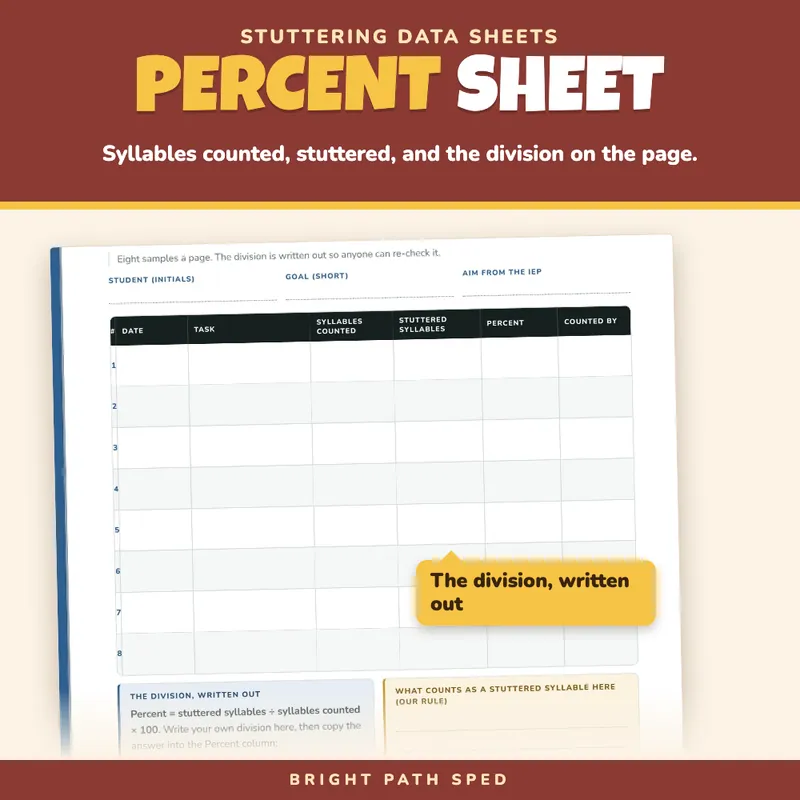
- Percent Syllables Stuttered Recorder - 8 samples a page, with the division written out: stuttered syllables divided by syllables counted, times 100
- 100-Syllable Count Grid - 100 numbered boxes, one per syllable, to circle stuttered syllables and count the circles
- Group Session Tally - 7 student rows by 8 type codes, with syllables and percent, plus notes per student
- Speaking Situations Log - 11 rows for where, with whom, how many moments, and the student's own rating
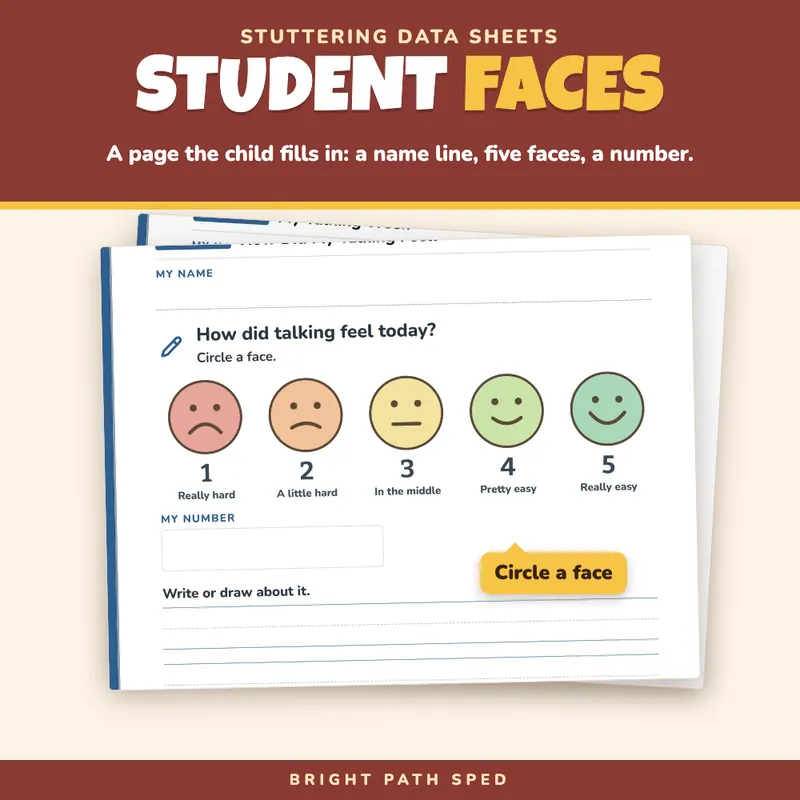
- How Did My Talking Feel? - a student page: a "My name" line, five faces numbered 1 to 5, one short instruction, a box for the number, and handwriting lines to write or draw
- My Talking Week - a student page: Monday to Friday, a box for each day's number, and handwriting lines
Track, Report And Share
- Session Log - 12 sessions: date, task, syllables counted, stuttered, percent, moments, self-rating
- Progress Graph - two 12-session graphs on one page, percent syllables stuttered (you type your own scale) and the student's 1 to 5 self-rating
- Caseload Summary - 12 rows: starting number, latest number, sessions, self-rating, team note
- Family Update - plain words, no percents, with the student's own 1 to 5 for each day
- Classroom Teacher Check-In - 5 days: what the student was doing, times they spoke aloud, moments noticed, what they said about talking
- Progress Note Phrase Bank - 20 starters in 5 groups, every one ending in a blank for a number, a count or a date from a page in this file
- A filled-in example for an invented student: a tallied session (20 moments), six logged sessions with the percent for each, and the student's week page, with every number re-countable
What This Is, And What It Is Not
It is a fillable PDF. Open it in a PDF reader, click a line or a box, type, press Tab to move on, and Save As once per student. It works offline with no account or subscription, and every page still reads when printed in black and white. It is NOT a Google Sheets file, a Google Doc, a PowerPoint or an Excel workbook, and it does not add or divide for you.
It is data collection only. There are no techniques, no therapy activities, no severity cutoffs, no age ranges and no norms. The type labels on the tally are row labels; the Type Key page (page 6) is where you write what each one means to you and what your team counts. The district's rule, and your own, are always blank lines.