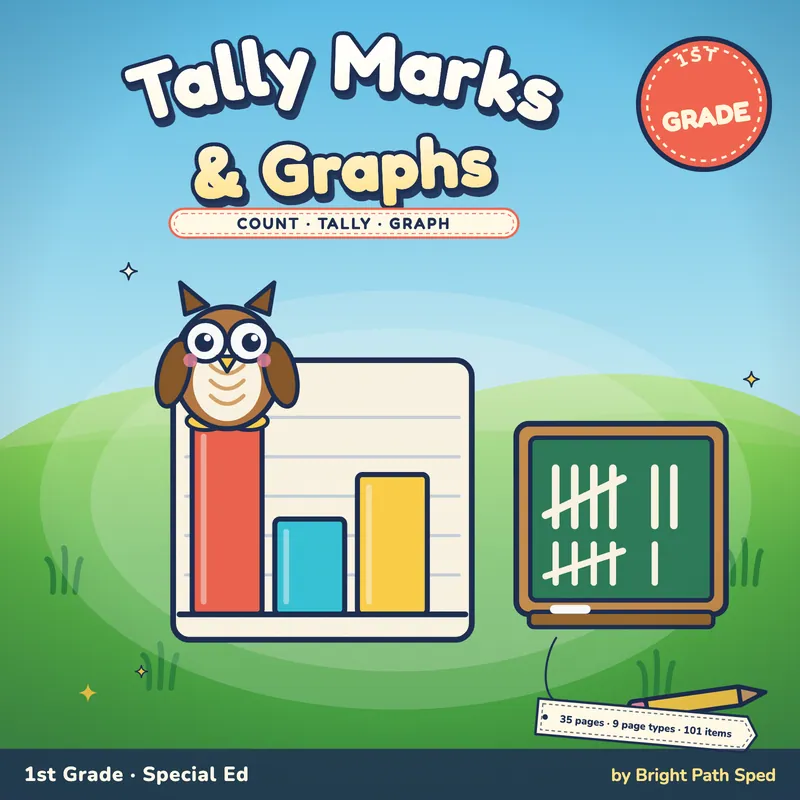
Tally Marks and Graphing Worksheets
- 35 pages
- 1st
$4.00
DownloadOr get it with All-Access: pick any 20 resources a month for $7.
New here? Your first month of All-Access is half off with code TEACHERTOK
Already bought this, or a member?
Instant download. One teacher's license: colleagues need their own copy. Each file carries a license number.
Also on Teachers Pay Teachers: see the Bright Path Sped store
About this resource
Tally marks and graphs for first grade, on pages a child can pick up and start. Read tally marks and write the number, make a tally, color a picture graph from a tally table, read a picture graph and a bar graph, color a bar graph, cut and glue, and ask a survey question of your own. Every page has a big "My name" line, one short instruction, and boxes made for a child's handwriting. Untimed: no clock, no score on the page.
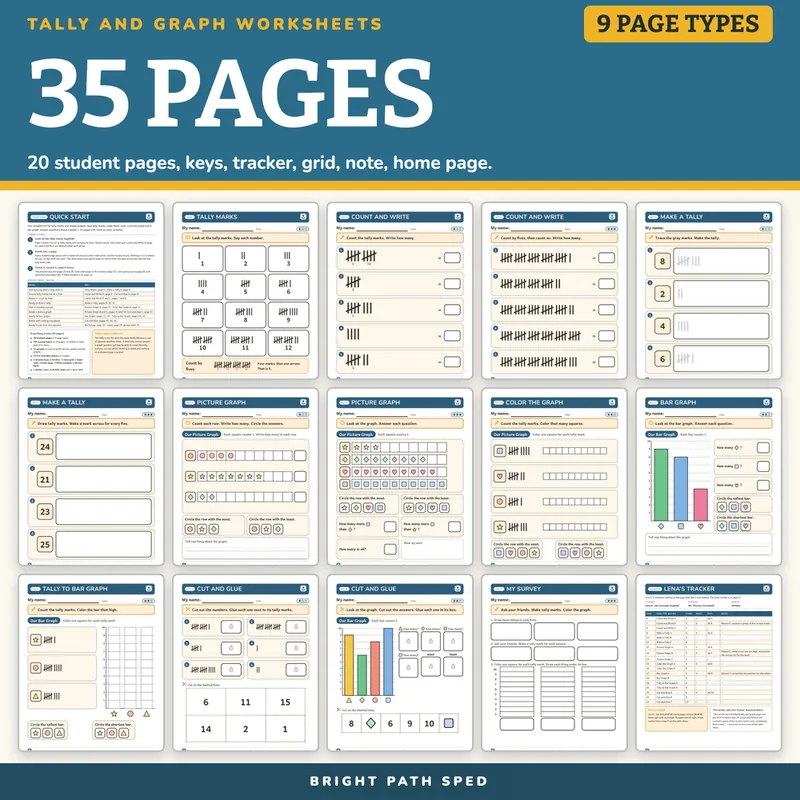
EVERYTHING INSIDE (35 pages: 20 student pages, 15 for you)
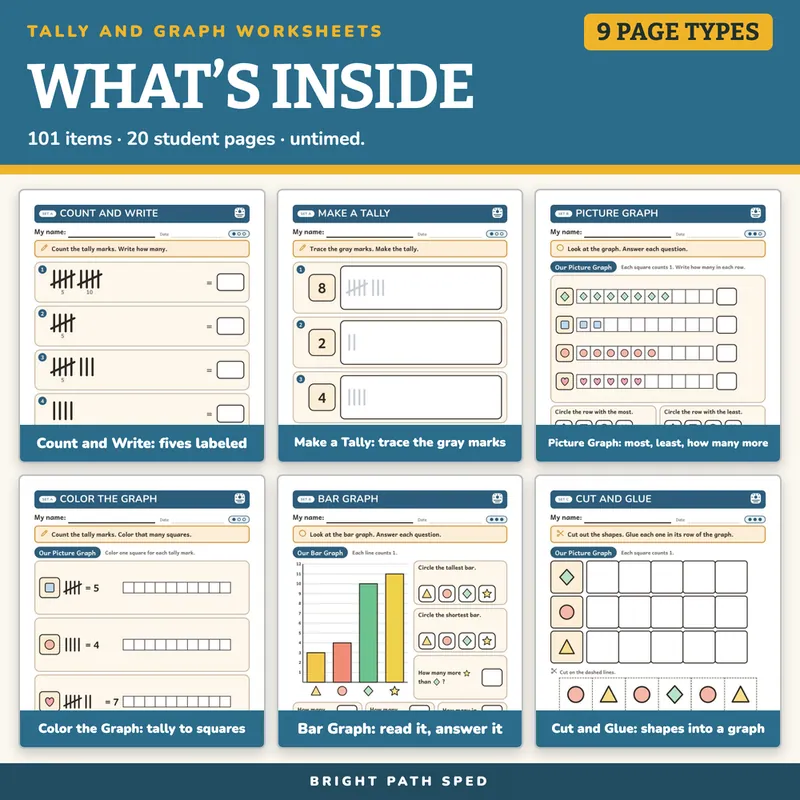
- 101 scored items on 18 pages, all computed in code; 21 tally counts to read and 12 to draw, and no tally count repeats inside its own group
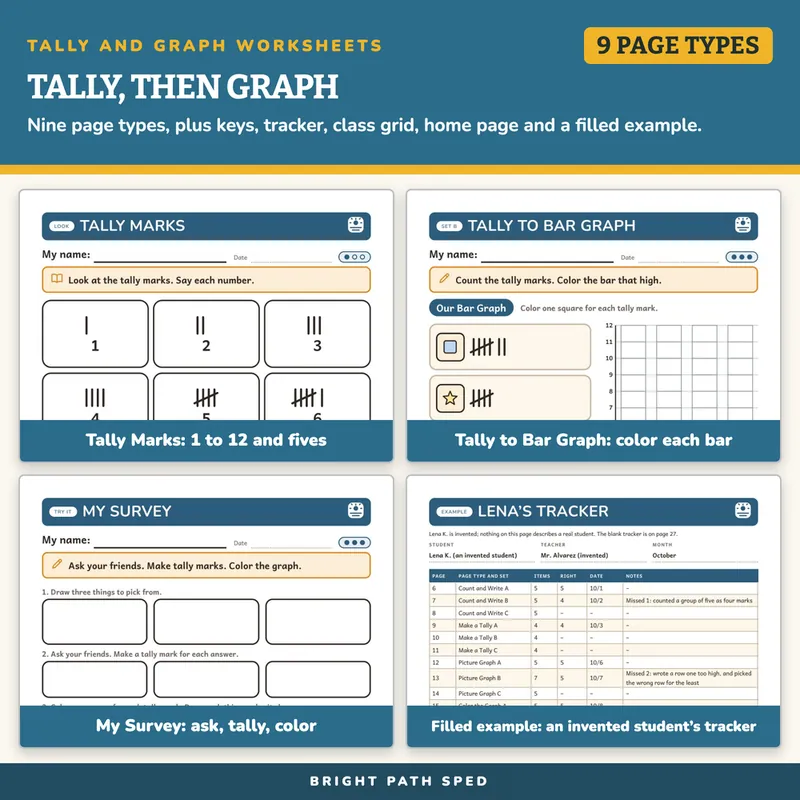
- Tally Marks: 1 to 12 as tally marks, and counting by fives to 20 (1 page)
- Count and Write: read the tally marks, write the number; A to 10 with the fives labeled under each group, B to 20, C to 30 (15 items, 3 pages)
- Make a Tally: draw the marks for a number; A traces gray marks, B and C draw with room to work up to 20 and 25 (12 items, 3 pages)
- Picture Graph: count each row, circle the row with the most and the least, how many more, how many in all (17 items, 3 pages)
- Color the Graph: a tally table, color that many squares in each row of a picture graph (11 items, 2 pages)
- Bar Graph: read a bar graph with a number at every line; how many, tallest, shortest, how many more, in all (11 items, 2 pages)
- Tally to Bar Graph: a tally table, color each bar as high as its tally (11 items, 2 pages)
- Cut and Glue: 24 pieces on 3 pages; numbers glued next to tally marks (6 pieces), graph answers glued into boxes (6 pieces), and 12 shapes glued into the rows of a picture graph (12 pieces)
- My Survey: pick three things, ask friends, make tally marks, color a 10-square graph (1 page)
- 2 answer keys (18 cards, one for every scored page), a tracker (18 rows), a class grid (15 student rows, 7 columns), a team note, a home page with three tally marks to read and three boxes to make your own, a filled example (an invented student), a phrase and graph-talk bank (17 starters in 5 groups), a binder cover, and 6 divider tabs with a spine label
- Start Here, a how-it-works page and a "What's next" back page
Built For The Child, Not The Office
Every student page has a big "My name" line, one short instruction with a picture (a pencil, a book, a circle or scissors), rounded answer boxes at least half an inch tall, and plenty of room. Make a Tally has a big drawing box for every number; My Survey has three drawing boxes and a tall graph to color. Everything for you (directions, answer keys, tracking) is on separate teacher pages.
Three Levels, Marked By Dots
One dot: starting (fives labeled under each group, gray marks to trace, answers to color from a number). Two dots: building (count by fives, draw the marks, a graph with four rows, a bar graph to color from tallies). Three dots: ready for more (tallies to 30, how many more and how many in all, shapes glued into a graph, a survey of your own). The dots are the only level code, so children at one table are not comparing papers.
Every Count And Every Answer Is Computed
Every tally is drawn by code that counts its own marks back out and stops if they do not equal the number, so a picture can never show a different count than the key. Every graph is drawn from its own data, and every answer (the row with the most, the row with the least, how many more, how many in all) is worked out from that same data. No graph has a tie for most or for least, every "how many more" question compares a bigger row to a smaller one (the answer is never zero), and no two graphs share the same set of counts. On the Cut and Glue pages no piece sits under its own box, so cutting across and gluing down never hands over the answer.
Easy Cutting
Every cutting page has at least six pieces that touch edge to edge, so each cut is one straight line: a 3 by 2 block (three cuts), a strip of six (five cuts) and a 6 by 2 block of twelve (six cuts). Every piece is over an inch on each side, and the pictures inside the pieces are drawn with solid lines, so the only dashed lines on a piece are the ones to cut on.
Type In, Or Print
The name and date lines, every answer box, the tracker, class grid, team note and home page are type-in fields in any PDF reader; the tally marks, graphs, symbols and cut pieces are always printed. Every page also prints clean in black and white: the symbols differ by shape, not only by color. This is a fillable PDF; it is not a Google Slides, Google Docs or PowerPoint file.
Who This Is For
First grade teachers, special education and resource room teachers, interventionists, and anyone who needs tally and graph practice at more than one level in one file, with the tracking and family pages already made.
What This Is, And What It Is Not
An untimed practice set for reading and making tally marks and for reading, coloring and building simple picture graphs and bar graphs of drawn symbols, with the record-keeping around it. It is not a timed fluency probe or a goal page, not a full math curriculum, and not a claim about any student's age, grade level or rate of progress. Tally counts go to 30; picture graph rows hold up to 10 squares and bar graphs go to 10 or 12.
Also From Bright Path Sped
Tally Marks 1-10 Task Box (the tally marks on their own as a task box), Place Value Tens and Ones Cut and Paste, 3 Levels, Addition to 20 Cut and Paste, 3 Levels, and Number Bonds to 10 Cut and Paste, 3 Levels.