Telling Time K-1 Cut and Paste Worksheets
- 41 pages
$4.50
DownloadOr get it with All-Access: pick any 20 resources a month for $7.
New here? Your first month of All-Access is half off with code TEACHERTOK
Already bought this, or a member?
Instant download. One teacher's license: colleagues need their own copy. Each file carries a license number.
Also on Teachers Pay Teachers: see the Bright Path Sped store
About this resource
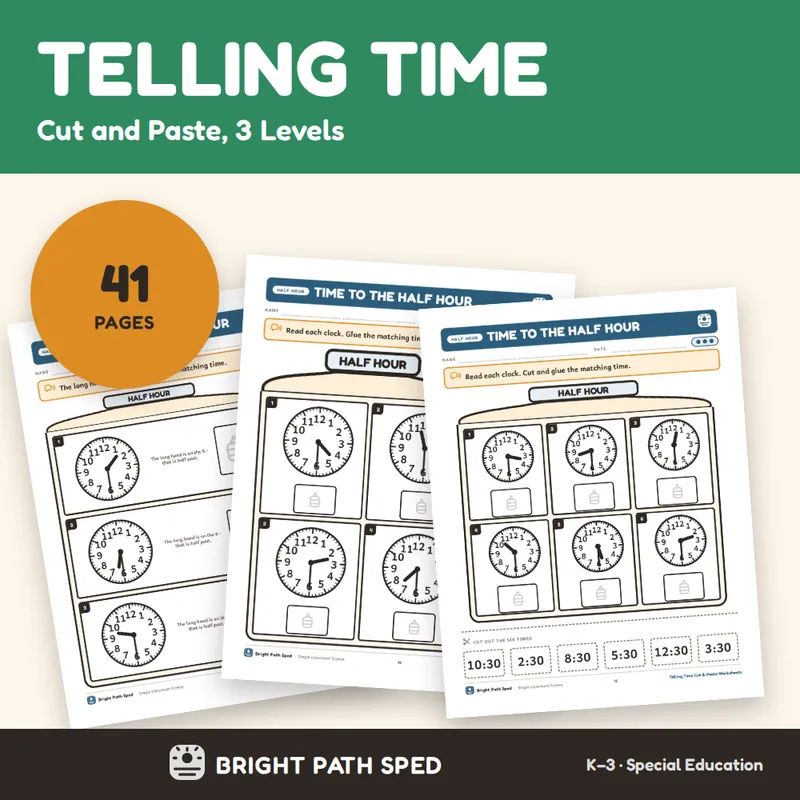
Nine telling-time skills. Every one of them printed three times, at three levels of support, so the whole room can work the same page at the same time.
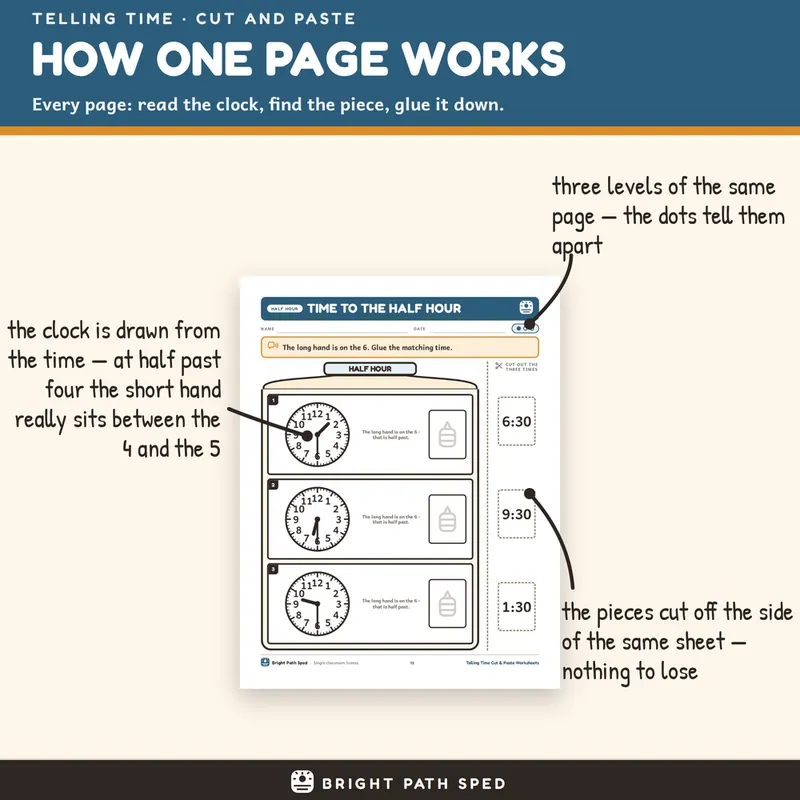
Twenty-seven cut-and-paste worksheets in one PDF. The cut pieces print on the child's own sheet, so nothing gets separated on the way to the desk.
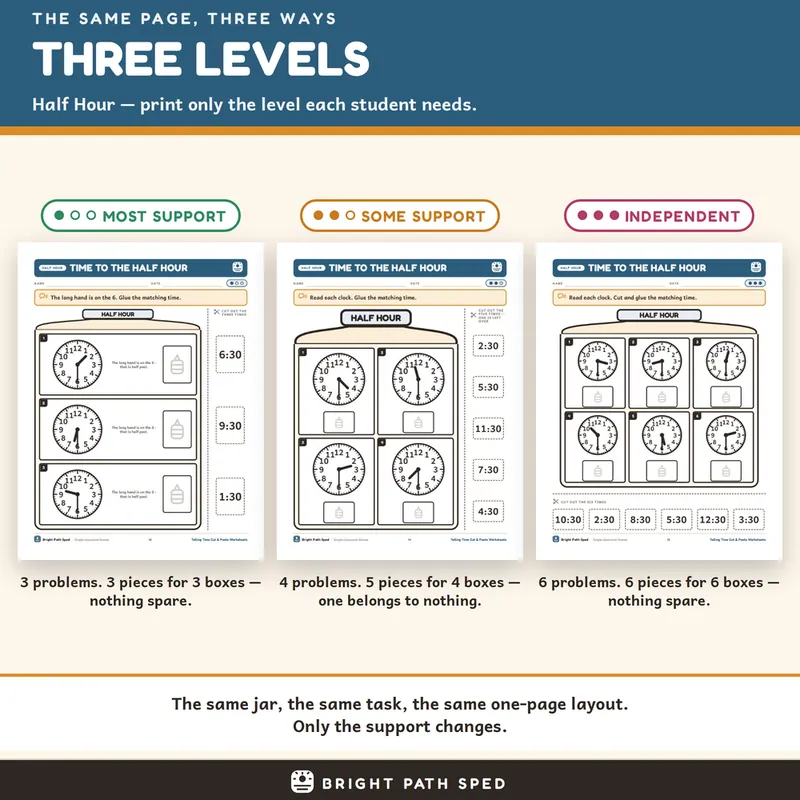
How The Three Levels Work
Level 1: two or three clocks, drawn as large as the page allows, with a printed hint under every one (the long hand is on the 6, that is half past). There are exactly as many pieces on the cut strip as there are boxes, so there is no wrong piece to pick up.
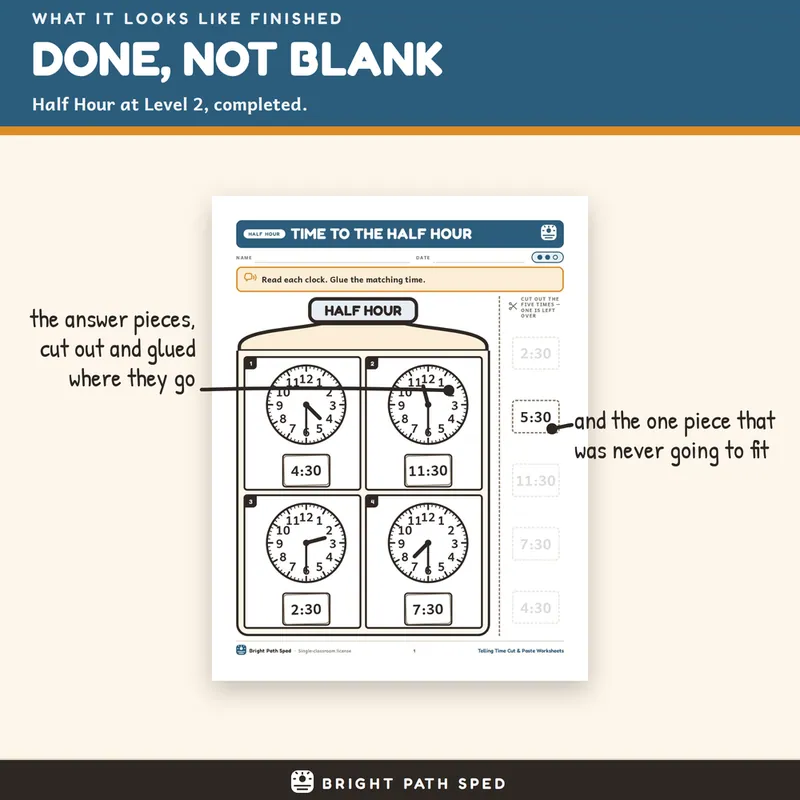
Level 2: four clocks, no hint, and one spare piece on the strip that belongs to nothing. The student has to reject something instead of matching everything.
Level 3: six clocks, nothing cued, and times chosen to be confusable: 3:15 against 3:45, 9:05 against 9:55.
The level is printed on the child's sheet as a color tone and a row of dots and nothing else. No student page says "Level 1" in words a child reads, so the three levels look the same on the desk.
The Nine Skills
1. Reading the hour hand (minute hand removed completely)
2. Time to the hour
3. Time to the half hour
4. Time to the quarter hour: quarter past, then quarter to
5. Five-minute intervals
6. Matching a digital time to the clock face that shows it
7. Elapsed time in whole hours, including past twelve o'clock
8. A.M. or P.M.
9. Putting the day in order
What A Page Looks Like
Every worksheet is one jar with the skill written on its lid and the clocks inside it, and the cut pieces stand in a column beside the jar at card size, big enough for a six-year-old to cut and hold. The clock faces are drawn large, in heavy black line, with hour numerals a child can actually read, and every time on a card is set in clear, child-friendly print. The pictures on the A.M./P.M. and order-the-day pages are heavy black line drawings.
Every Clock Is Drawn From Its Time
The hands are computed, not placed by eye. The minute hand sits at six degrees per minute and the hour hand at thirty degrees per hour PLUS half a degree per minute, so at 3:30 the short hand really is halfway between the 3 and the 4. That is the single thing most clock worksheets get wrong, and the single thing that confuses students most. The whole Level 3 hour-hand page is built on it: the hand is between two numbers on all six clocks and the answer is always the one it has gone past.
The Support That Comes Off
Level 1 of the five-minute page prints 05, 10, 15 all the way round the outside of the ring, so counting by fives is visible instead of remembered. Level 2 takes the numbers away and leaves the marks. Level 3 takes the marks off the conversation entirely and puts the minute hand anywhere on the dial.
Time You Can Actually Use
The last six pages attach a real time to a real part of a school day: the alarm, breakfast, school starting, lunch, the bus home, bedtime. Print them again with your own class schedule written in and they become a functional-skills page rather than a math page.
What Is In The File
- 41 pages, one PDF
- 27 worksheets (9 skills x 3 levels)
- 6 section dividers for your binder
- 1-page teacher guide to the three levels, with what to do when a student is stuck
- 3 pages of answer keys, with the spare Level 2 piece named on every line
- Name and date line and a scissors line on every worksheet
- No page depends on color to be understood. The frames, the clocks and the numbers are drawn in heavy black line, so a grayscale copy works exactly as well as a color one and there is no separate B&W file to hunt for.
Who This Is For
Self-contained, resource and life-skills classrooms, early intervention, and any elementary room with a wide skill range in it. Also useful as a progress-monitoring set: a clean Level 3 in May beside a Level 1 in October is a data point you can put in a report.