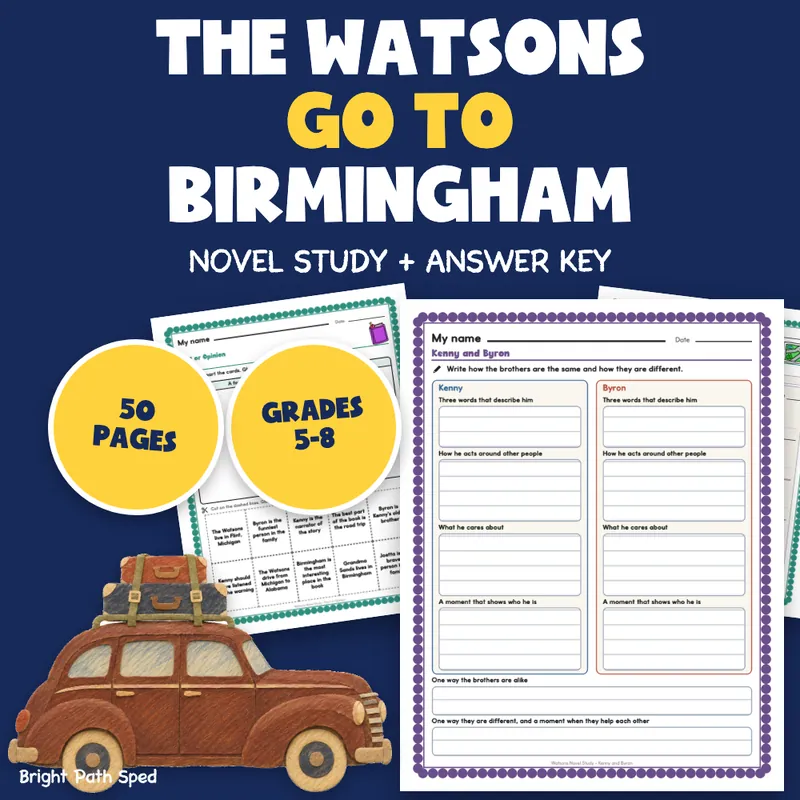
The Watsons Go to Birmingham Novel Study
- 50 pages
- 5th, 6th, 7th, 8th
$3.00 $6.00 on Teachers Pay Teachers
Half the Teachers Pay Teachers price. The same PDF, sold direct.
DownloadOr get it with All-Access: pick any 20 resources a month for $7.
New here? Your first month of All-Access is half off with code TEACHERTOK
Already bought this, or a member?
Instant download. One teacher's license: colleagues need their own copy. Each file carries a license number.
Also on Teachers Pay Teachers: see the Bright Path Sped store
About this resource
Looking for a Watsons Go to Birmingham novel study that gets students talking about family, courage and the year 1963? This is a complete study for grades 5-8 to use with The Watsons Go to Birmingham - 1963 by Christopher Paul Curtis: 27 comprehension questions in 9 parts, 24 vocabulary words, a 1963 reading page, a plot path, a character map, a conflict chart, a Kenny-and-Byron page and a fact-or-opinion cut-and-sort. It ends with an essay, a final project and an answer key (pages 41-45).
Every question, word and page is our own. There is no text from the book in this file. Students use their own copy of the book. Every question is a discussion question, and every question page says it is okay to pass.
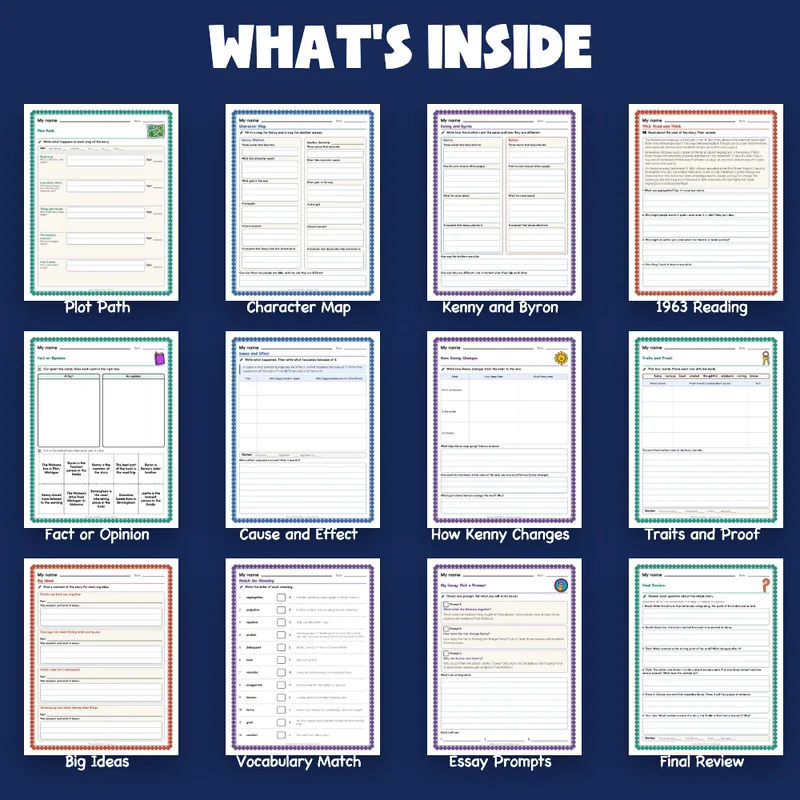
EVERYTHING INSIDE (pages 1 to 50)
- 34 student pages, each with a "My name" line and one short instruction
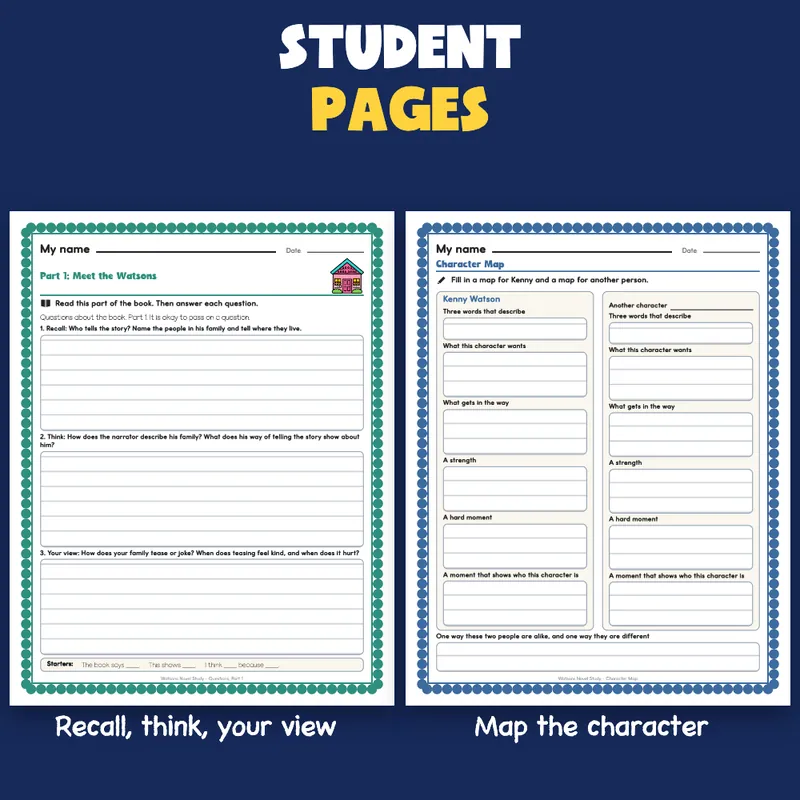
- 27 comprehension questions in 9 parts, 3 on each page: recall, think and your view (student pages 7-15). The nine parts are our own split of the book, with our own labels
- A before-you-read page and a 1963 reading page with 4 questions, written in our own words
- A 5-step plot path (somebody, wanted, but, so, then), a character map for Kenny and one other character, a conflict chart, and a page that compares Kenny and Byron
- A page of 3 invented everyday choices where students check a choice and give a reason
- A 10-card cut-and-sort, Fact or Opinion: cards to cut apart and glue in the right box (5 and 5)
- A cause-and-effect page with 5 rows, a how-Kenny-changes chart (start, middle, end), a traits-and-proof page (pick four words, prove each one) and a write-a-letter page
- Vocabulary: 24 words on 4 word pages, each with our own definition and a spot for the student's sentence, plus a 12-word match
- A big-ideas page (4 ideas), a text-evidence page (claim, evidence, reasoning), a 6-question final review and a questions-I-still-have page
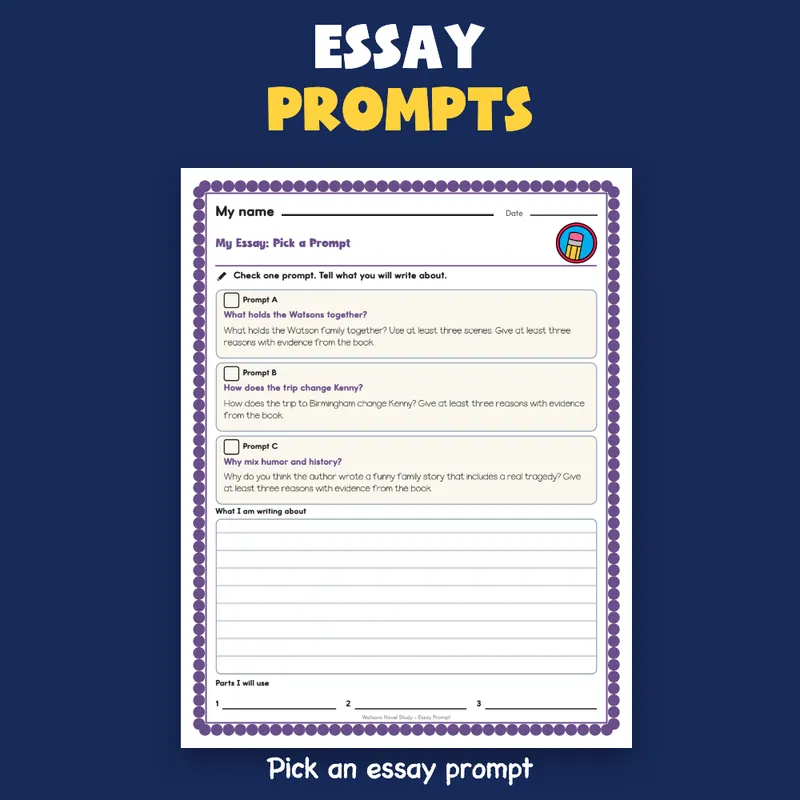
- A three-prompt essay: a prompt page, a plan page with a checklist and a draft page
- A final project page with 3 choices (a trip map, a note to a character or a book review), a work space and a checklist
- Teacher pages: a how-to page with a plan for the whole book and a place to write your own chapters, a discussion guide with 6 questions, a 1963 Birmingham background page with a 7-row timeline, an answer key over five pages, an essay rubric, a filled example (an invented student with an invented story), a family page and a phrase bank (19 starters in 6 groups)
- Start Here page with a which-page-for-which-job chart
How To Use It
1. Students read the 1963 reading first. Then read the book in 9 parts: the how-to page has a plan and a table to write your own edition's chapters, because editions differ.
2. Students answer the question page for each part, and keep the plot, character and conflict pages going alongside.
3. Talk about family, courage and unfair rules with the guide, the choices page and the sort, teach the words, then finish with the final review, the essay or the project.
The 1963 Background
The student page and the teacher page cover only well-known events in our own words: segregation, the Birmingham protests of 1963, the bombing of the 16th Street Baptist Church and the Civil Rights Act of 1964. The teacher page has a short timeline, a note on what is real and what is made up, and tips for teaching it with care. It is a starting point, not a full history, and it tells you to check dates against a trusted source before you quote them.
Answer Key Included
Recall questions give the answer where it is a fact we are sure of. Think and your-view questions say Varies and tell you what to look for: a detail, a part of the book and a reason. Vocabulary has a model sentence for each word and the match answers. The key gives away how the story goes, so keep it from students until the book is done.
Built For The Student Holding The Page
A big "My name" line, one short instruction with a small picture cue, a plain colored border, sentence starters and room to write on every page. Nothing on a student page is written for an adult.
Invented Examples
The filled example is an invented student working on an invented story about a school play, so it never repeats the book. It is not the book, and it says so on the page. The everyday choices are invented too.
Type In, Or Print
The name line, every ruled box and every table cell are type-in fields in any PDF reader: click one, type, then save. You can also print any page. This is a fillable PDF; it is not a Google Slides or PowerPoint file.
What This Is, And What It Is Not
A study guide with original questions, vocabulary and graphic organizers for a novel you teach with your own copy of the book. It is not the book, does not reproduce its text, and does not match any one state's standards. The book deals with prejudice and a real tragedy, so read it first and decide what fits your students. This resource is not affiliated with or endorsed by Christopher Paul Curtis, the publisher, or the owners of the book The Watsons Go to Birmingham - 1963.
Who This Is For
Teachers of grades 5-8 reading The Watsons Go to Birmingham - 1963 as a class, in literature circles or independently, and substitutes who need a ready-to-go question page.