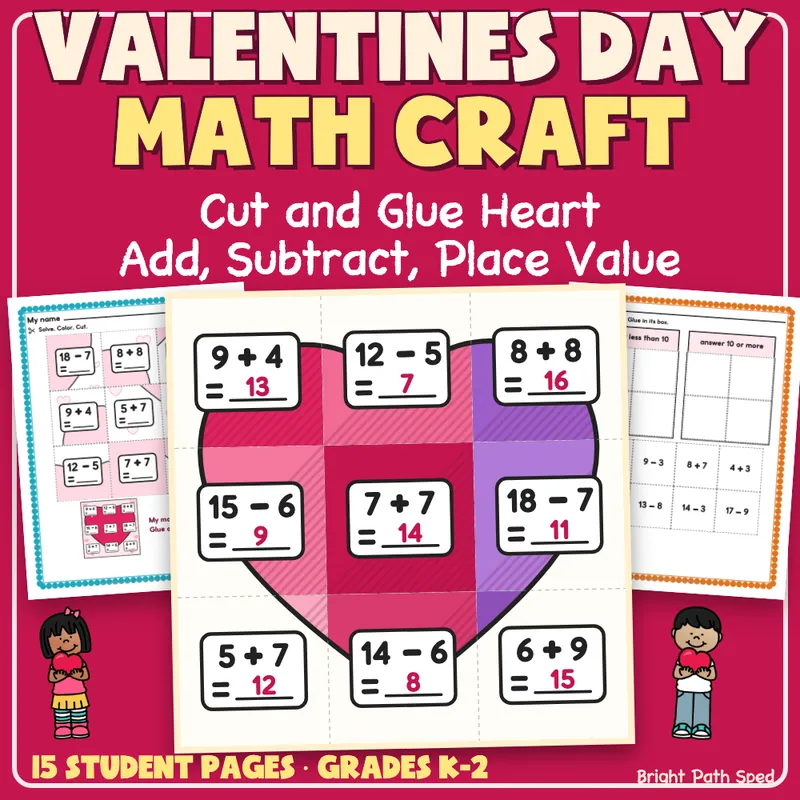
Valentines Day Math Craft
- 20 pages
- Kindergarten, 1st, 2nd
$2.25 $4.50 on Teachers Pay Teachers
Half the Teachers Pay Teachers price. The same PDF, sold direct.
DownloadOr get it with All-Access: pick any 20 resources a month for $7.
New here? Your first month of All-Access is half off with code TEACHERTOK
Already bought this, or a member?
Instant download. One teacher's license: colleagues need their own copy. Each file carries a license number.
Also on Teachers Pay Teachers: see the Bright Path Sped store
About this resource
A Valentine's Day math craft where the math builds the heart: one big red heart is cut into 9 tiles, and every tile has a math problem on it. Children solve the problem, color the tile, cut it out and glue it in the box that shows its answer. When every answer is right, the 9 tiles make one whole heart, so the craft checks itself. It comes in 3 levels (add within 10, add and subtract within 20, and tens and ones) for kindergarten to 2nd grade and special education classrooms, with a recording sheet for each level, a sort, ten-frames, a number sentence page and a heart story. Print and go: you only need scissors and glue.
How The Heart Works
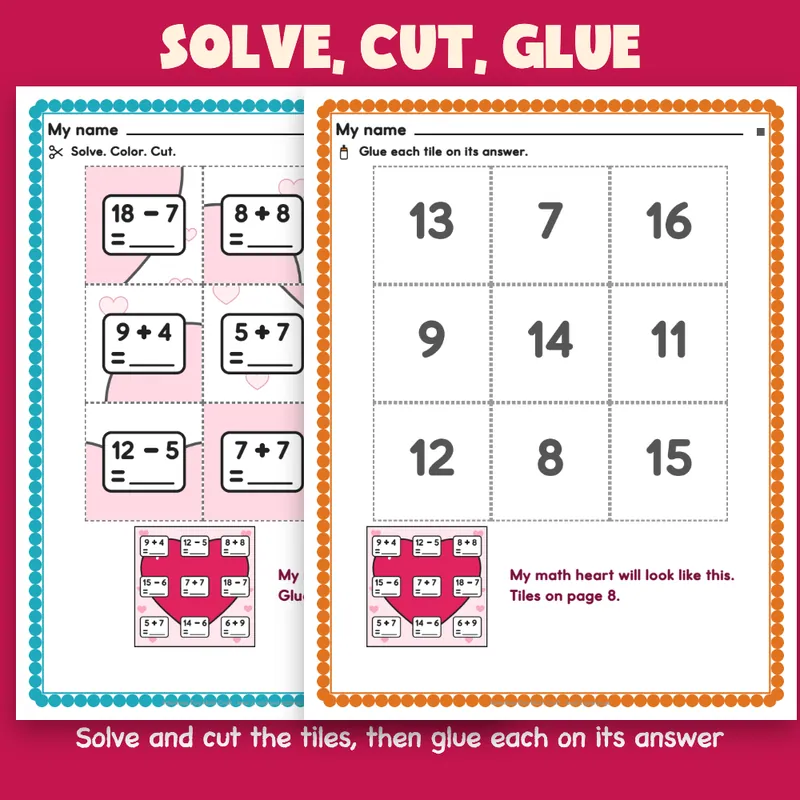
Each level has a tile page, a glue page and a recording sheet. The tile page holds 9 tiles, each 2.1 inches square, edge to edge, so every cut is a straight line. The tiles are black-and-white outlines to color (print in color too if you like). The glue page has 9 boxes, each exactly the size of a tile, and each box has a number in it. A child solves the problem on a tile and glues the tile in the box with the answer. The tiles are printed in a shuffled order, so children have to solve to place them. A small picture of the finished heart sits on every page for checking. Every student page has a "My name" line and one short instruction with a picture.
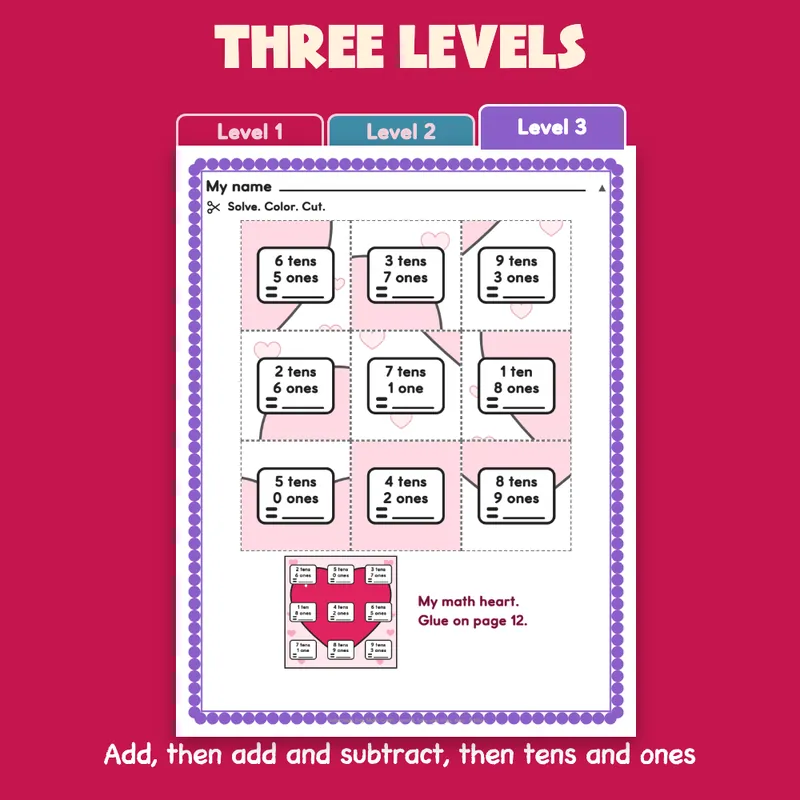
THREE LEVELS (the small circle, square or triangle beside the name line only marks the level)
- Level 1, add within 10: 9 problems, answers 2 to 10, with ten-frames on the recording sheet
- Level 2, add and subtract within 20: 9 problems, 5 adding and 4 taking away, answers 7 to 16, with two ten-frames to work in
- Level 3, tens and ones: 9 problems like "3 tens 7 ones", answers from 18 to 93, with a tens and ones mat to work in
What'S Inside
- Start Here: how the craft works, the three levels and a five-day plan
- How to make it: four steps with a picture for each, and the finished heart
- A math words page: 6 words (add, subtract, equals, tens, ones, heart) to trace and write on handwriting lines
- Level 1, level 2 and level 3, each with a tile page (9 tiles), a glue page (9 numbered boxes) and a recording sheet (9 problems with room to show your work)
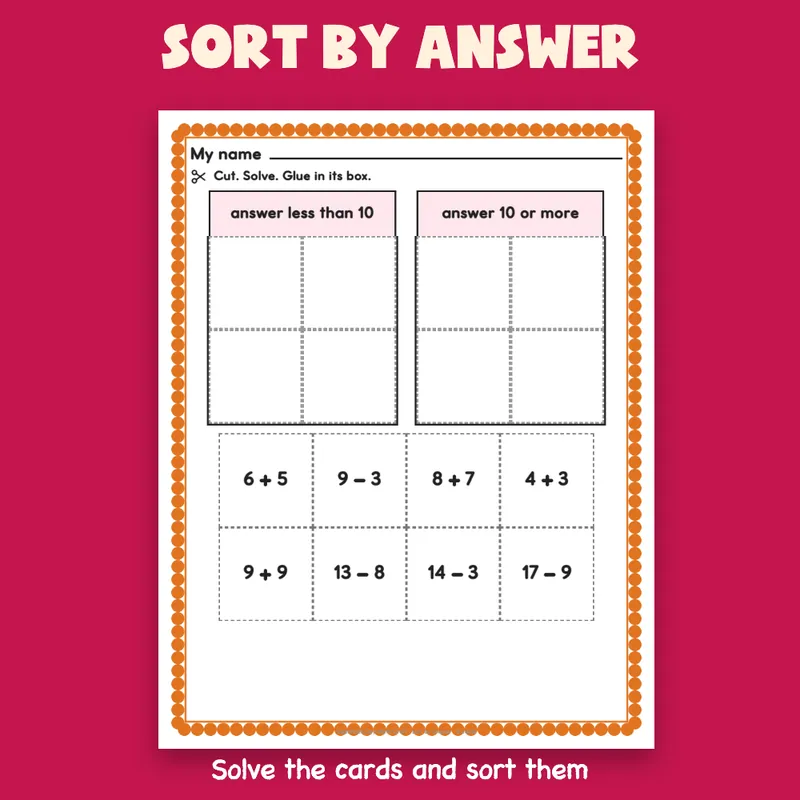
- Sort by answer: 8 problem cards, cut and glue each under "answer less than 10" or "answer 10 or more"
- Count the hearts: 6 ten-frames to count to 10
- Make my own heart: a big drawing box and a number sentence to write
- A heart story: "I had... I got... Now I have..." with a word bank and a drawing box
- A "Who Did What This Week" class data page with an answer key for every page (the first row is an invented example)
- A family letter to send home
- A credits page (font and art license)
20 pages in all, 15 of them for students.
Cutting Built For Small Hands
Every cutting page has big squares lined up edge to edge: 2.1 inches for the heart tiles and 1.65 inches for the sort cards. 35 pieces to cut in all (3 levels of 9 tiles, and 8 sort cards). You will need crayons, scissors and glue sticks. Card stock suits the glue pages.
Who This Is For
Kindergarten, 1st and 2nd grade classrooms, self-contained special education classrooms, math centers, and paraprofessionals who want a Valentine's Day math craft with the three levels already made, ready to print.
What This Is, And What It Is Not
A printable PDF (print and cut). The heart is a paper puzzle to solve, color, cut and glue. It is not Google Slides, Docs or PowerPoint, and it has no fillable fields. It has no faces drawn on it, and it is a math craft, not a math program: it gives no guidance for any child and makes no claim about any student's age or rate of progress.