Vocabulary by Function Picture Cards
- 19 pages
- Not Grade Specific
$5.00
DownloadOr get it with All-Access: pick any 20 resources a month for $7.
New here? Your first month of All-Access is half off with code TEACHERTOK
Already bought this, or a member?
Instant download. One teacher's license: colleagues need their own copy. Each file carries a license number.
Also on Teachers Pay Teachers: see the Bright Path Sped store
About this resource
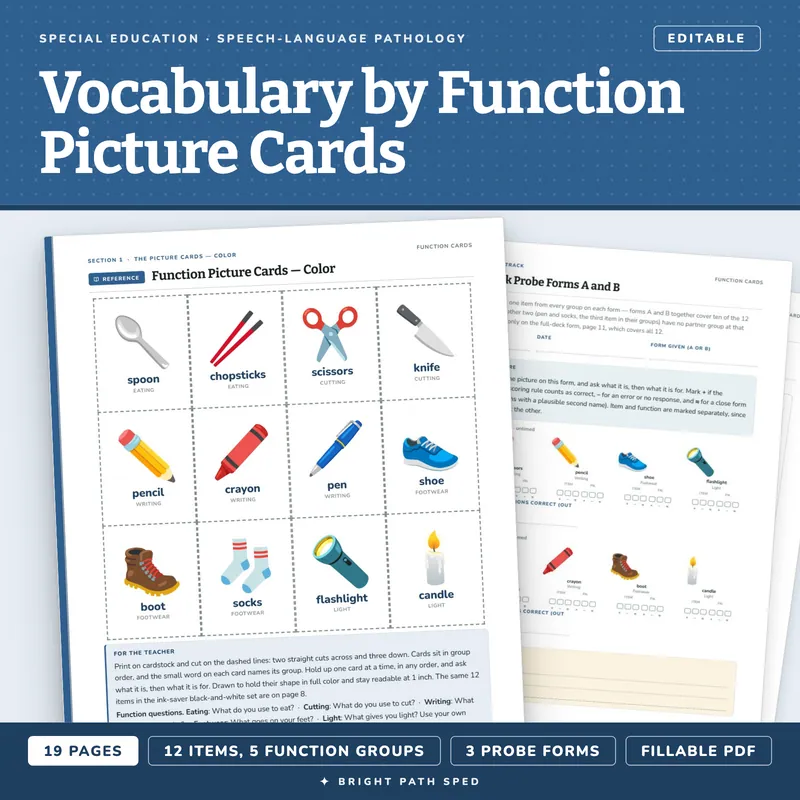
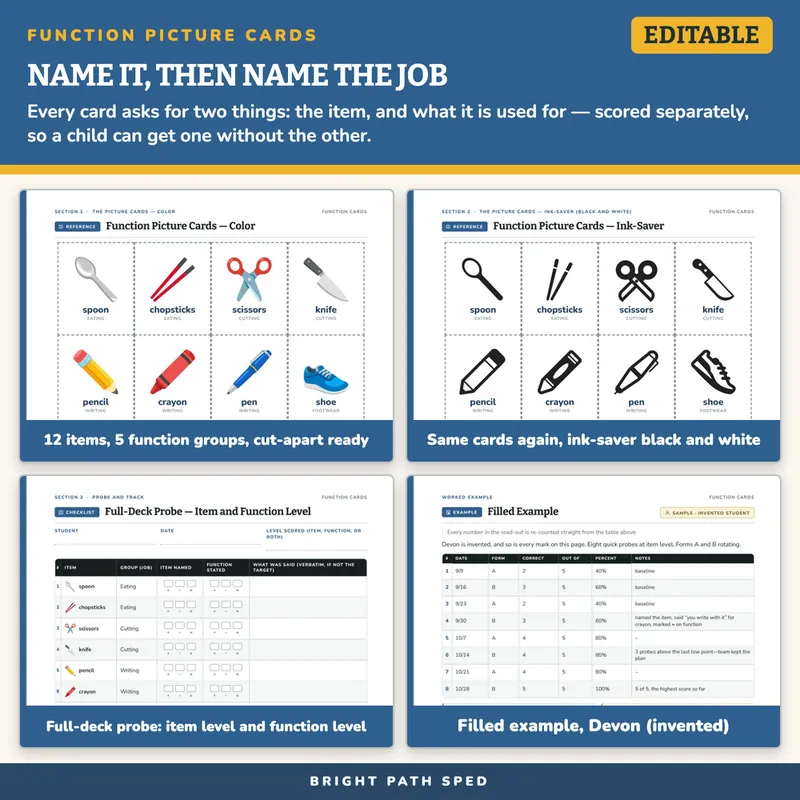
A picture card for every item on the probe, organized by the job it shares with a group of other objects, so a child who cannot yet read a word list still has something to look at — and every card asks for two things: what the item is, and what it is used for. This groups objects by USE ("spoon — you eat with it"), which is a different target from a picture set that groups by KIND.
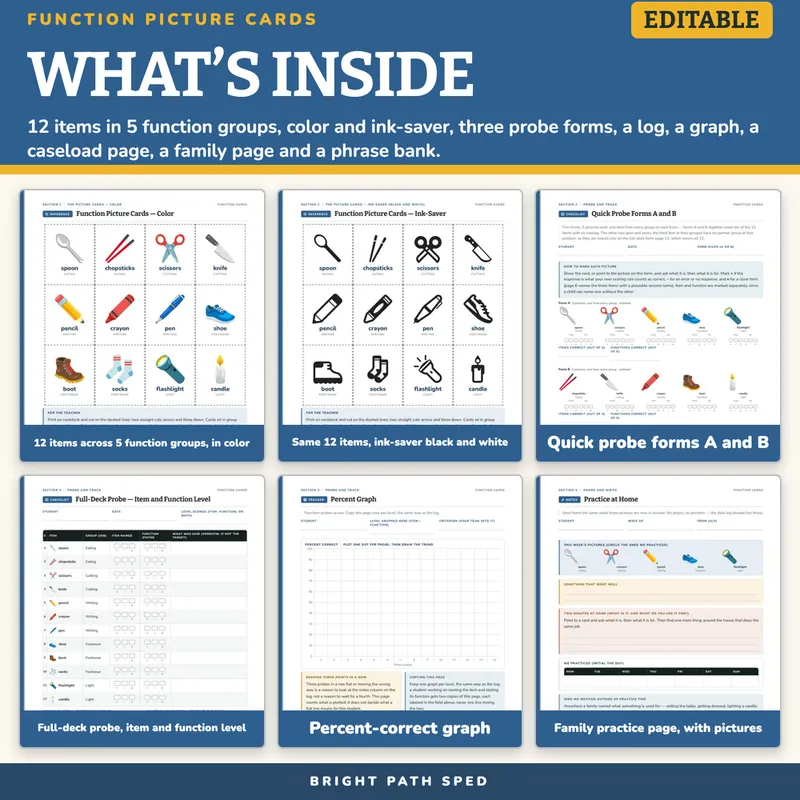
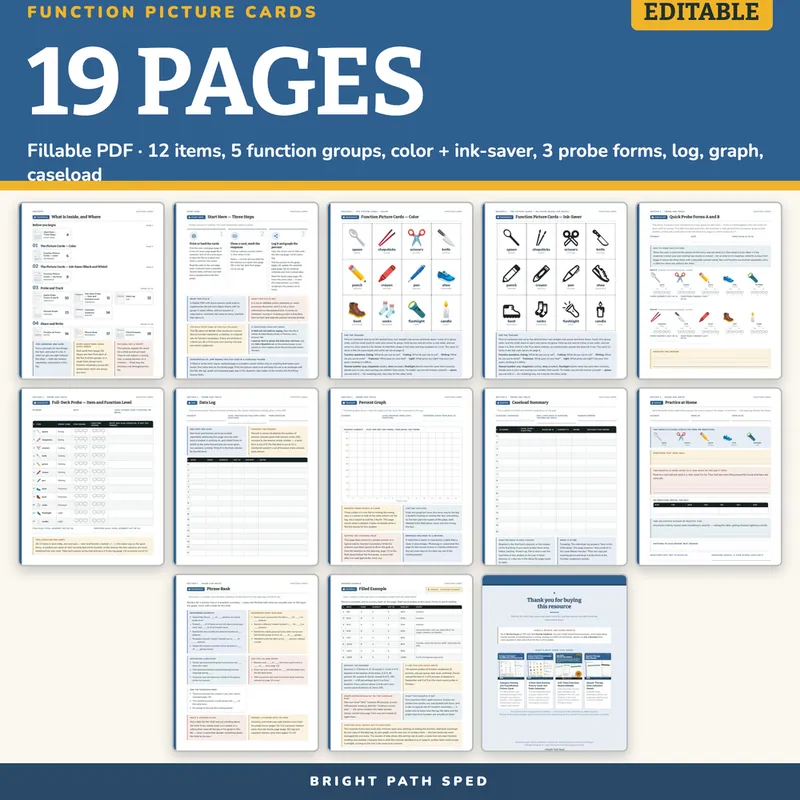
WHAT IS INCLUDED — 19 pages, 386 type-in fields
Picture Cards
- 12 picture cards in full color across 5 function groups — Eating (spoon, chopsticks), Cutting (scissors, knife), Writing (pencil, crayon, pen), Footwear (shoe, boot, socks), Light (flashlight, candle) — large picture and word on every card, the group's name printed small on each card, cards laid edge to edge in 4 across and 3 down so the whole sheet cuts apart with straight lines (2 cuts across, 3 down)
- The same 12 cards again as an ink-saver set in pure black outlines, for the photocopier
- A note printed on both card pages naming the 3 pictures a young child may name another way (chopsticks "sticks," shoe "sneaker," flashlight "torch") so the scoring rule is decided once, before the first probe
- A one-sentence modeling example (spoon, you eat with it) inside a card note, for a child who needs to hear one full answer first — an example, never a printed key for all 12 items
Probe And Track
- 2 quick picture probe forms (A, B), 5 pictures each — one item from every function group on each form, so every form tests function vocabulary across the whole bank — untimed, item and function each marked correct / error / approximation separately; Forms A and B together cover 10 of the 12 items with no overlap, plus a Notes on this session box on the page
- Full-Deck Probe — all 12 items on one sheet (adds the two items, pen and socks, that have no partner group on a five-a-side quick form), rows and totals out of 12, scored at item level and function level, with a verbatim column for what was actually said
- Data Log — 17 rows: date, form, correct, out of, percent, notes
- Percent Graph — 14 probes across, 0–100 percent grid, a field for the team's own criterion
- Caseload Summary — 16 rows: student, level, baseline, current, trend, decision
Share And Write
- Practice at Home — a family update built from five of the same pictures used in session (one per function group), a weekly practice table, and lines for the jobs a family noticed outside of practice time
- Phrase Bank — 18 observable-language starters across 5 groups (accuracy, what was said, carryover, the log and graph, the caseload page)
- Filled Example — an invented student, eight probes, every percent re-counted from its own row
What This Is, And What It Is Not
It is a fillable PDF: type into the log, graph, caseload page, family page, and probe-form headers, or print and use a pen. It works offline with no account or subscription. It is NOT an editable online slideshow or word-processor document, and it is not a norm-referenced or standardized test.
It carries no elicitation, cueing or modeling script beyond the one-sentence example noted above. It does not decide what counts as a correct item or function statement, a criterion, or a typical rate for function vocabulary — every one of those is this clinician's own call, written once and reused every session. The group labels printed on the cards (Eating, Cutting, Writing, Footwear, Light) name the shared job, not a fixed rule for what the child must say; use your own goal's wording if it differs. Pictures replace the printed word list a child cannot yet read; they do not replace the clinician's scoring rule.
Who This Is For
Speech-language pathologists and special education teams with young or pre-reading students on a function vocabulary, "what do you use to ___," or receptive-expressive vocabulary goal, and the families who get the practice page sent home.
Pictures: Noto Emoji by Google, Apache License 2.0 (color); Fluent Emoji by Microsoft, MIT License (ink-saver black and white).