Weather Instruments Middle School Science: Read, Label, Cut and Glue Grades 5-8
- 26 pages
- 5th, 6th, 7th, 8th
$1.75 $3.50 on Teachers Pay Teachers
Half the Teachers Pay Teachers price. The same PDF, sold direct.
DownloadOr get it with All-Access: pick any 20 resources a month for $7.
New here? Your first month of All-Access is half off with code TEACHERTOK
Already bought this, or a member?
Instant download. One teacher's license: colleagues need their own copy. Each file carries a license number.
Also on Teachers Pay Teachers: see the Bright Path Sped store
About this resource
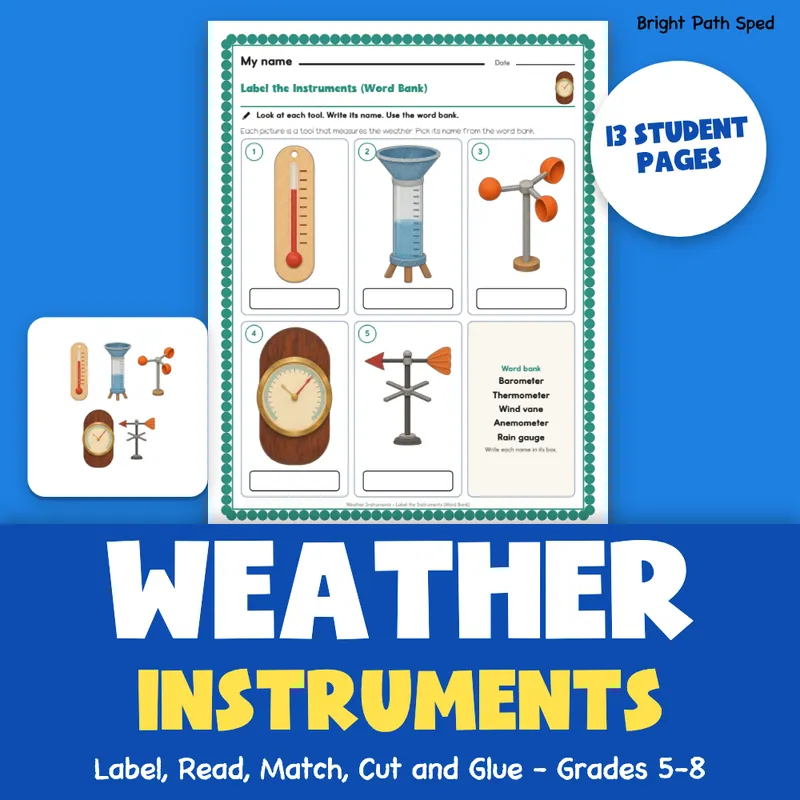
Teaching weather instruments to grades 5-8 and want pages where students actually read a thermometer and a rain gauge, not just color one in? This is a complete set. Students learn five instruments (thermometer, rain gauge, anemometer, barometer and wind vane), label them twice (once with a word bank and once with none), read drawn thermometers in degrees Celsius and Fahrenheit, read drawn rain gauges in centimeters, read wind vanes and wind speeds, match each tool to what it measures and its unit, pick the right tool for a job, write short answers and finish with two cut-and-glue pages. Answer keys give the answer for every item and a sample for every written answer.
EVERYTHING INSIDE (26 sheets)
- 13 student pages in 9 kinds of page, each with a name line and one short instruction
- 85 scored items spread over 11 scored worksheets, every answer key built from the same lists that print on the page
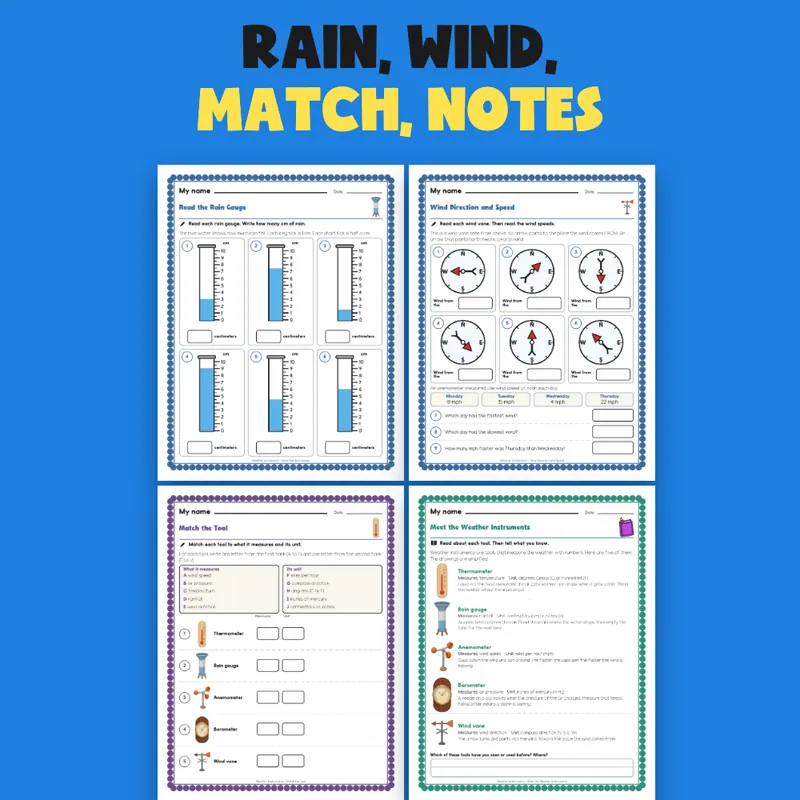
- 1 notes page on the five instruments: what each one measures, its unit and how it works
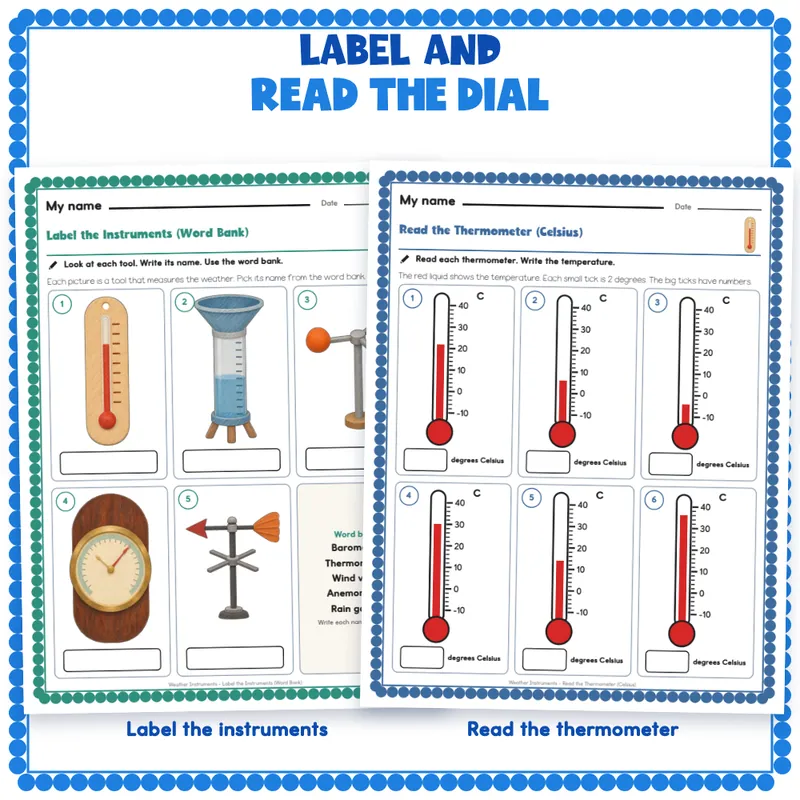
- 2 label pages on five illustrated instruments: with a word bank (5 pictures, 5 words in the bank) and with no word bank (the five tools in a different order, each named and with what it measures)
- 12 drawn thermometers to read: 6 in degrees Celsius (ticks 2 degrees apart) and 6 in degrees Fahrenheit (ticks 5 degrees apart), plus 2 questions on the Fahrenheit page
- 11 drawn rain gauges to read: 6 on one page (whole and half centimeters) and 5 on a rainy-week page (Monday to Friday) that also asks for the total and the rainiest day
- 1 wind page: 6 wind vanes seen from above to read (the arrow points to where the wind comes from), 4 wind speeds in miles per hour and 3 questions on them
- 1 match page: 5 tools matched to what they measure and to their unit, 10 answers in all
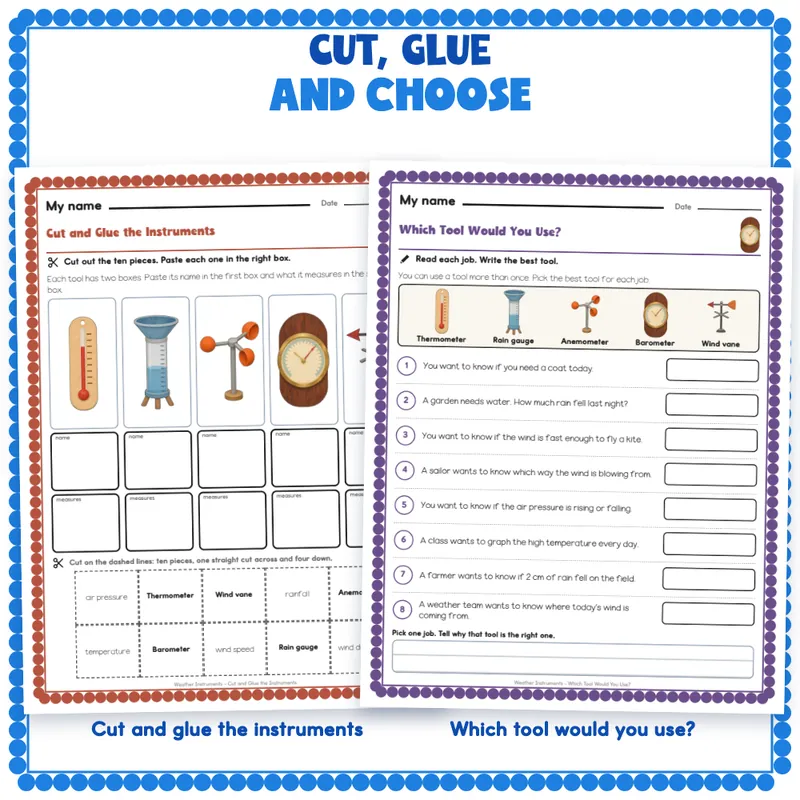
- 1 which-tool page: 8 jobs, each answered with one of the five tools
- 1 writing page with 3 prompts and an exit question
- 16 cut-and-glue pieces across two pages: the instruments (10 pieces in a 5 by 2 grid, a name and a "what it measures" box under each drawing) and tool facts (6 pieces in a 3 by 2 grid, pasted under thermometer, rain gauge or anemometer)
- 2 answer keys; 1 tracker, 1 class grid, 1 family page
- 1 filled example (an invented student), 1 phrase bank (17 starters in 6 groups)
- A binder cover with type-in teacher and class fields, and a page of divider tabs (Learn and Label, Thermometer, Rain and Wind, Match and Choose, Cut and Glue) with a spine label to cut out
- Start Here, with a page for each job and a note for a paraprofessional, a sub or a family
Built For The Student Holding The Page
A "My name" line, one short instruction with a small picture cue, a plain scalloped border and big answer boxes. Nothing on a student page is written for an adult: the keys and records are on separate teacher pages. The cut pages have their pieces edge to edge, so there are only a few straight cuts. The five instruments are cut-paper style illustrations made for this file by Bright Path Sped; the reading scales and wind vane views are plain diagrams: no photos, no faces, no people, no animals. Clip art is kept to a book and a pencil. The file prints clean in black and white.
A Short Account, Not A Full Weather Course
The notes are a plain-words summary written for this file (a thermometer measures temperature, a rain gauge measures rainfall, an anemometer measures wind speed, a barometer measures air pressure, a wind vane shows which way the wind comes from). Every reading on the pages is invented, the drawings are simplified and not to scale, and the pages say so. Check units against your own textbook; the pages are not tied to any standard.
Type In, Or Print
The name line, every answer box and every ruled work box are type-in fields in any PDF reader: click one, type, then save. This is a fillable PDF; it is not a Google Slides or PowerPoint file.
What This Is, And What It Is Not
A set of weather-instrument pages with the record-keeping around them. It is not a timed test, a screener, a clinical tool, or a claim about any student's age or rate of progress. There is no IEP goal language or eligibility wording anywhere in the file, and no claim of alignment to any standard. The only student in the file is an invented example, and it says so.
If You Want More
Muscular System Worksheets | Diagram, Sort, Fill-In 6th-8th Grade; Body Systems Worksheets | Diagram, Sort, Fill In, Short Answer 6th-8th Grade; Cell City Project Grades 6-8.