Auditory Discrimination Data Sheets Editable
- 22 pages
- Not Grade Specific
- PDF, fillable
$3.50
DownloadOr get it with All-Access: pick any 20 resources a month for $7.
New here? Your first month of All-Access is half off with code TEACHERTOK
Already bought this, or a member?
Instant download. One teacher's license: colleagues need their own copy. Each file carries a license number.
Also on Teachers Pay Teachers: see the Bright Path Sped store
About this resource
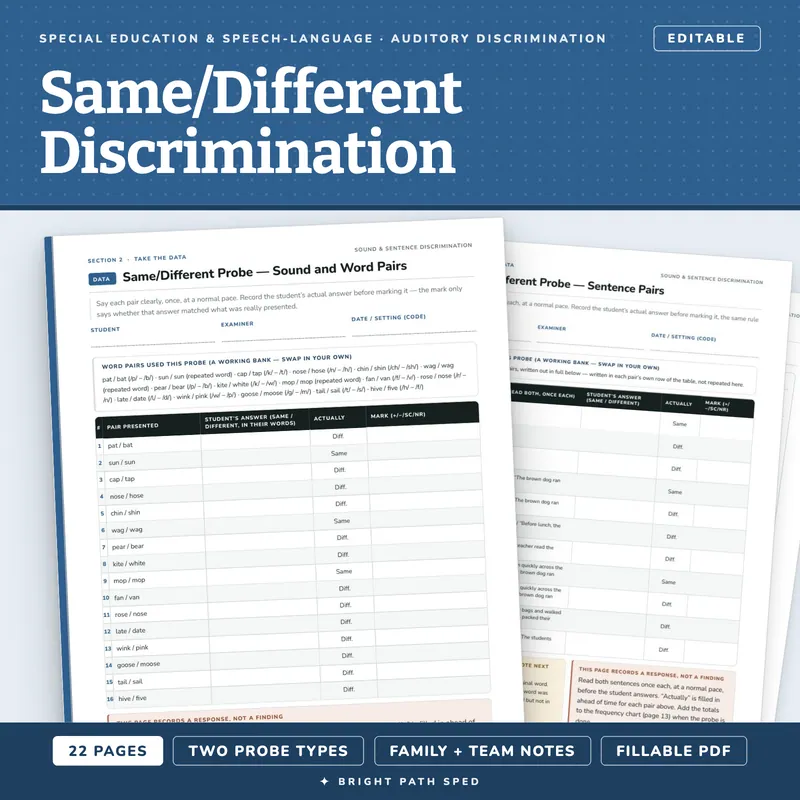
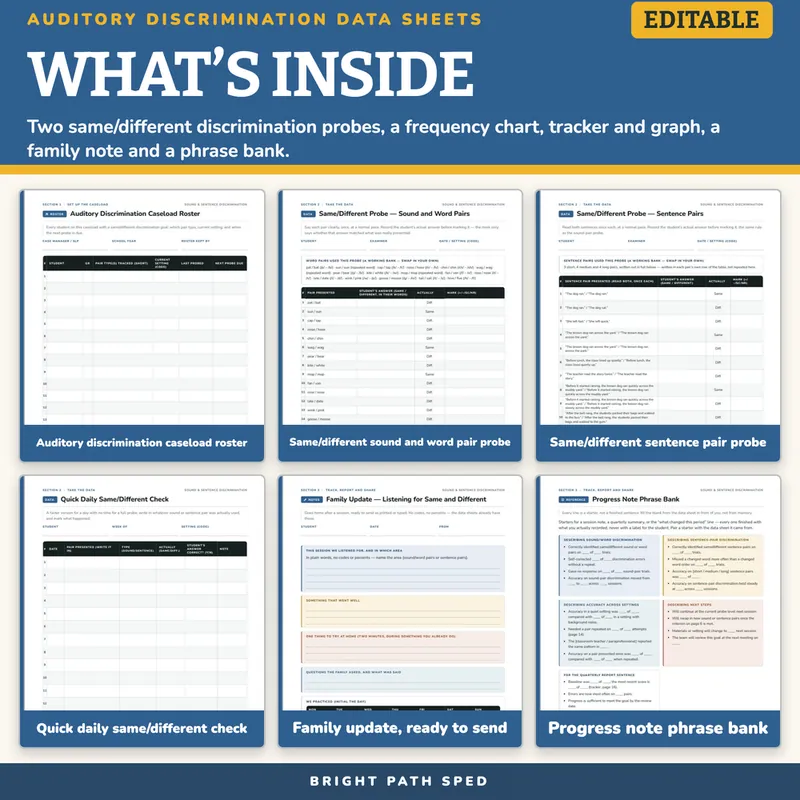
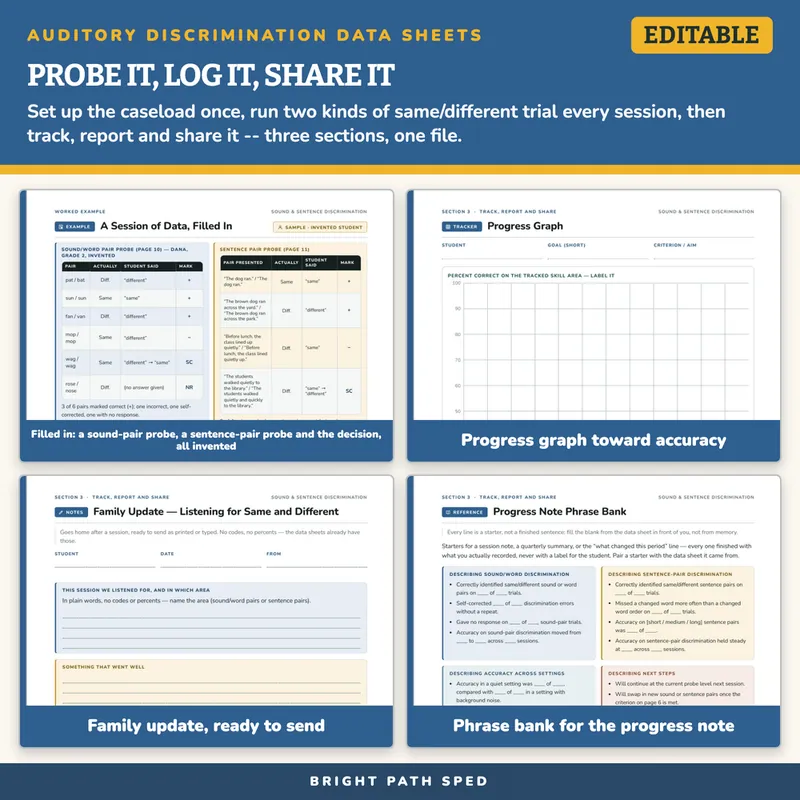
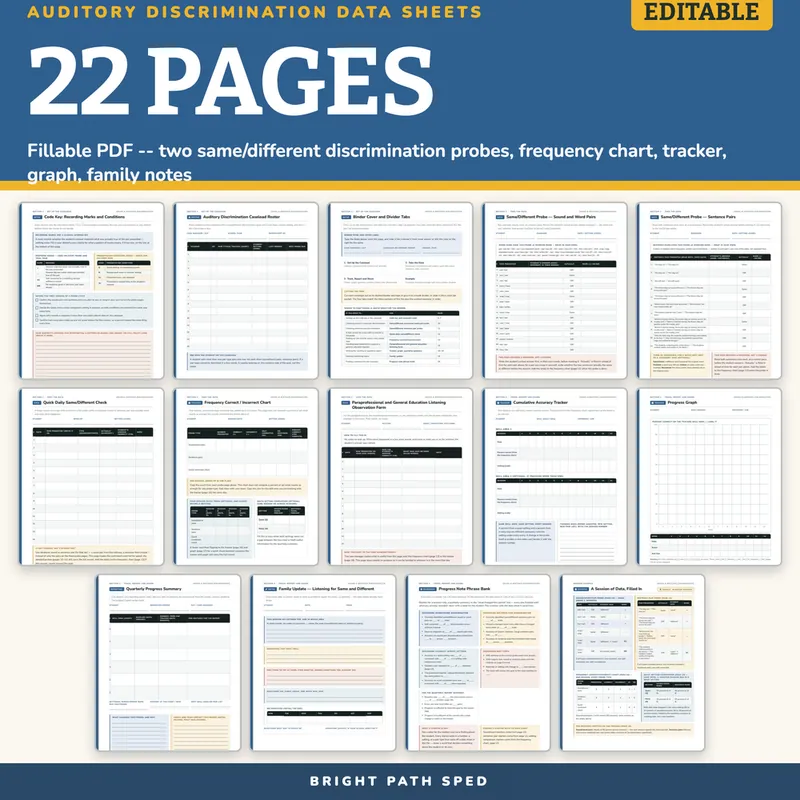
Everything inside: 22 pages, 537 type-in fields · two same/different discrimination probes (16 sound/word pairs, 11 sentence pairs across short/medium/long lengths) · a fast combined daily check for both probe types · a within-session frequency chart with a setting-comparison table and a 4-session quick-trend table · a whole-caseload roster · a binder cover and 4 cut-out tabs · a 2-skill-area, 12-session tracker and graph · a quarterly summary · a family update · a 20-starter phrase bank · a simplified paraprofessional form · a worked, invented example.
Speech-language pathologists and special educators are asked to show whether a same/different auditory discrimination goal is changing, across however many students are on a caseload — not just whether a wider five-skill binder's pages were filled in. This file is the narrower trial-data system for exactly that goal: run a sound/word pair probe, a sentence pair probe, or the quick combined check, mark what the student actually answered, add the session up on one chart, and roll it into a report and a family update that write themselves. Every mark on every page says only whether the student's recorded answer matched what was actually true of the pair presented — never a score against a published norm, a name for a condition, or a rule for when a referral is warranted.
WHAT IS INCLUDED — 22 pages
Set Up The Caseload
- Code Key: Recording Marks and Conditions — 4 response marks (+/−/SC/NR), 4 presentation-condition codes (quiet/noisy, presented once/twice), and a 4-item "before the first session" setup checklist, every descriptor a blank line the team defines
- Auditory Discrimination Caseload Roster — 14 rows: student, pair type(s) tracked, current setting, last probed, next probe due
- Binder Cover and Divider Tabs — a spine/cover card, 4 cut-out tabs matching the file's sections, and a 9-row "where to find things" index
Take The Data
- Same/Different Probe, Sound and Word Pairs — a 16-pair working bank (3 identical pairs, 13 different-sound pairs, so a real probe cannot be passed by always answering "different"), with the actual same/different answer printed beside every pair
- Same/Different Probe, Sentence Pairs — an 11-pair working bank across three lengths (short/medium/long; 3 identical pairs and 8 pairs that differ by a substituted, omitted, added, or reordered word), with a difference-type reference legend
- Quick Daily Same/Different Check — a 14-row log for whatever sound or sentence pair actually came up that day, trading the fixed bank for speed
- Frequency Correct/Incorrect Chart — one row per probe type (3 rows) tallying presented/correct/incorrect/self-corrected/no-response for the session, an optional quiet-versus-noisy setting-comparison table, plus an optional 4-session quick-trend table (3 rows x 4 sessions) for a fast read before a meeting
- Paraprofessional and General Education Listening Observation Form — 12 rows, plain words instead of codes, for the adult in the room who is not the case manager
Track, Report And Share
- Cumulative Accuracy Tracker — two 12-session blocks (skill area 1, and an optional skill area 2), with date, percent correct and setting logged each session
- Progress Graph — a scaled 0–100 grid to plot the trend, with an aim line
- Quarterly Progress Summary — 6 rows (baseline, current level, one sentence per skill area), plus settings, percent then/now, and two write-on cards
- Family Update — Listening for Same and Different — a ready-to-send communication page: what was worked on and which area, something that went well, one thing to try at home, family questions and answers, and a 7-day practiced table
- Progress Note Phrase Bank — 20 observable-language starters across 5 groups (sound/word discrimination, sentence-pair discrimination, accuracy across settings, next steps, the quarterly-report sentence), every one ending in a blank pulled from a data sheet in the file
Plus a Start Here quick-start, a 3-section contents page with real page thumbnails and a page-tag legend, 3 section dividers, and a "what's next" back page.
What This Is, And What It Is Not
It is a fillable PDF. Open it in a PDF reader, click a field, type, Save As once per student. It works offline with no account or subscription. It is NOT a Google Sheets file, a Google Doc, or an Excel workbook, and it does not score a trial against a published norm or compute a percent for you.
It is not Auditory Processing and Discrimination Assessment and Tracking Data Sheets Editable — that file is a wider, five-skill caseload binder (sound/word pairs, sentence repetition, number memory, word/sentence memory, and multi-step directions). This file is the narrower cut for a goal written in terms of same/different discrimination only: a code key, a roster, two same/different probes, a fast combined daily check, a frequency chart, a tracker and graph, a quarterly summary, a family update, and a phrase bank. It is also not a hearing screening product and not a listening-comprehension product — nothing here tests understanding of a passage or logs whether a screening happened. No page in this file names a condition, states an age or a milestone, or sets a rule for when a referral is warranted; every criterion is a blank line the team writes in from the IEP and its own judgment. The sound pairs and sentence pairs are informal, invented examples built for this file, not a standardized instrument. No health data is pre-filled anywhere, and the example student (Dana) is invented and named as such on page 21.
Who This Is For
Speech-language pathologists and special education case managers with a same/different auditory discrimination goal on the caseload, plus the paraprofessionals and general education teachers who help collect the data.