Autism (ASD) Progress Monitoring Data Sheets Editable
- 25 pages
- Not Grade Specific
- PDF, fillable
$5.00
DownloadOr get it with All-Access: pick any 20 resources a month for $7.
New here? Your first month of All-Access is half off with code TEACHERTOK
Already bought this, or a member?
Instant download. One teacher's license: colleagues need their own copy. Each file carries a license number.
Also on Teachers Pay Teachers: see the Bright Path Sped store
About this resource
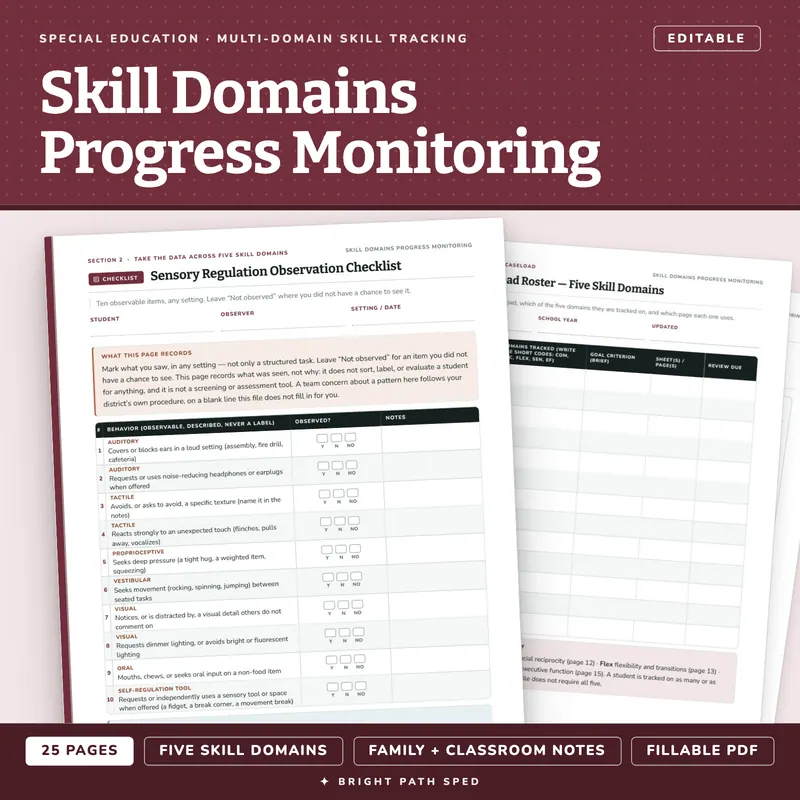
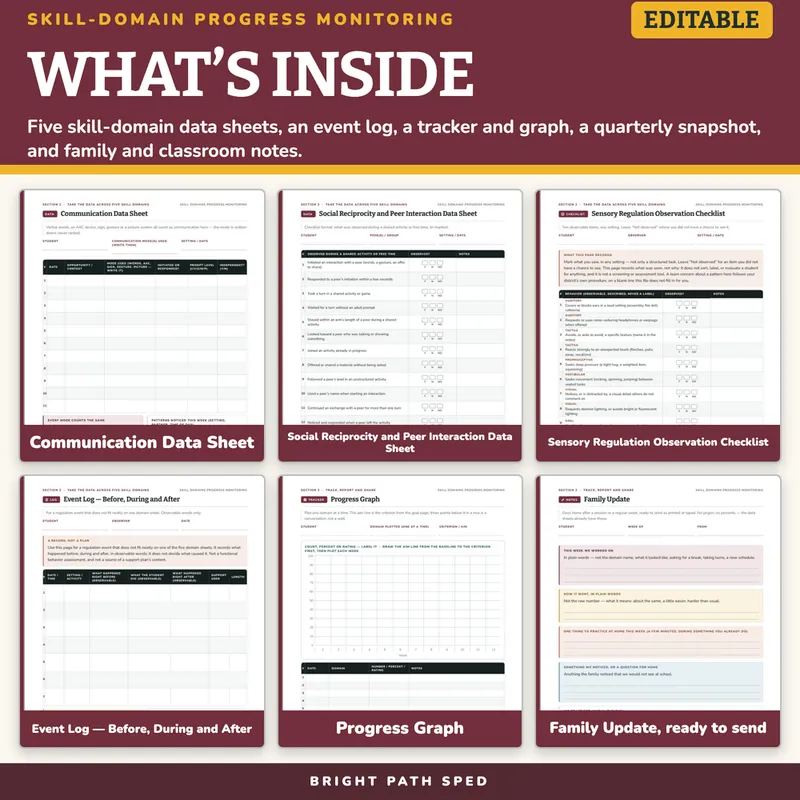
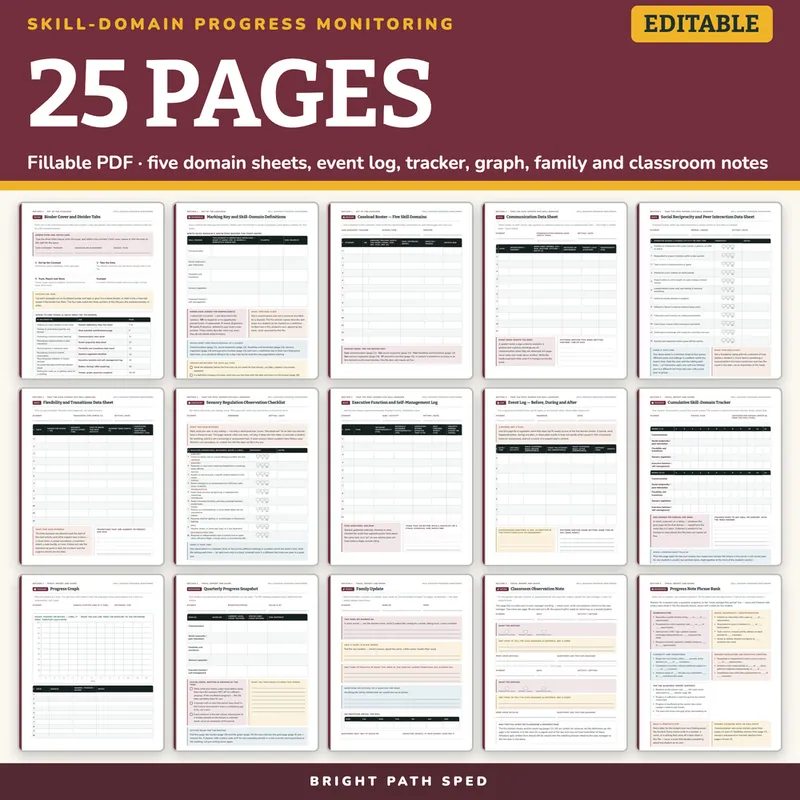
Everything inside: 25 pages · a marking key and domain-definitions page · a caseload roster across five skill domains · a goal page with one sample goal per domain · five data sheets (communication, social reciprocity, flexibility and transitions, a sensory regulation observation checklist, executive function) · a before/during/after event log · a two-block, 24-week cumulative tracker · a progress graph · a quarterly IEP-meeting snapshot · a ready-to-send family update · a classroom observation note for a second adult · an 18-starter phrase bank · a binder cover and 4 cut-out divider tabs · a worked, invented example.
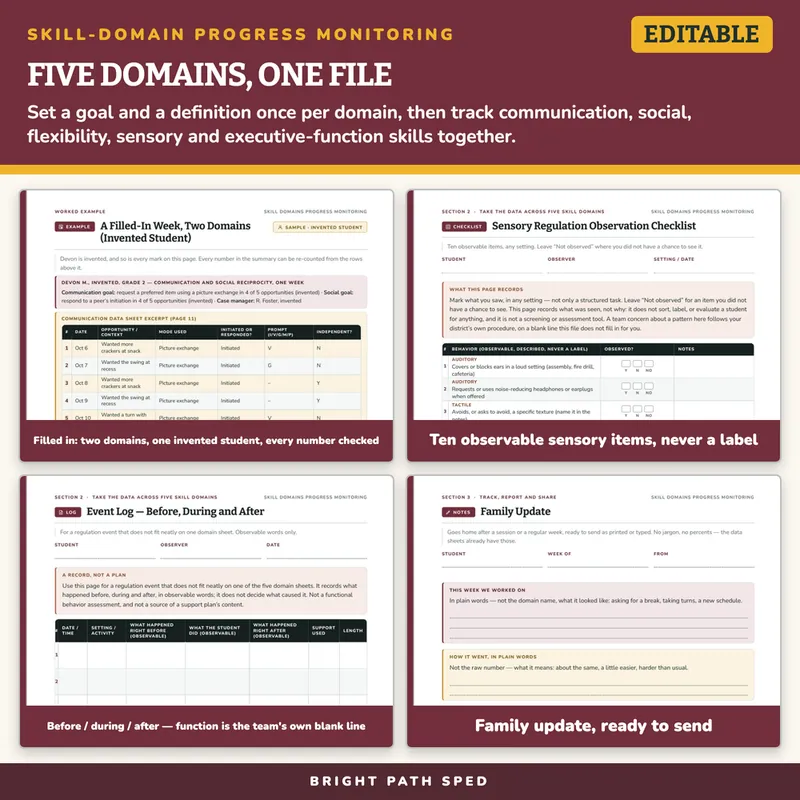
The store already carries a single-behavior data sheet (ABC, frequency, interval) and an undated planner, but nothing that tracks several skill domains on the same caseload at once. This file gives a case manager one place for communication, social reciprocity, flexibility and transitions, sensory regulation, and executive function / self-management — five domain sheets that share one marking key, one roster and one tracker, so a student tracked on three domains does not need three separate files.
WHAT IS INCLUDED — 25 pages, 746 type-in fields
Set Up The Caseload
- Binder Cover and Divider Tabs — a spine/cover card, 4 cut-out tabs matching the file's sections, and a 9-row "where to find things" index
- Marking Key and Skill-Domain Definitions — a 5-row definitions table (one row per domain: observable definition, example, non-example), the marks used across every sheet (+/−/NR, five prompt-level codes), a "which sheet uses which domain" reference, and a 2-item checklist for keeping definitions consistent all year
- Caseload Roster — 13 rows: student, grade, which of the five domains are tracked (short codes), goal criterion, sheet/page, review due
- Goal, Baseline and Directions by Skill Domain — one goal frame plus a 5-row table of sample goals, one per domain, every bracket meant to be edited, and a 3-observation baseline table
Take The Data Across Five Skill Domains
- Communication Data Sheet — 11 rows: opportunity/context, mode used (words, AAC, sign, gesture, picture — written in, never ranked), initiated or responded, prompt level, independent yes/no
- Social Reciprocity and Peer Interaction Data Sheet — 12 observable items (initiated, responded, took a turn, joined an activity, and more), each a real Y/N/NOT OBSERVED field
- Flexibility and Transitions Data Sheet — 12 rows: transition, advance notice given, time to begin the next activity, support used, completed without additional support
- Sensory Regulation Observation Checklist — 10 observable items across six sensory categories (auditory, tactile, proprioceptive, vestibular, visual, oral, plus a self-regulation-tool item), each a real Y/N/NOT OBSERVED field, framed explicitly as "what was seen, not why"
- Executive Function and Self-Management Log — 11 rows, four separate yes/no facts per task: initiated, gathered materials, completed on time, self-checked
- Event Log — Before, During and After — 7 tall rows (what happened right before, what the student did, what happened right after, support used, length) for an event that does not fit one domain sheet, plus a "hypothesized function, if any" line that is the team's own blank, never asserted by this file
Track, Report And Share
- Cumulative Skill-Domain Tracker — 5 domain rows by 24 weeks, two 12-week blocks
- Progress Graph — a scaled 0–100 grid plus a 10-row log table; plot one domain at a time
- Quarterly Progress Snapshot — 5 domain rows: baseline, current level, a status code the team defines, one sentence, plus a decision-rules card and a meeting-prep note
- Family Update — a ready-to-send communication page: what was worked on in family words, how it went, a practice idea, a 7-day practiced table
- Classroom Observation Note — two half-page notes per sheet, cut apart: a checkbox, one sentence, no codes, for the general education teacher or paraprofessional
- Progress Note Phrase Bank — 18 observable-language starters across 5 groups (communication, social reciprocity, flexibility, sensory/executive function, the quarterly-report sentence), every one ending in a blank pulled from a data sheet in the file
- A Filled-In Week, Two Domains — a worked, invented example (Devon M., invented second grader) with a 5-row communication excerpt, a 3-row social excerpt, and a 2-row tracker excerpt, every number cross-checked against the arithmetic behind it
Plus a Start Here quick-start, a 3-section contents page with real page thumbnails, 3 section dividers, and a "what's next" back page.
What This Is, And What It Is Not
It is a fillable PDF. Open it in a PDF reader, click a field, type, save. It works offline with no account or subscription. It is NOT a Google Sheets file, a Google Doc, or an Excel workbook, and it does not calculate a percent or draw the graph for you.
It is not a screening or evaluation tool, and it does not require any clinical label to be useful — every one of the five domains is a skill area any student can be tracked on. The sensory checklist and the event log record what was observed, never why: neither sorts, labels, ranks nor evaluates a student for anything. The event log's "hypothesized function, if any" line is copied by the team from their own plan or assessment; this file never suggests one. It is not Behavior Data Collection Sheets Editable, the single-target-behavior ABC/frequency/interval pack — use that file when one behavior needs a full functional data set, and this one when a caseload needs several skill domains tracked together. It is also not the Special Education Teacher Planner, which schedules and plans rather than collects data; the two pair well on the same desk.
No age, eligibility, IDEA-timeline, or diagnostic claim anywhere; no health data is pre-filled, and the example student (Devon) is invented and named as such on page 24.
Who This Is For
Special education teachers, behavior specialists and school psychologists working with an autism-focused caseload who need more than one skill domain tracked in one place — communication, social reciprocity, flexibility and transitions, sensory regulation, and executive function — plus the paraprofessionals and general education teachers who see the same student outside the case manager's room.
If You Want More
Behavior Data Collection Sheets Editable is the 22-page single-behavior pack: ABC, frequency, interval, scatterplot and a rating scale. Special Education Teacher Planner Editable (24 pages) is the undated planner that sits beside this file. Social Skills, Peer Interaction Progress Monitoring Data Sheets Editable (19 pages) goes deeper on the social domain. Self-Monitoring, Self-Regulation and Executive Function Progress Tracking Data Sheets Editable (19 pages) goes deeper on the executive-function domain.
You might also need
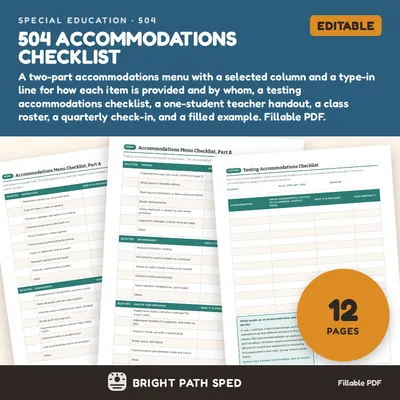
504 Accommodations Checklist Editable
$3.00 or with All-Access
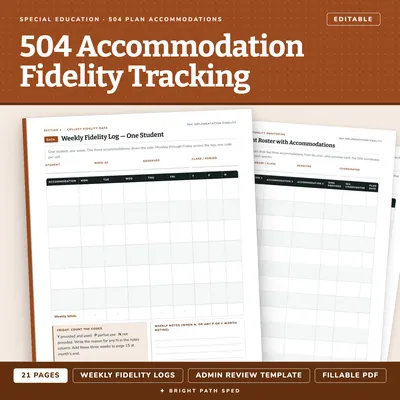
504 Plan Accommodation Implementation Fidelity Data Collection Editable
$3.50 or with All-Access
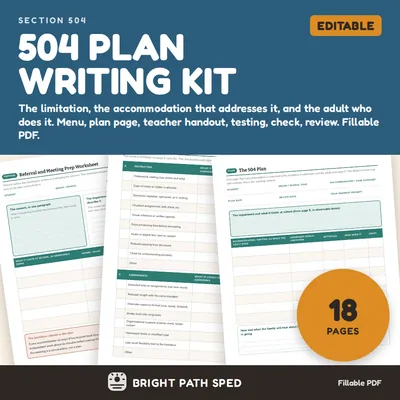
504 Plan Template Accommodations Checklist Teacher Handout
$5.00 or with All-Access
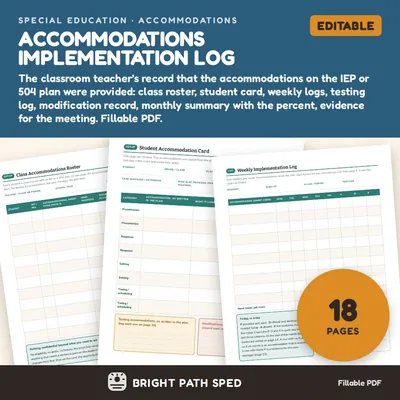
Accommodations Implementation Log Editable
$5.00 or with All-Access