Conversation Starters
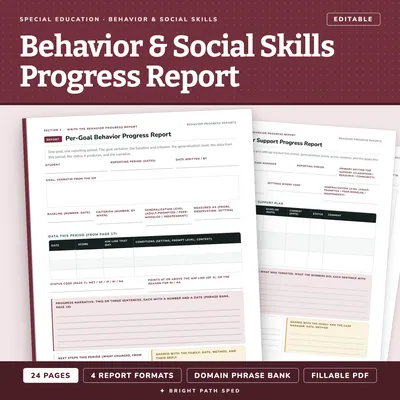
- 24 pages
- Not Grade Specific
$2.00 $4.00 on Teachers Pay Teachers
Half the Teachers Pay Teachers price. The same PDF, sold direct.
DownloadOr get it with All-Access: pick any 20 resources a month for $7.
New here? Your first month of All-Access is half off with code TEACHERTOK
Already bought this, or a member?
Instant download. One teacher's license: colleagues need their own copy. Each file carries a license number.
Also on Teachers Pay Teachers: see the Bright Path Sped store
About this resource
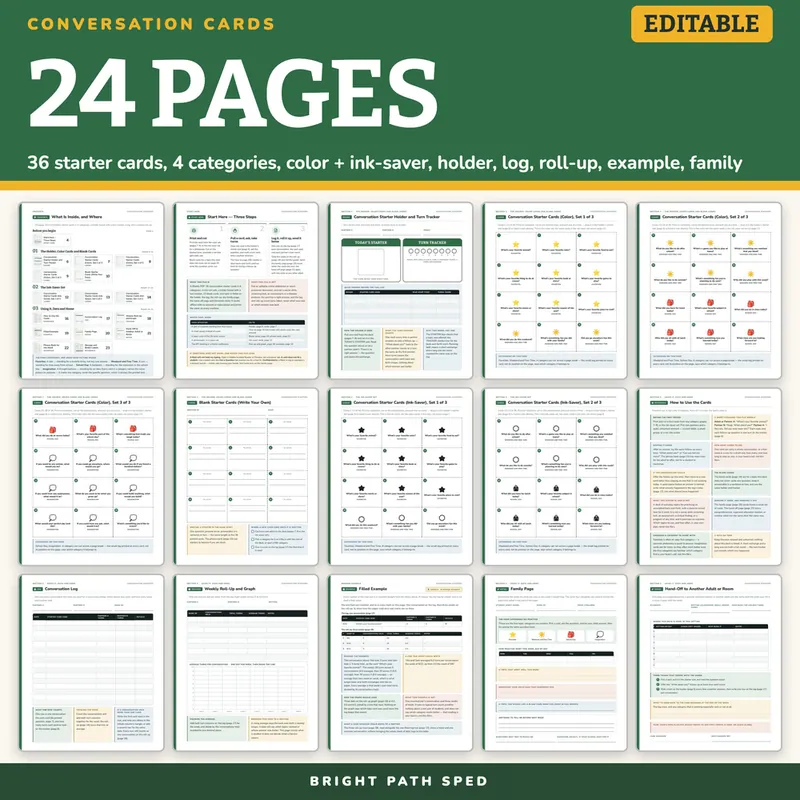
EVERYTHING INSIDE — 24 pages, 233 type-in fields
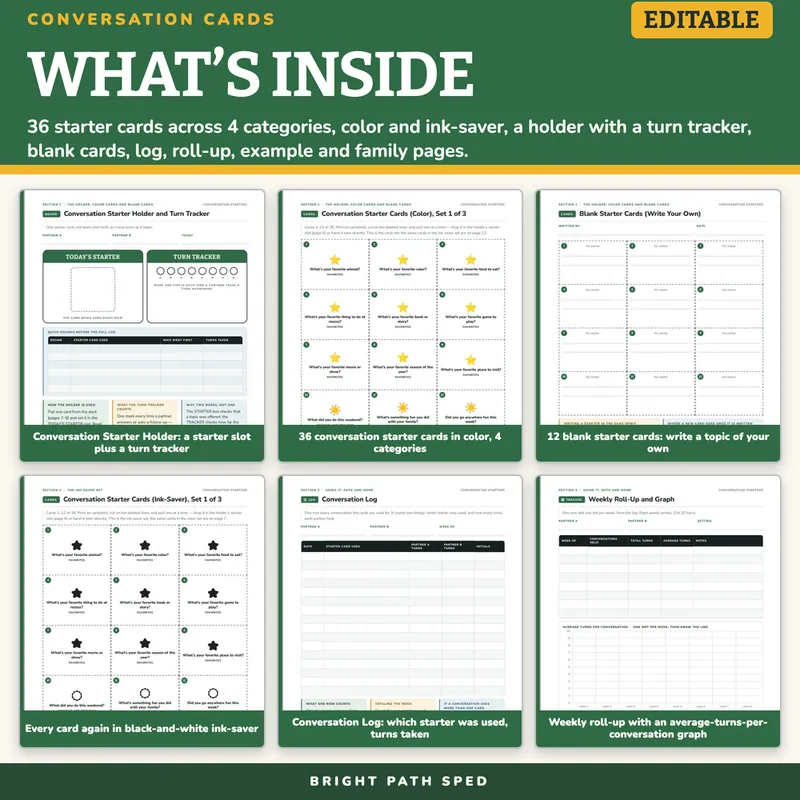
- A Conversation Starter Holder board: a “Today's Starter” slot, an 8-circle turn tracker (alternating Partner A / Partner B), and a quick-rounds table, for pulling one card at a time
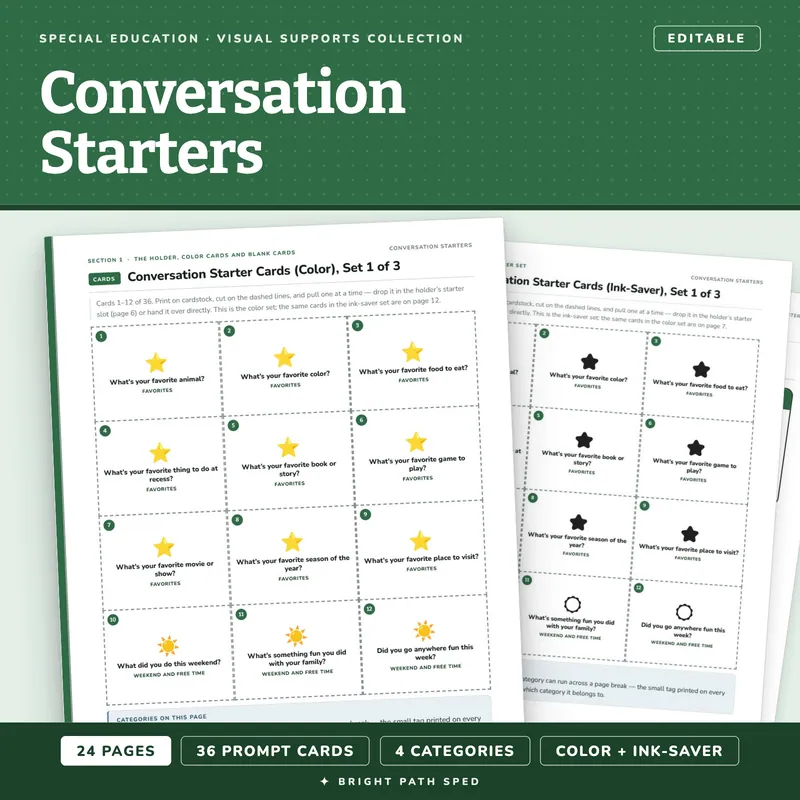
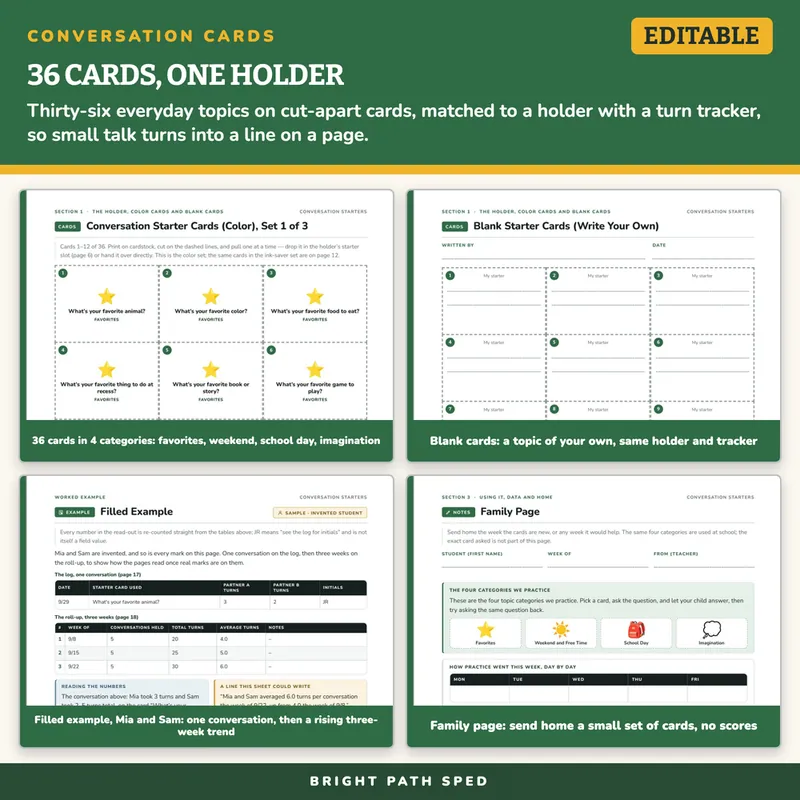
- 36 conversation starter prompt cards, cut-apart, across 4 categories — Favorites, Weekend and Free Time, School Day, Imagination — in full color across 3 sets of 12
- The same 36 cards again in black-and-white ink-saver line art, across 3 sets of 12, for a photocopier or a spare set
- 12 blank cut-apart cards for writing a starter of your own, with “My starter” writing lines
- A how-to page: before the first round, a short back-and-forth exchange this file models, keeping it going, how many cards to use, if the conversation stalls, the blank cards, what this system is and is not, sending home and handing off, choosing a category to start with, a note on tone
- A Conversation Log (16 rows: date, starter card used, Partner A turns, Partner B turns, initials)
- A weekly roll-up (8 weeks: conversations held, total turns, average turns, notes) with an average-turns-per-conversation graph
- A filled example — an invented pair of students, Mia and Sam, one conversation on the log and three weeks on the roll-up, every average re-derived from its own row
- A family page naming the four categories with a small picture strip, a day-by-day read-at-home table, and lines for what was said at home
- A hand-off page so a paraprofessional, a general education teacher or another adult runs the same deck the same way
- A phrase bank for the ADULT holding the deck: “try asking…” lines for keeping a turn going, plus starters for the log, the roll-up, the family page and a brand-new card, and a 3-point check before a new card is printed
- A storage and binder label sheet with one labeled cell per category and a spine strip
- Start Here, a contents page with page thumbnails, and a “what's next” back page
Thirty-six everyday, concrete questions a peer can actually answer out loud — “What's your favorite animal?”, “What did you do this weekend?”, “What's something that made you laugh today?”, “If you could have any superpower, what would it be?” — grouped into four everyday categories, never a clinical or screening-style item. There is no right answer on any card: the holder board's turn tracker counts how far the back-and-forth went, not what was said or which answer was best. A log and a weekly roll-up turn that into a line on a page.
The Holder Board
The Cards
Every card carries one small picture that marks its CATEGORY, not the specific question — a star for Favorites, a sun for Weekend and Free Time, a backpack for School Day, a thought balloon for Imagination — so every card in a category shares the same picture on purpose, disclosed on the cards pages themselves. The question text is always the point; the picture only sorts the deck into four groups. A category can run across a page break; the small tag printed on every card, not its position on the page, says which category it belongs to.
What This Is, And What It Is Not
It is a fillable PDF: type into the holder board, the log, the roll-up, the family page, the hand-off page and the blank cards, or print and use a pen. The card pages print on cardstock or plain paper; cards cut along dashed lines. It works offline with no account or subscription. It is NOT an editable online slideshow or word-processor document.
It is a deck of everyday topics for practicing an unscripted back-and-forth, with a place to record how far it went. It is NOT a social-skills screening tool, an assessment, a therapy protocol, a clinical finding, or a program of any kind, and it promises no outcome. No card has a right answer, and the log and roll-up count turns taken — never what was said or which answer was best. Which topics to use, and how often, is your own team's plan, never this file's.
Who This Is For
Special education teachers and paraprofessionals building in a regular time for peer small talk, speech-language clinicians working on initiating and maintaining a conversation, case managers who want that practice to show up as data for a meeting, and the families who get the home page sent home.
More In The Collection
Part of the Visual Supports Collection, alongside SEL Scenario Discussion Cards (ten open classroom scenarios with one constant question, not a prompt-card deck), Friendship Skills Cue Cards and Log, and WH-Question Visual Answer Cue Cards Editable (five question-word cue cards matched to an answer board); more picture-card sets are being added to the collection regularly. Also in the Visual Supports Collection Bundle — this and every other single in the collection, packaged together at 35% off buying them separately (each set keeps its own file).
Pictures (color pages): Noto Emoji by Google, Apache License 2.0. Pictures (ink-saver pages): Fluent Emoji, Copyright (c) Microsoft Corporation, MIT License.