Feelings Thermometer Desk-Strip
- 17 pages
- Not Grade Specific
- PDF, fillable
$1.75 $3.50 on Teachers Pay Teachers
Half the Teachers Pay Teachers price. The same PDF, sold direct.
DownloadOr get it with All-Access: pick any 20 resources a month for $7.
New here? Your first month of All-Access is half off with code TEACHERTOK
Already bought this, or a member?
Instant download. One teacher's license: colleagues need their own copy. Each file carries a license number.
Also on Teachers Pay Teachers: see the Bright Path Sped store
About this resource
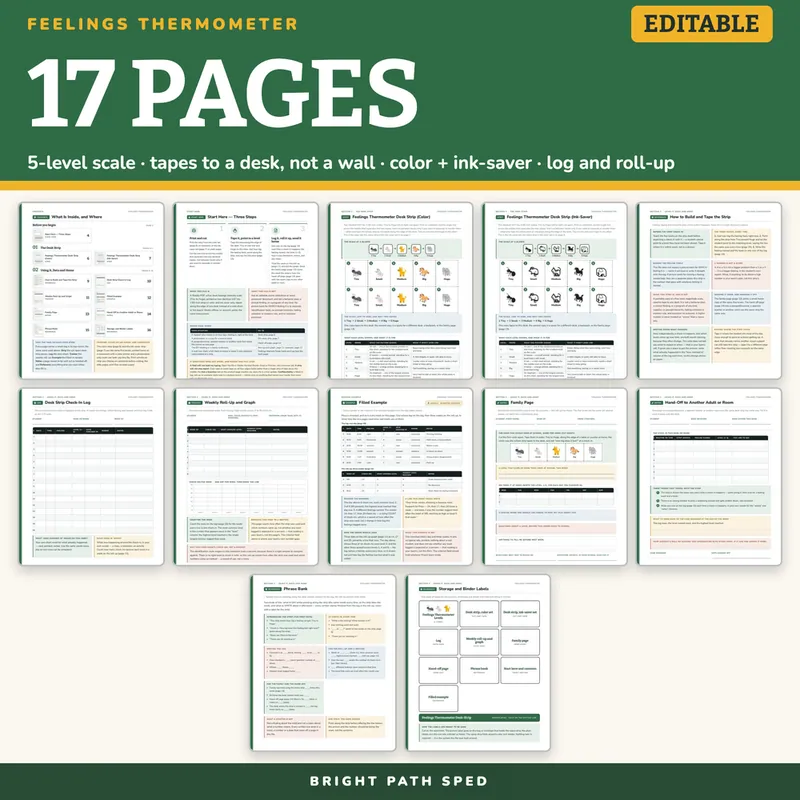
EVERYTHING INSIDE — 17 pages
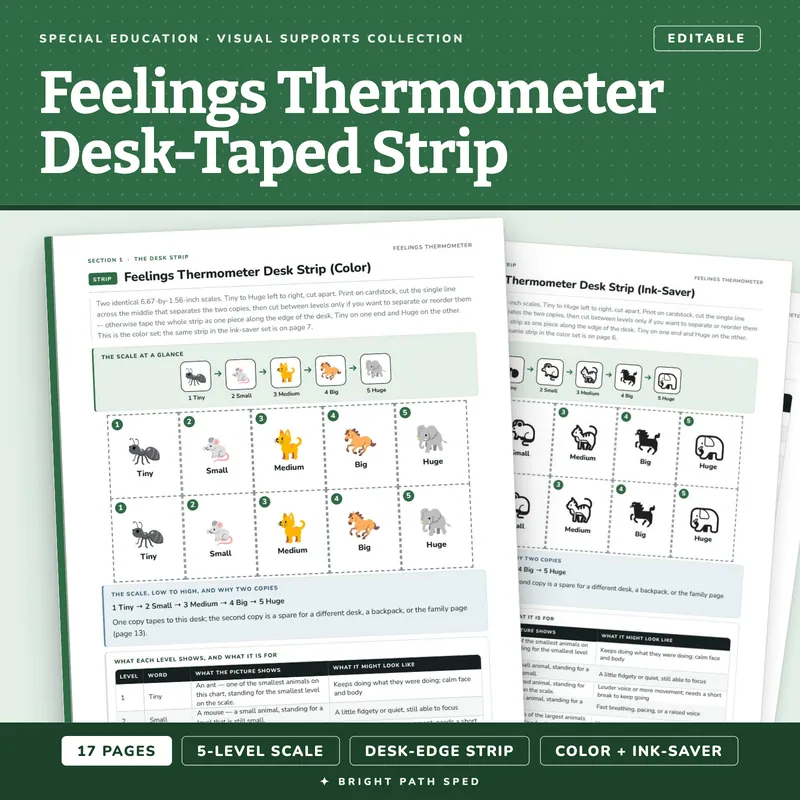
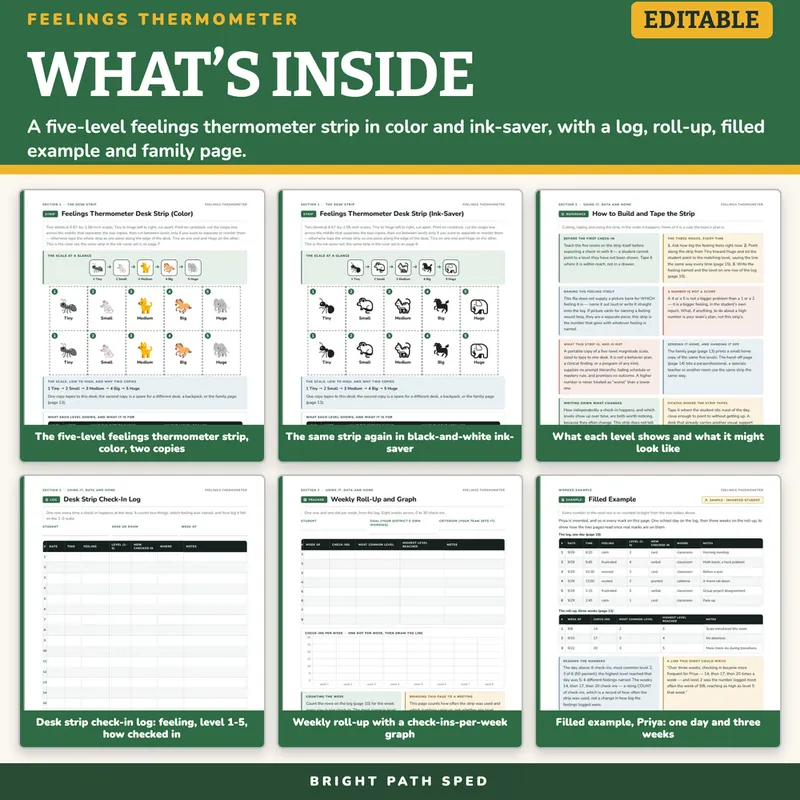
- A Feelings Thermometer Desk Strip: the same five-level intensity scale (1 Tiny, 2 Small, 3 Medium, 4 Big, 5 Huge) a wall chart would carry, cut to two identical narrow strips sized to tape along the edge of one desk, left to right, Tiny to Huge
- The strip twice: a full-color set and a black-and-white ink-saver set, each with two copies per sheet (one to tape, one spare for a second desk or a backpack)
- A detail card on each strip page naming what each level's picture shows and what it might look like
- A how-to page: before the first check-in, the three moves every time, naming the feeling itself, why a number is not a score, what the strip is and is not, sending it home and handing it off, writing down what changes, picking where the strip tapes
- A Desk Strip Check-In Log (16 rows: date, time, feeling, level 1–5, how checked in, where, notes)
- A weekly roll-up (8 weeks) with a check-ins-per-week graph
- A filled example — an invented student, one day on the log and three weeks on the roll-up, every number re-counted from its own row
- A family page with a small cut-apart home copy of the same five levels
- A hand-off page so a paraprofessional, a specials teacher or another room runs the same strip the same way
- A phrase bank: 20 lines in 5 groups (spoken lines for pointing along the strip, written starters for the log, the roll-up and the note home)
- A storage and binder label sheet: 10 labels and a spine strip
- Start Here, a contents page with page thumbnails, and a "what's next" back page
A desk that has no room for a wall chart or a full board still needs a way to check in on how big a feeling is, right at the seat it happens in. This file is that strip: the same five-level magnitude scale, cut down to a narrow object taped along the edge of one desk, with its own log, weekly roll-up and phrase bank behind it. This file uses a plain five-level scale and its own wording throughout — it is not affiliated with, and does not reproduce, any single published curriculum or its published scale.
The Strip
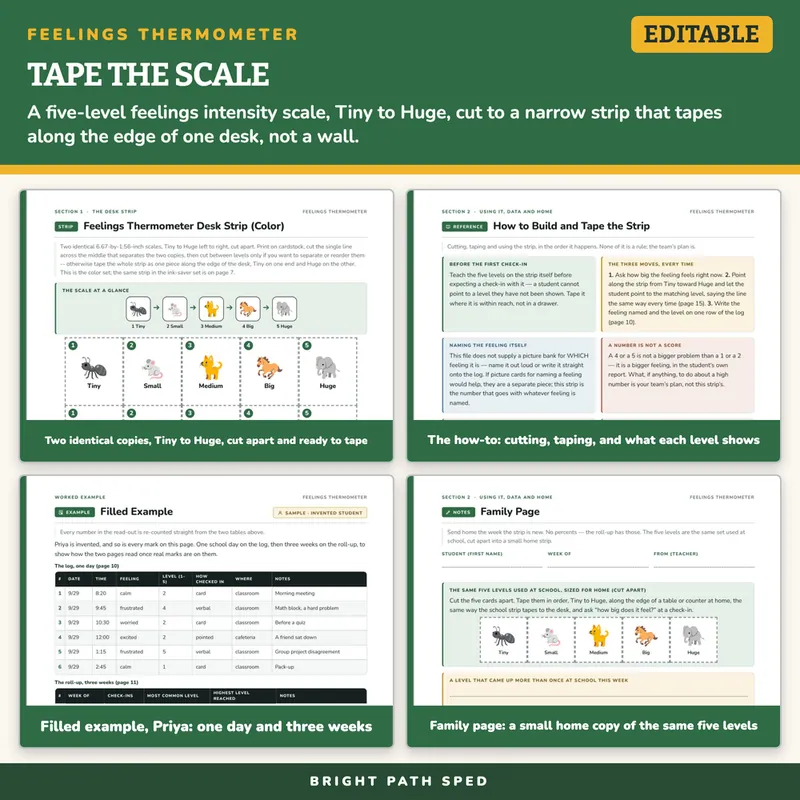
- Two identical copies per sheet, five levels each, left to right: Tiny (ant), Small (mouse), Medium (cat), Big (horse), Huge (elephant) — a real-world size order for an abstract magnitude scale
- Cut the single line across the middle to separate the two copies; cut between levels only if you want to separate or reorder them
- Tape the whole strip along the edge of the desk, Tiny on one end and Huge on the other
Every picture was chosen to be named in one word by a young child, in color AND in the black-and-white set — the same checked bank the Feelings Intensity Scale Cards and Log file uses, reused here rather than redrawn.
What This Is, And What It Is Not
It is a fillable PDF: type into the log, the roll-up, the family page and the hand-off page, or print and use a pen. The strip pages print on cardstock or plain paper and cut along dashed lines. It works offline with no account or subscription. It is NOT an editable online slideshow or word-processor document.
It is a way for a student to name a feeling in their own words and put a number on how big it feels, with that check-in written down, right at the desk. It is NOT a picture-card set for identifying WHICH feeling it is (that is a separate identification task) and it does NOT include a wall-size chart, a full check-in board or loose 2-inch reference cards — those live in the full Feelings Intensity Scale Cards and Log file, named below. It is not a behavior plan, a clinical finding, a screening tool or a program of any kind, and it promises no outcome. It carries no prompt hierarchy, fading schedule or mastery rule; it does not say why a feeling was picked or what to do about it, and a higher number is never treated as "worse" than a lower one — how the strip is used with a student, and for how long, is what your team's plan says. The goal line and the criterion field are blanks for your district's own wording and your team's own number. The log counts two things: which feeling was named, and how big it felt on the 1–5 scale.
Who This Is For
Special education teachers and paraprofessionals who need a feelings intensity scale within arm's reach at one desk rather than on a wall, case managers who need that use to show up as data, and the families who get the home page sent home.
More In The Collection
Alongside Feelings Intensity Scale Cards and Log (the same five-level scale at full size — a wall chart, a check-in board, two desk-size boards and 2-inch reference cards, for a room with space for all of them) and Desk-Taped Mini Schedule Strip (the same narrow, taped-to-the-desk format, for a first/then schedule instead of a feelings scale); more picture-card sets are being added to the collection regularly.
Pictures (color pages): Noto Emoji by Google, Apache License 2.0. Pictures (ink-saver pages): Fluent Emoji, Copyright (c) Microsoft Corporation, MIT License.
You might also need
10 Fat Turkeys Book Companion November Preschool Kindergarten 1st 2nd Special Ed
$2.50 $5.00 on TPT
504 Accommodations Checklist Editable
$1.50 $3.00 on TPT
504 Plan Accommodation Implementation Fidelity Data Collection Editable
$1.75 $3.50 on TPT
504 Plan Template Accommodations Checklist Teacher Handout
$2.50 $5.00 on TPT