Handwriting Practice CVC Words and Sentences
- 45 pages
- 2nd, 3rd
$4.00
DownloadOr get it with All-Access: pick any 20 resources a month for $7.
New here? Your first month of All-Access is half off with code TEACHERTOK
Already bought this, or a member?
Instant download. One teacher's license: colleagues need their own copy. Each file carries a license number.
Also on Teachers Pay Teachers: see the Bright Path Sped store
About this resource
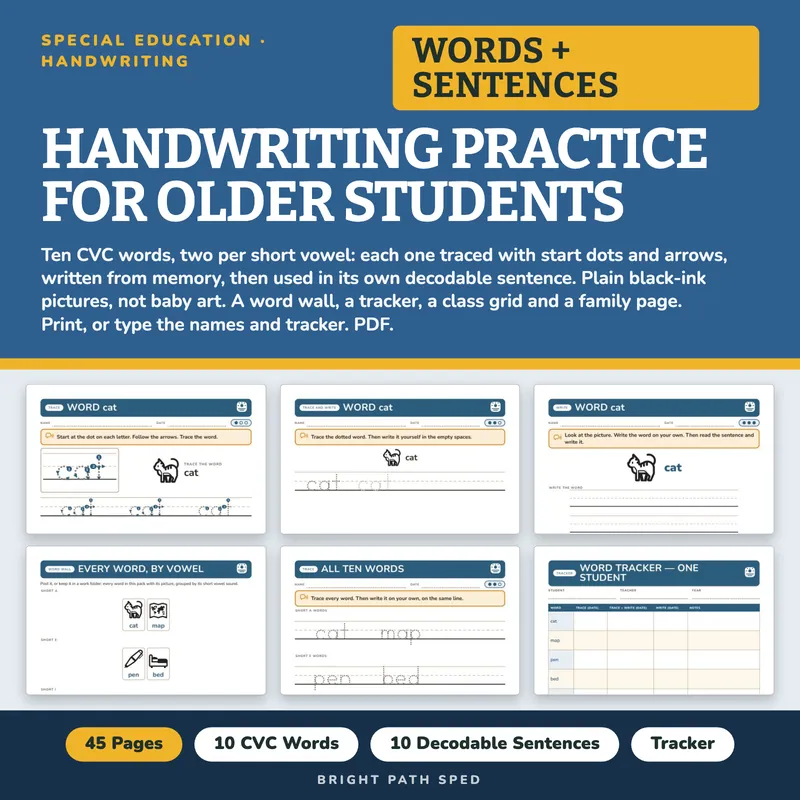
A student who can trace and write single letters is not yet reading. The next step is a real word,
then that word inside a sentence made only of words the student already knows — at a page built for
an older grade, not a page that looks like it was made for a much younger one. Ten real
three-letter words across the five short vowels, each traced, written from memory, and used in its
own decodable sentence, with plain black-ink pictures instead of bright cartoon icons.
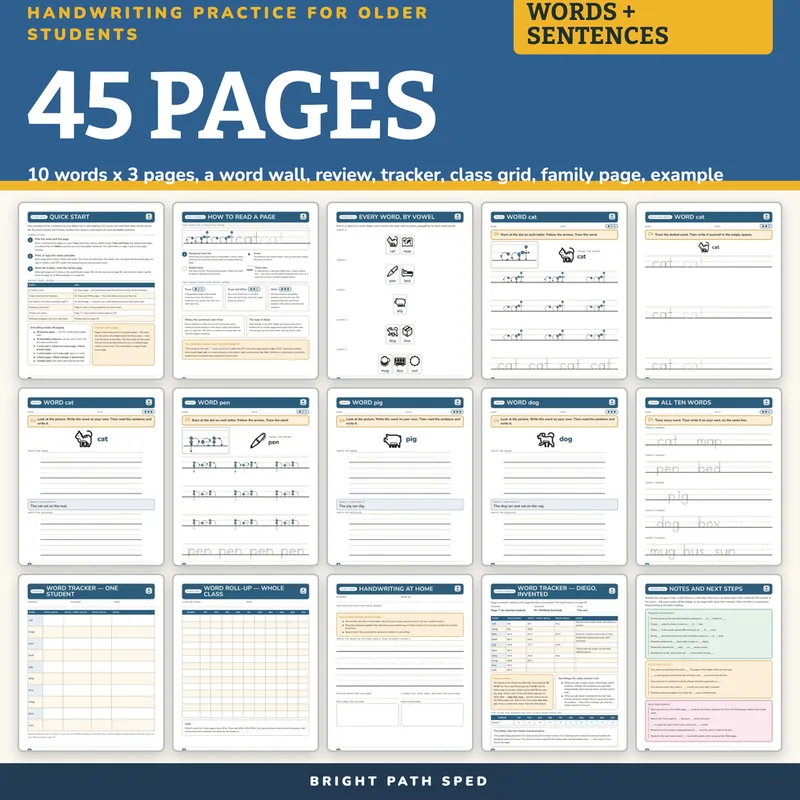
EVERYTHING INSIDE (45 pages)
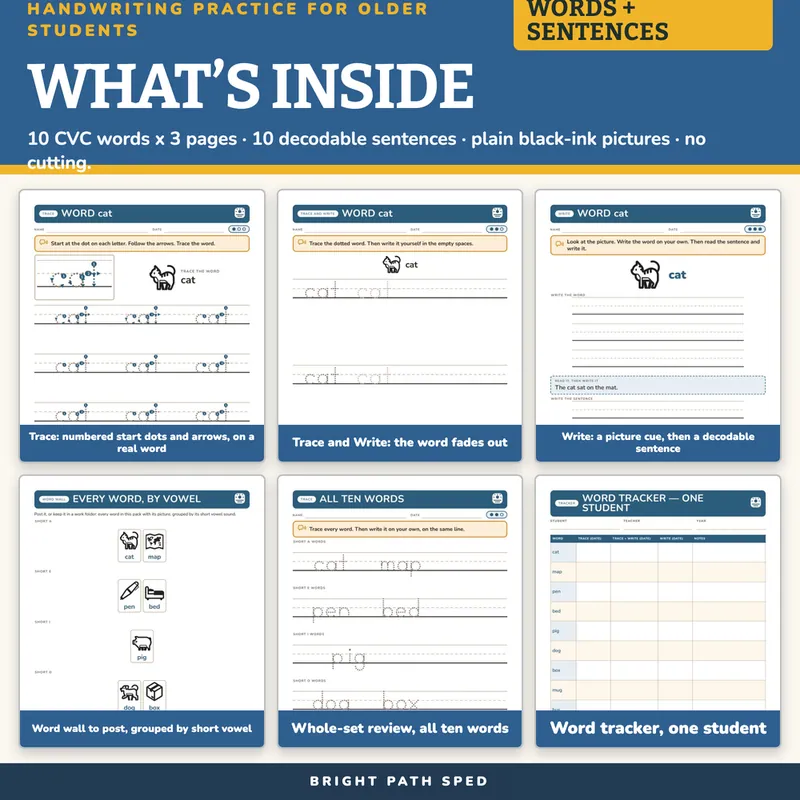
- 30 practice pages — 10 CVC words x 3 pages each: Trace, Trace and Write, Write
- 10 decodable sentences, one per word — every word in every sentence is checked in code against
this store's own CVC word bank (all five short vowels) and its Fry-first-hundred sight-word list
- 1 word wall to post, all ten words grouped by short vowel, with a picture for each
- 1 whole-set review page and 1 blank practice page on the same rule
- 1 word tracker (one student, 10 words) and 1 class grid (whole class), type-in or print
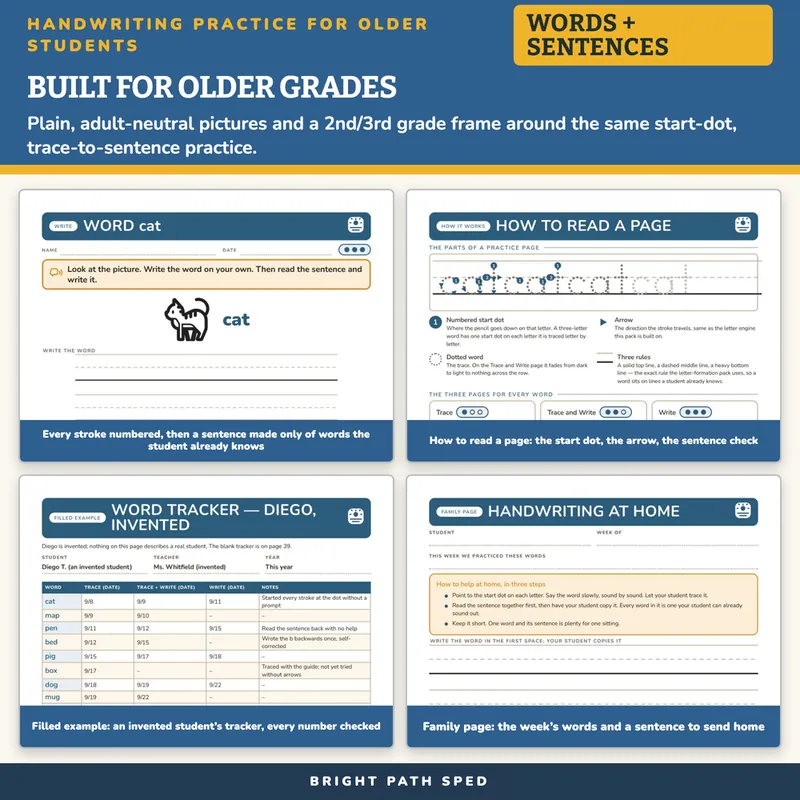
- 1 family page — the week's words, a sentence to read together, and a note box each way
- 1 filled example — an invented student's tracker, every number read off its own table
- 1 phrase bank — progress-note, family-note and next-step starters, observations with blanks
- 1 binder cover with a spine label and six divider tabs
- Start Here, a how-to-read-a-page key (with one sentence checked word by word), and a word index
that gives every page number
The Three Pages For Every Word
1. Trace — a big guided model of the whole word, then four rows: the first row carries two guided
instances and one start-dot instance, the next two rows are start-dot only, and the last row fades
to dotted-only with no numbers or arrows.
2. Trace and Write — no arrows. Three rows, each one dark dotted instance of the word, one faint
instance, then two blank lines to write it from memory.
3. Write — a picture cue and the word are the only prompt: three blank lines to write the word, then
the word's own decodable sentence in a callout box and three more blank lines to copy it.
The three dots on the name line are the level code, there for the teacher: no student page carries a
level word, and every page is the same slate tone, so nobody's paper is obviously the easy one.
Where The Words And Sentences Come From
The ten words are drawn from this store's own CVC word list (a-2, e-2, i-1, o-2, u-3; "i" carries
one word because "pig" is the only short-i word this store's picture set can show without an
ambiguous or mismatched icon), the same bank behind this store's CVC reading probes — nothing here
is a new or invented word list. Every sentence is checked at build time: every word in it must be a
CVC word from any short vowel, a word already on this store's sight-word probes, or "a"/"the" — a
sentence that fails the check does not ship. Nothing in a sentence is harder than the word the page
is teaching.
The Rule And The Pictures
Every row is a solid top line, a dashed middle line and a heavy 3px baseline — the identical rule
Letter Formation Handwriting Tracing Practice A-Z uses, so a word sits on lines a student already
knows. Every page prints clean on a black-and-white copier. One plain black-ink picture per word,
from the Microsoft Fluent Emoji High Contrast set (MIT License) — this store's black-and-white
ink-saver picture style, not the full-colour set used on the K-1st sibling — with the word always
printed beside it; naming the picture is never the task.
Type In, Or Print
The name and date lines, the tracker, the class grid, the family page and the binder cover are type-in
fields in any PDF reader. The tracing rows are always pencil work. This is a fillable PDF; it is not a
Google Slides or PowerPoint file.
Who This Is For
Resource rooms, self-contained classrooms, and any 2nd or 3rd grade special education setting with
a student who is building CVC words and sentences at an older grade than the words themselves.
Pairs with this store's Letter Formation Handwriting Tracing Practice A-Z, the letter-by-letter step
before this one, and its K-1st sibling, CVC Words Handwriting Practice.
What This Is, And What It Is Not
A print-and-trace practice pack with the record-keeping around it. It is not a reading curriculum, not
a phonics program, and not a claim about any student's age, grade placement, or rate of progress.
You might also need
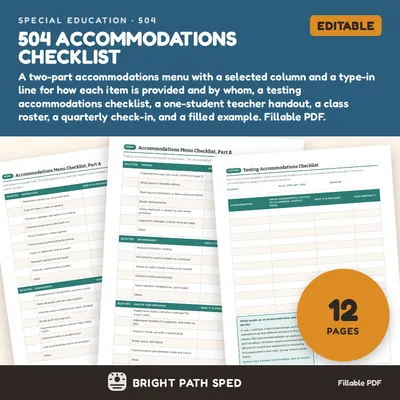
504 Accommodations Checklist Editable
$3.00 or with All-Access
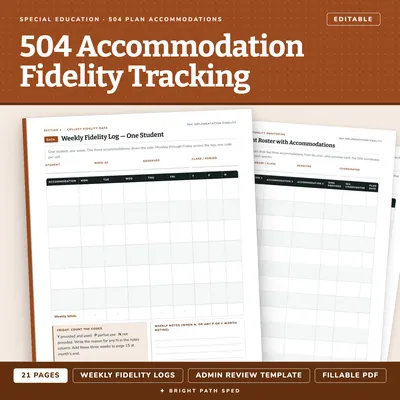
504 Plan Accommodation Implementation Fidelity Data Collection Editable
$3.50 or with All-Access
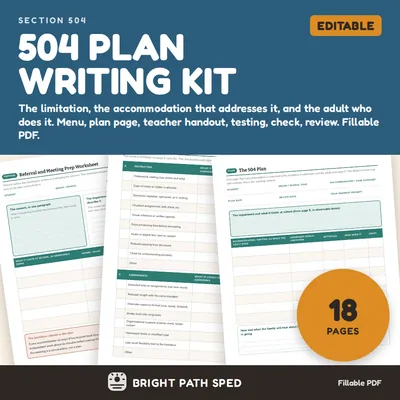
504 Plan Template Accommodations Checklist Teacher Handout
$5.00 or with All-Access
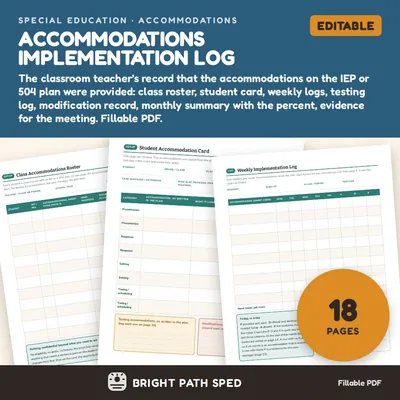
Accommodations Implementation Log Editable
$5.00 or with All-Access