Lateral Lisp Practice Pack
- 25 pages
- Kindergarten, 1st, 2nd, 3rd
$2.25 $4.50 on Teachers Pay Teachers
Half the Teachers Pay Teachers price. The same PDF, sold direct.
DownloadOr get it with All-Access: pick any 20 resources a month for $7.
New here? Your first month of All-Access is half off with code TEACHERTOK
Already bought this, or a member?
Instant download. One teacher's license: colleagues need their own copy. Each file carries a license number.
Also on Teachers Pay Teachers: see the Bright Path Sped store
About this resource
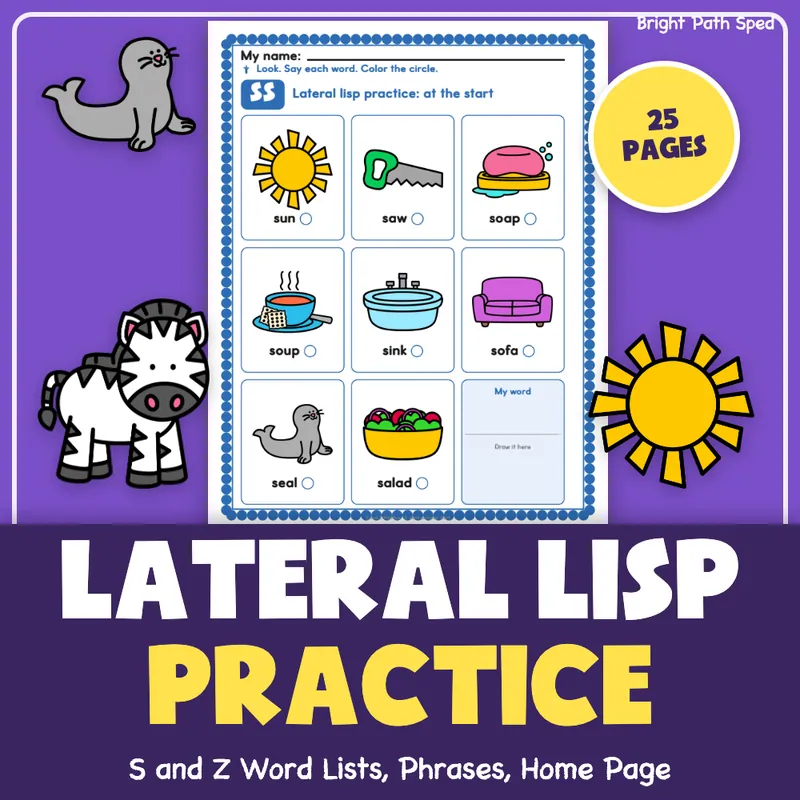
Lateral lisp practice pages for the speech room: S and Z words sorted by where the sound sits (start, middle, end), with picture cards, text word lists, phrase lists and sentence lists, plus a carryover home page and a session data sheet with tally boxes. The word pages are ready to print. The plan, home, data and update pages have blank lines and boxes for your own directions and your own numbers.
EVERYTHING INSIDE (25 pages)
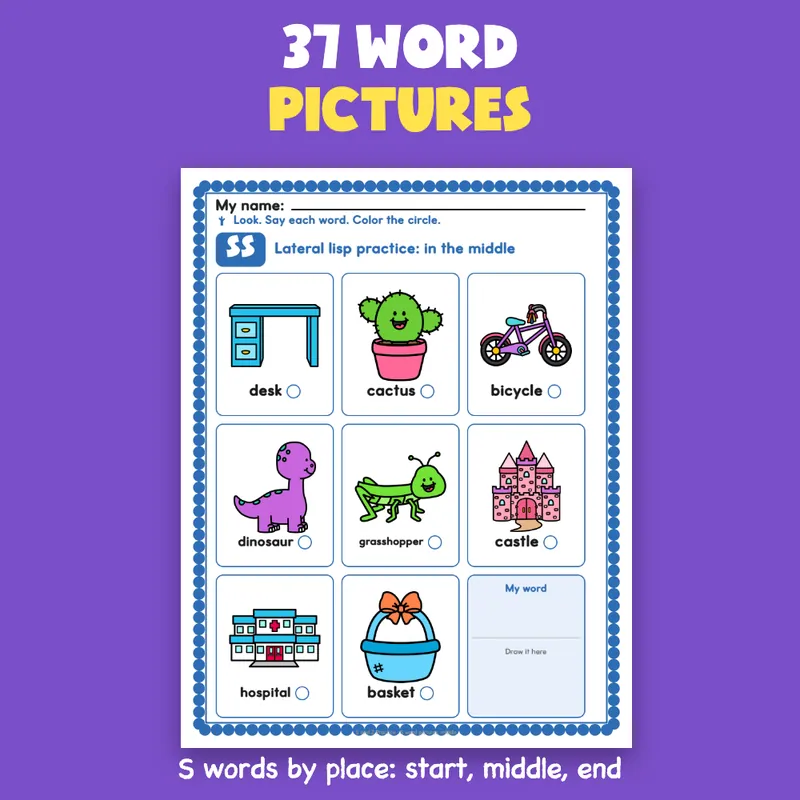
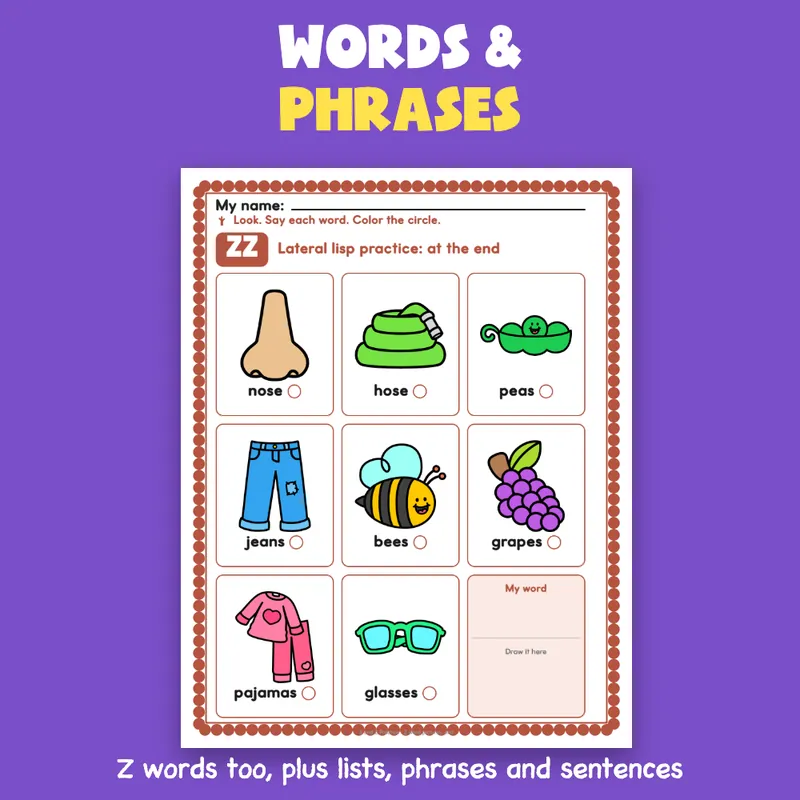
- 5 pages of picture words: 37 picture cards in all (24 for S and 13 for Z). S has one page each for the start, the middle and the end of the word (8 pictures on each). Z has one page for the start and middle (5 pictures) and one for the end (8 pictures). Each card shows the picture, the word, and a circle for the child to color. A "My word" card on every picture page is left blank.
- 1 page of blank word cards: type or write 6 words of your own and draw them.
- 2 text word lists, one for S and one for Z, 64 words in all (36 S words and 28 Z words), each sorted by start, middle and end.
- 2 phrase pages, one for S and one for Z: 24 phrases for each sound (8 for each place in the word), 48 phrases in all.
- 2 sentence pages, one for S and one for Z: 8 sentences each, 16 in all.
- 1 home page for the family: blank lines for the speech-language pathologist's directions, the words for the week, how often, and a way to reach you.
- 1 home chart the child colors: 4 weeks, a star for each day.
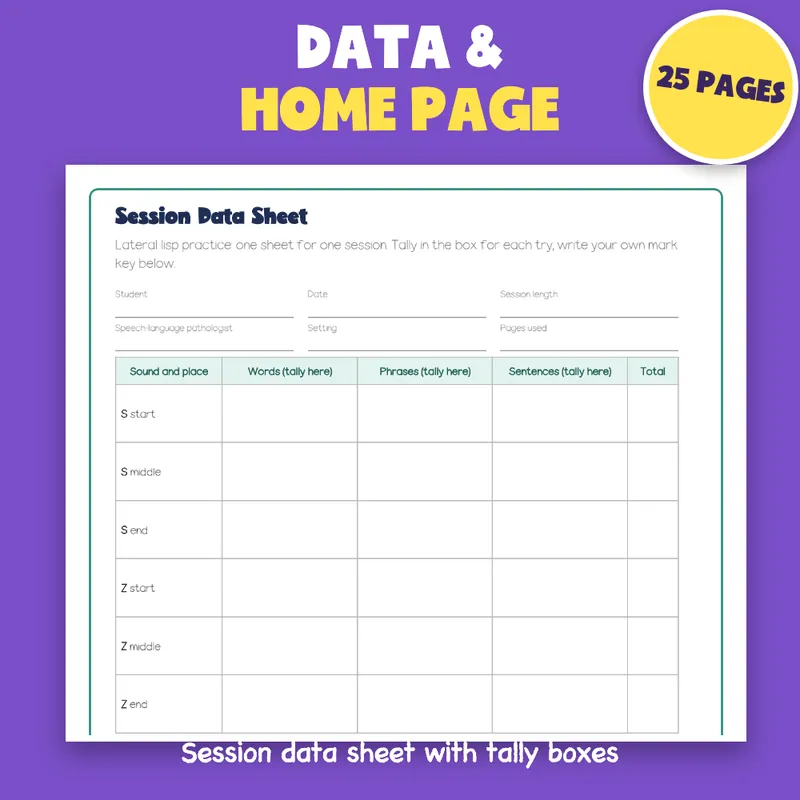
- 1 session data sheet: date, student, a tally box for words, phrases and sentences for each place for each sound, a total, your own mark key and a notes box.
- 1 session log for 20 sessions, with tries, correct tries and percent, and 1 progress graph for the percent.
- 1 filled-in session log for an invented child, with its numbers worked out on the page.
- 1 family and team update with blanks for your own words and a handoff list.
- Teacher pages: Start Here, a plan page of blank lines, a binder cover with 6 divider tabs, terms of use, and a thank-you page with what's next.
How To Use It
Fill in the plan page with the sounds, words and directions that are yours. Print the picture, list, phrase or sentence page you want, hand it to the child, and tally the session on the data sheet. Log it, plot the percent, and send the home page and home chart with the family. Nothing in this pack tells you how to teach a sound; it gives you the words and a place to write down what you decide.
Built For The Child Holding The Page
Every student page has a big "My name" line, one short direction with a picture, big rounded type, and a circle beside each item to color. The picture cards use clean clip art with the word printed under it. Pages read the same in black and white.
Type In, Or Print
The name lines, the plan page, the home page, the data sheet, the log, the example blanks and the family update are type-in fields in any PDF reader. You can also print any page and write by hand. Print at 100 percent with fit-to-page turned off. This is a fillable PDF; it is not a Google Slides or PowerPoint file.
Who This Is For
Speech-language pathologists, school-based and private practice, and special education teachers who carry over a speech plan, working with children in kindergarten to grade 3 on the S and Z sounds.
What This Is, And What It Is Not
Practice words and record-keeping pages. It does not teach or explain how to make a sound, it contains no placement or step-by-step instructions, and it does not replace a speech-language pathologist's own plan or advice. It has no benchmarks or targets: you write the goal and what counts as a correct try. The invented child on the example page is made up.