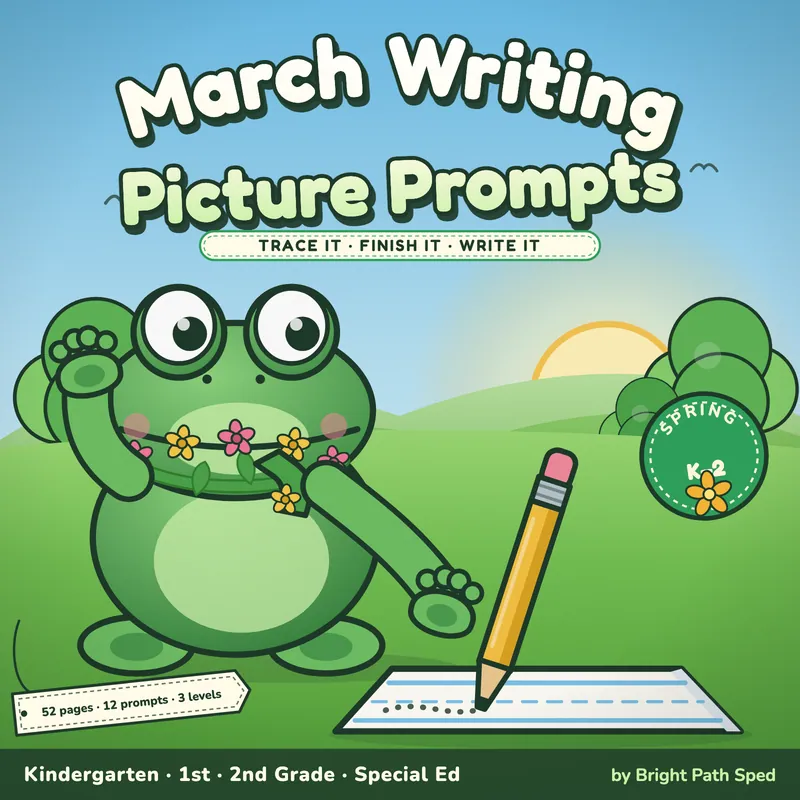
March Writing Picture Prompts with Word Bank and Sentence Starters
- 52 pages
- PreK, Kindergarten, 1st, 2nd
$4.00
DownloadOr get it with All-Access: pick any 20 resources a month for $7.
New here? Your first month of All-Access is half off with code TEACHERTOK
Already bought this, or a member?
Instant download. One teacher's license: colleagues need their own copy. Each file carries a license number.
Also on Teachers Pay Teachers: see the Bright Path Sped store
About this resource
A child who can say a whole sentence about a kite and then writes "k" and stops does not need a bigger picture. That child needs the first words already on the line to trace, then the same words printed to read and finish, then a page with nothing but the picture and the words to pull from. This is that: twelve March picture prompts, three pages each, the same picture and the same word bank on all three, so the whole room writes about the same thing and nobody's paper is obviously the easy one. No shamrocks, no leprechauns, no dyed eggs or bunnies — every picture and starter comes from a fifteen-word spring list checked against that rule before it went in.
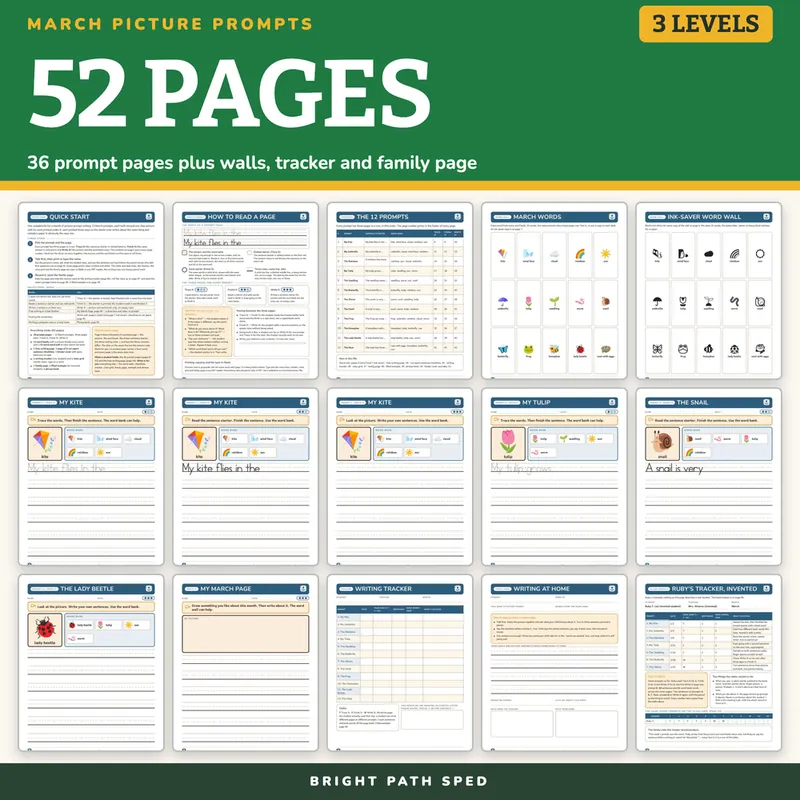
EVERYTHING INSIDE (52 pages)
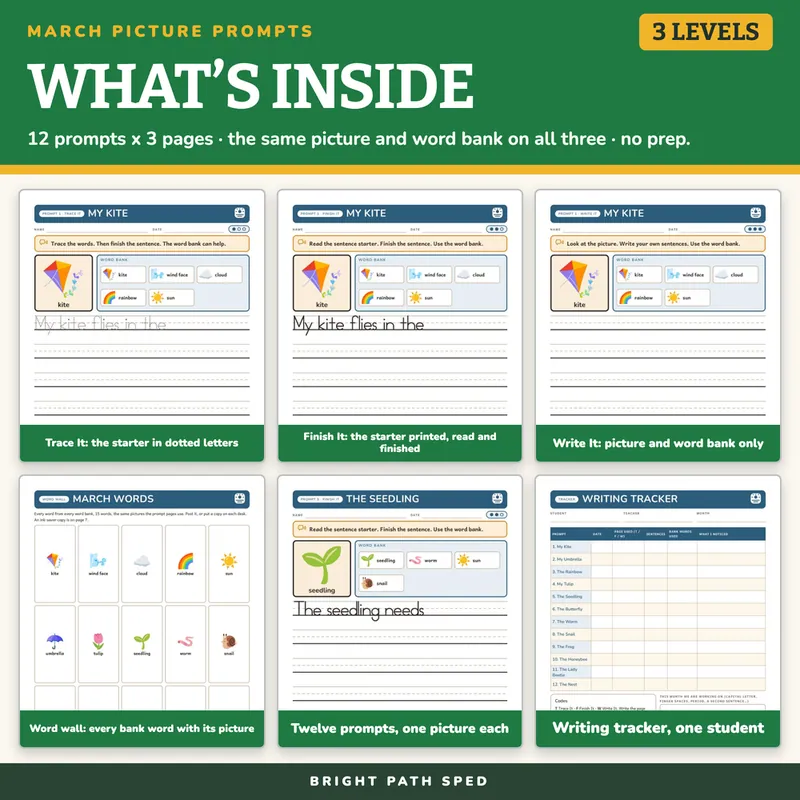
- 36 prompt pages — 12 March prompts x 3 pages each, in contents order
- 12 word banks — 4 or 5 words each with a picture beside every word, the same bank on all three pages of a prompt
- 2 word walls — every word from every bank, 15 words, once in color and once in heavy black outline for a copier
- 1 free-writing page — a draw box and six writing rules, no prompt, for a fast finisher
- 1 page of 6 cut-apart sentence checklists — five checks each (capital letter, finger spaces, a word-bank word, a period, read it to someone); the six sit edge to edge, so it takes three cuts
- 1 writing tracker (one student, 12 prompts) and 1 class grid (whole class x 12 prompts), type-in or print
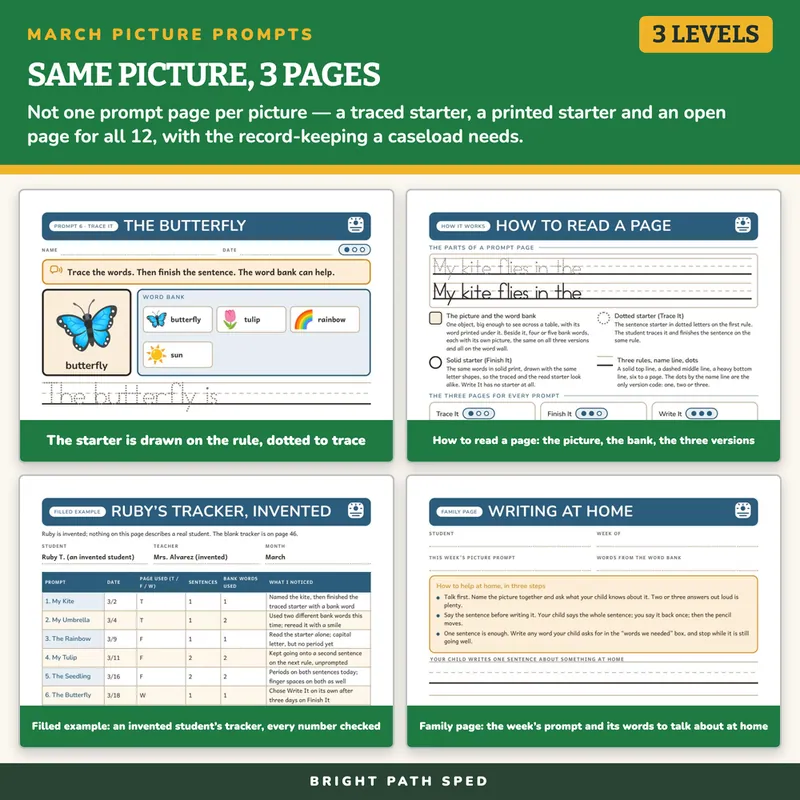
- 1 family page — the week's prompt and its words, three plain steps for home, writing rules for your child, and a note box each way
- 1 filled example — an invented student's tracker, every number on it read off its own table
- 1 phrase bank — progress-note, family-note and next-step starters, plus the talk-first questions to ask before the pencil moves
- 1 binder cover with a spine label and six divider tabs (the six tabs sit edge to edge)
- Start Here, a how-to-read-a-page key, and a contents page that gives every page number
The Twelve Prompts
My Kite ("My kite flies in the…"), My Umbrella ("My umbrella is…"), The Rainbow ("A rainbow has many…"), My Tulip ("My tulip grows…"), The Seedling ("The seedling needs…"), The Butterfly ("The butterfly is…"), The Worm ("The worm is very…"), The Snail ("A snail is very…"), The Frog ("The frog can jump…"), The Honeybee ("A honeybee visits…"), The Lady Beetle ("A lady beetle has…"), The Nest ("The nest has three…"). Twelve prompts is three a week for a month, or one a day with a Write It page for the fast finisher. It is a plain spring-nature mix — weather, a garden, small creatures — so there is something for every writer in the room, and nothing tied to a single day on the calendar.
The Three Pages For Every Prompt
1. Trace It — the sentence starter in dotted letters on the first writing rule. The student traces it and finishes the sentence with a word from the bank.
2. Finish It — the same starter in solid print, drawn with the same letter shapes on the same rule. The student reads it, finishes it, and keeps going on the rules below.
3. Write It — the picture and the word bank only. Six empty rules; the student writes from scratch.
Every student page starts with a big name line and one short instruction with a picture. The dots on the name line are the version code, there for the teacher: no student page carries a level word, and every page is the same tone, so nobody's paper is obviously the easy one.
The Pictures And The Rules
Every prompt is one big picture with its word printed under it, never a scene, and every word-bank word has its own picture. If a child gives a picture a different name, you say the word and move on; naming the picture is never the task. The starters are drawn on a real primary rule (a solid top line, a dashed middle line, a heavy bottom line) with the same letter shapes as this store's Letter Formation Handwriting Tracing pack, so the traced starter and the read starter look alike and sit exactly on the lines. Pictures are from the Google Noto set (Apache-2.0) on the color pages and the Microsoft Fluent High Contrast set (MIT) on the ink-saver wall. Every page prints clean on a black-and-white copier.
Type In, Or Print
The name and date lines, the tracker, the class grid, the family page and the binder cover are type-in fields in any PDF reader. The writing rules are always pencil work. This is a fillable PDF; it is not a Google Slides, PowerPoint or Google Docs file.
Who This Is For
Kindergarten, first and second grade classrooms, self-contained and resource rooms, and any teacher with three kinds of writer at one table. The talk-first questions on the how-to page are written for a paraprofessional or a volunteer to run the table; the family page sends the same prompt home.
What This Is, And What It Is Not
A month of picture-prompt writing pages with the record-keeping around it. It is not a writing curriculum, not an assessment, and not a claim about any student's age or rate of progress. The how-to page has a blank line for your district's own criterion.
You might also need
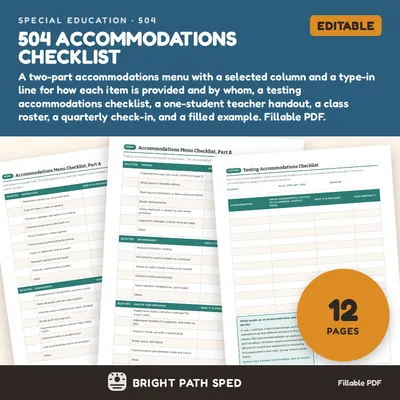
504 Accommodations Checklist Editable
$3.00 or with All-Access
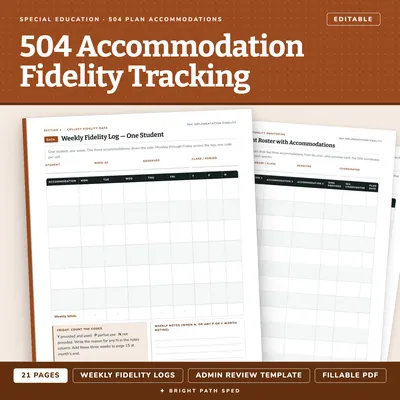
504 Plan Accommodation Implementation Fidelity Data Collection Editable
$3.50 or with All-Access
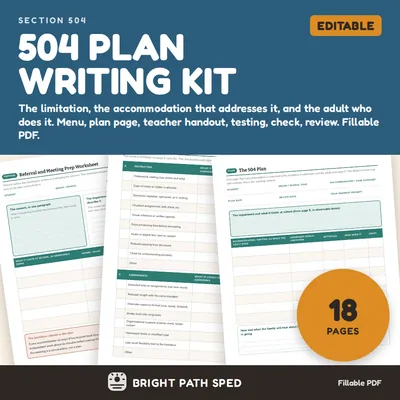
504 Plan Template Accommodations Checklist Teacher Handout
$5.00 or with All-Access
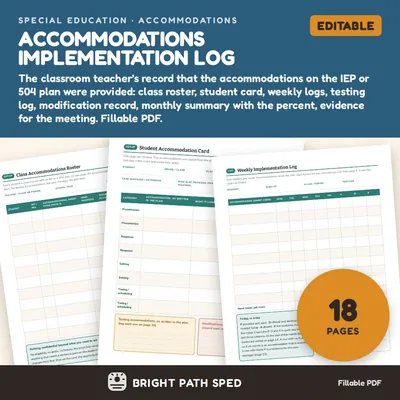
Accommodations Implementation Log Editable
$5.00 or with All-Access