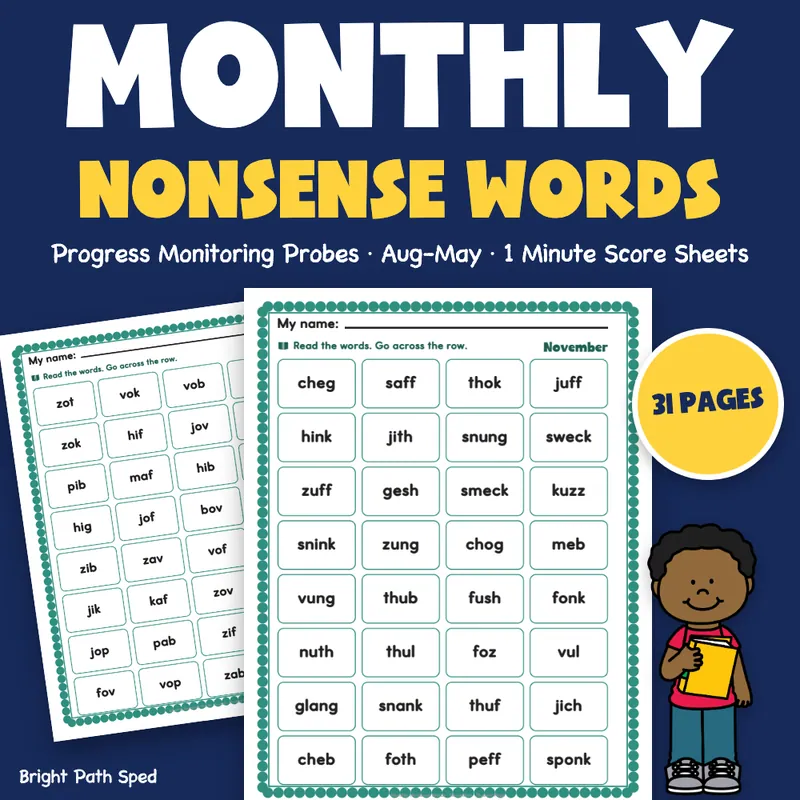
Monthly Nonsense Words
- 31 pages
- Kindergarten, 1st, 2nd
$1.75 $3.50 on Teachers Pay Teachers
Half the Teachers Pay Teachers price. The same PDF, sold direct.
DownloadOr get it with All-Access: pick any 20 resources a month for $7.
New here? Your first month of All-Access is half off with code TEACHERTOK
Already bought this, or a member?
Instant download. One teacher's license: colleagues need their own copy. Each file carries a license number.
Also on Teachers Pay Teachers: see the Bright Path Sped store
About this resource
Ten monthly nonsense word probes, August to May. One page of 32 made-up words a month for the child, one score sheet a month for you, and one yearly graph that shows the whole school year in ten dots.
Made-up words, so the score shows how the child uses the letters and not what the child has memorized. Each month adds one spelling pattern and keeps the earlier ones in the mix, so the probes build on each other all year.
WHAT IS INCLUDED - 31 pages, 10 student pages, 10 score sheets, 320 made-up words, 354 type-in fields
THE TEN MONTHS (a student page and a score sheet each)
- August: Short a, i, o in three-letter words (32 new words; all 32 words are new), pages 6 and 7
- September: Short e and u join in (16 new words, 16 review words from earlier months), pages 8 and 9
- October: Digraphs sh, ch, th (16 new words, 16 review words from earlier months), pages 10 and 11
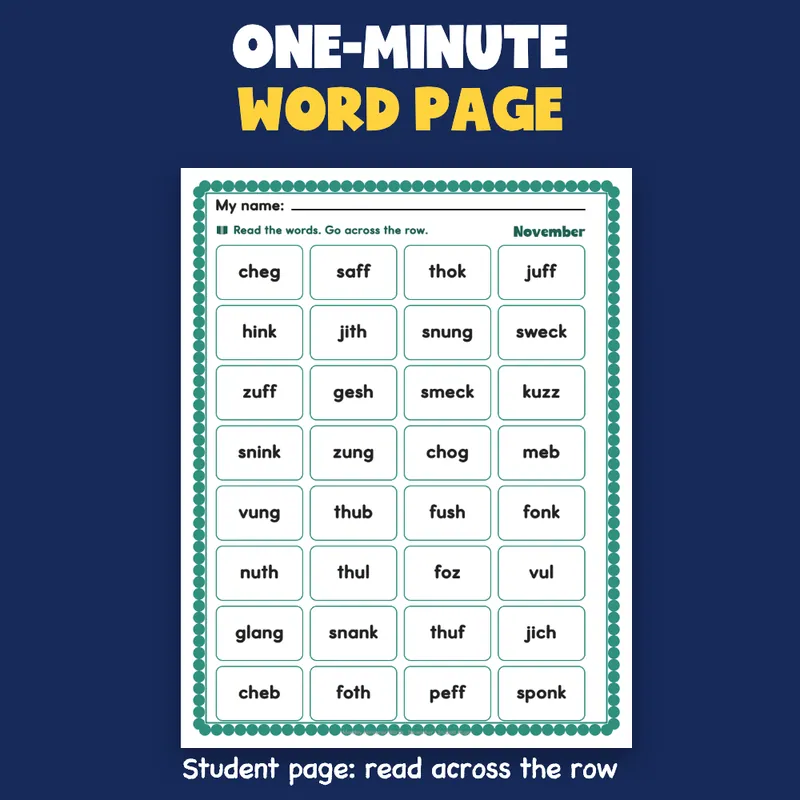
- November: Endings ck, ng, nk, and doubled ll, ff, ss (16 new words, 16 review words from earlier months), pages 12 and 13
- December: Blends at the start and the end (16 new words, 16 review words from earlier months), pages 14 and 15
- January: Silent e (a_e, i_e, o_e, u_e) (16 new words, 16 review words from earlier months), pages 16 and 17
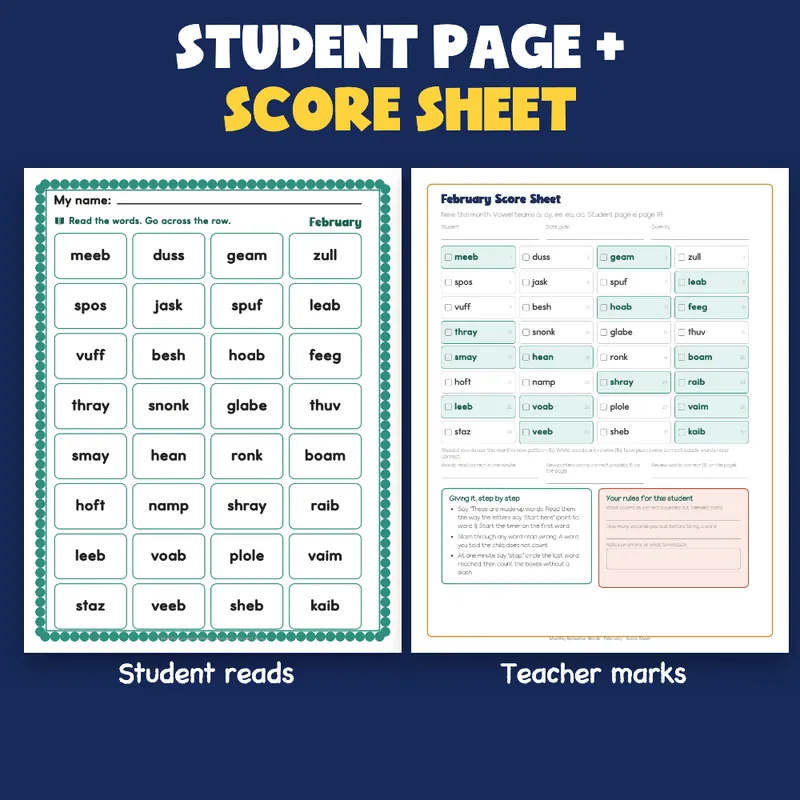
- February: Vowel teams ai, ay, ee, ea, oa (16 new words, 16 review words from earlier months), pages 18 and 19
- March: R-controlled vowels ar, or, er, ir, ur (16 new words, 16 review words from earlier months), pages 20 and 21
- April: Vowel sounds oo, ou, ow, oi, oy, aw (16 new words, 16 review words from earlier months), pages 22 and 23
- May: Two-syllable made-up words (16 new words, 16 review words from earlier months), pages 24 and 25
The Student Page
- My name line, one instruction ("Read the words. Go across the row."), the month, and 32 big words in four columns and eight rows
- Nothing for adults on it: slide it in a sheet protector and the child reads and writes nothing
The Score Sheet
- The same 32 words with a box beside each and a number, so you can slash the misses and circle the last word reached
- New-pattern words are shaded and review words are white, so you can see which kind a child missed
- Boxes for words read correct in one minute, new-pattern correct and review correct, and lines for what counts as correct and how long you wait, written by your team
- Step-by-step directions for giving the probe
The Year
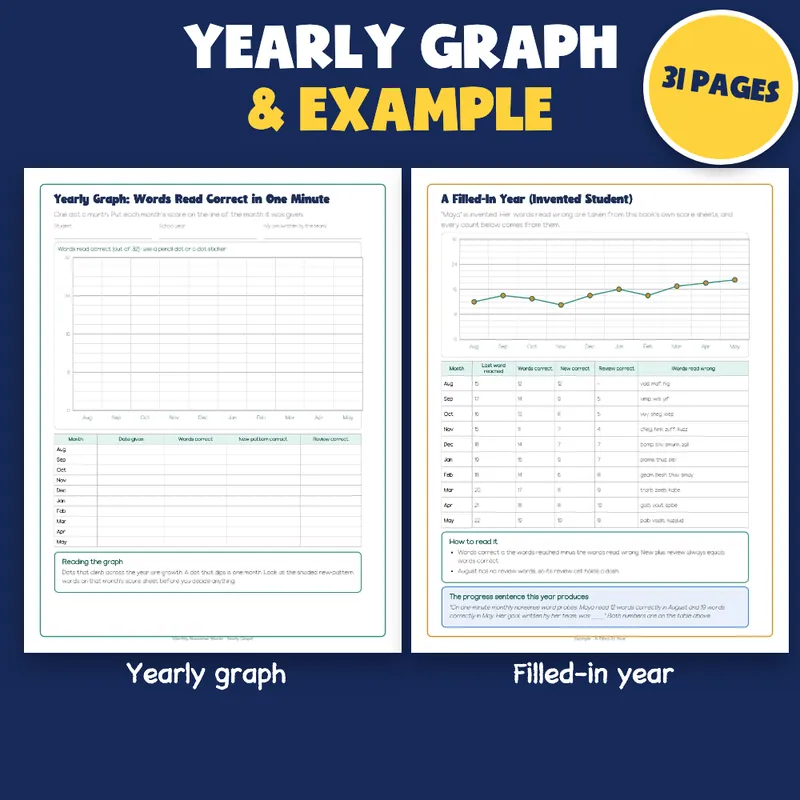
- A yearly graph: ten month columns, 0 to 32, with a table for the date and the three counts
- A class roll-up: 17 student rows by ten months
- A month-by-month map (The Year at a Glance) showing what each month adds
Setup And Communication
- Start Here page with four steps and a "which page for which job" table
- A binder cover, spine label and seven divider tabs
- Words for Your Notes: sentence starters for a score sheet, a progress note or a meeting, each ending in a blank for a real number
- A family update and team handoff page for an aide, a substitute or a new provider
- A filled-in year for an invented student, with every count computed from the book's own words
What This Is, And What It Is Not
It is a fillable PDF. The score sheets, the graph table, the class roll-up and the family page are type-in fields: open the file in a PDF reader, click a line or a cell, type, and Save As once per student. The student pages are meant to be printed. It works offline with no account or subscription. It does not calculate scores or draw the graph for you; you plot the dots with a pencil.
Who This Is For
Special education teachers and case managers, reading interventionists, Title and RTI teachers, and the paraprofessionals who give the monthly probe, working with students in kindergarten through second grade or older students who are still learning the code.