Multiple-Meaning Words Progress Monitoring Data Sheets Editable
- 22 pages
- Not Grade Specific
- PDF, fillable
$4.00
DownloadOr get it with All-Access: pick any 20 resources a month for $7.
New here? Your first month of All-Access is half off with code TEACHERTOK
Already bought this, or a member?
Instant download. One teacher's license: colleagues need their own copy. Each file carries a license number.
Also on Teachers Pay Teachers: see the Bright Path Sped store
About this resource
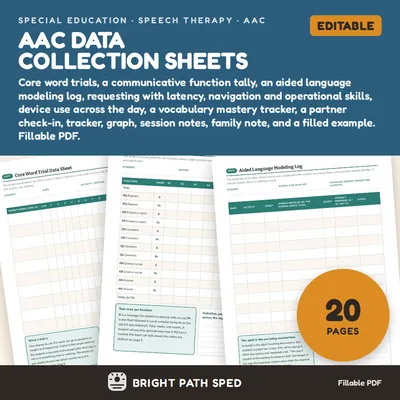
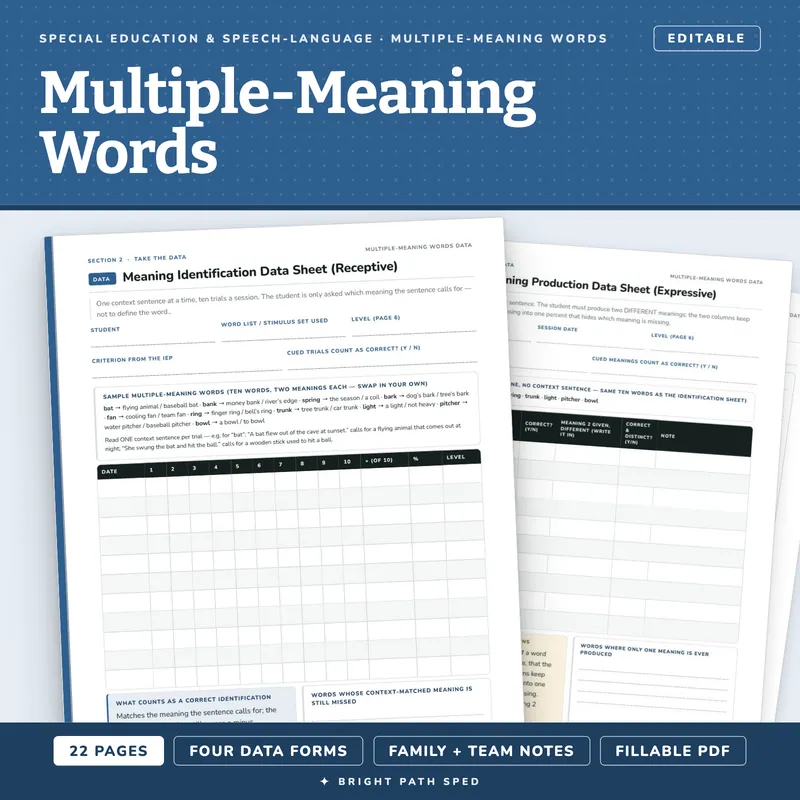
Everything inside: 22 pages, 673 type-in fields · a detailed sheet for identifying the meaning a context sentence calls for and a separate sheet for producing both meanings of a word, each with its own 10-item sample word bank · a quick combined daily check · a within-session frequency chart with a 4-session quick-trend table · a whole-caseload roster · a binder cover and 4 cut-out tabs · a 2-skill, 12-session tracker and graph · a quarterly summary · a family update · a 20-starter phrase bank · a plain-language paraprofessional/classroom form · a worked, invented example.
Speech-language pathologists and special educators are asked to show whether a multiple-meaning-word goal is changing, across however many students are on a caseload — not a vocabulary SIZE screener, and not one page spread across a six-domain pack that also carries synonyms, antonyms, word categories, figurative language and word-family production. A multiple-meaning word is a word that already has two or more distinct meanings depending on context ("bat," "bank," "spring") — this file checks that skill two ways: can the student pick the meaning a sentence calls for, and can the student produce both meanings on their own. Run the identification sheet, the production sheet, or the quick combined check, mark what the response actually was, add the session up on one chart, and roll it into a report and a family update that write themselves. Every mark on every page says only whether a response matched the meaning the context called for, or whether a second meaning was produced, as judged that session — never a score against a published norm, a name for a condition, or a rule for when a referral is warranted.
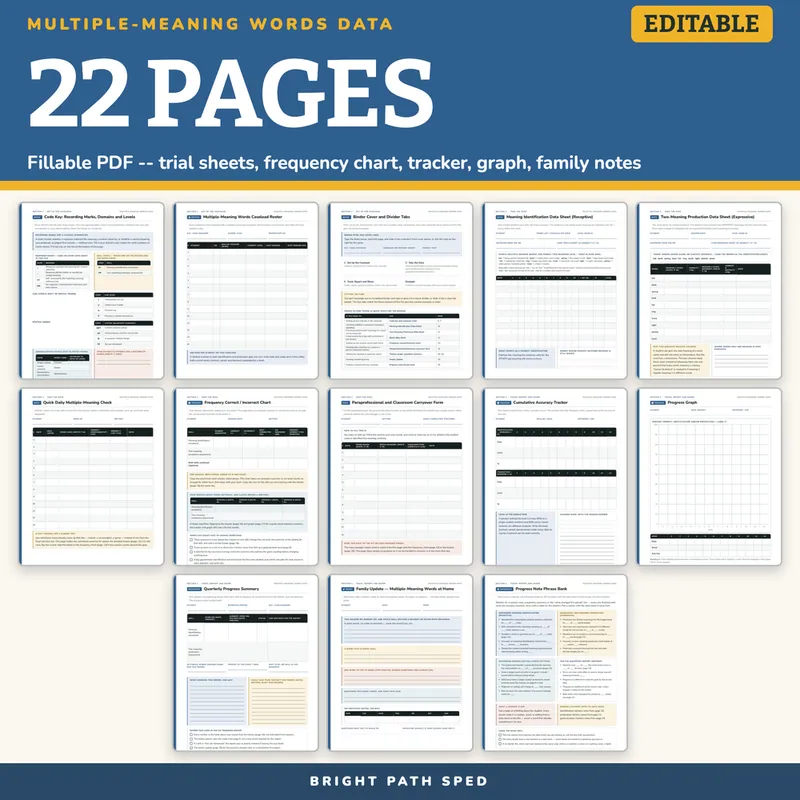
WHAT IS INCLUDED — 22 pages
Set Up The Caseload
- Code Key: Recording Marks, Domains and Levels — 4 response marks (+/−/SC/NR), 2 skill codes (ID/PR), 4 cue-level codes, 4 progress-status codes, 3 generalization levels (context/varied/spontaneous), every descriptor a blank line the team defines
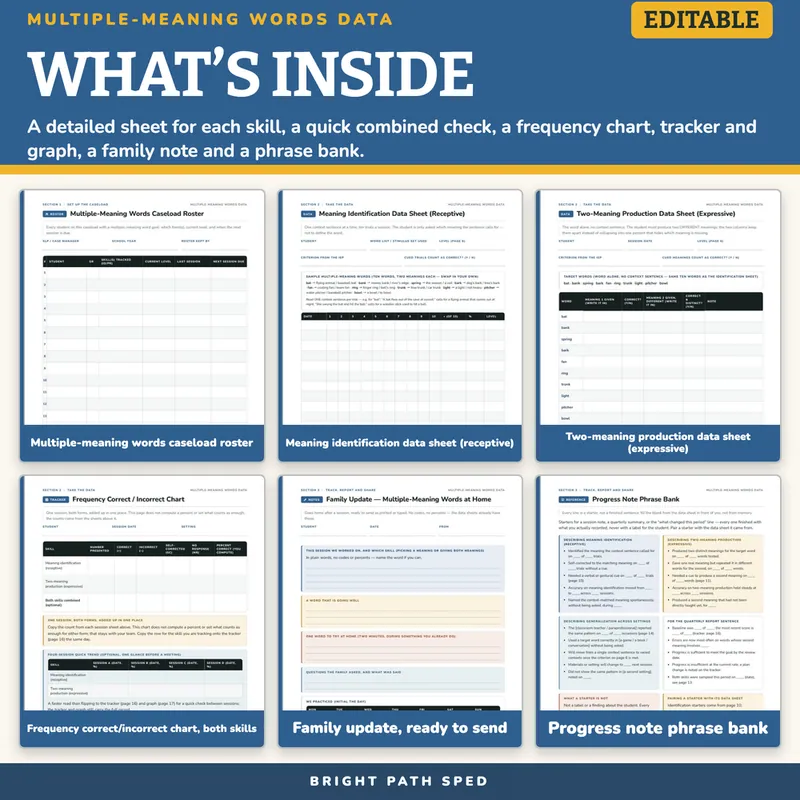
- Multiple-Meaning Words Caseload Roster — 14 rows: student, skill(s) tracked, current level, last session, next session due
- Binder Cover and Divider Tabs — a spine/cover card, 4 cut-out tabs matching the file's sections, and a 9-row "where to find things" index
Take The Data
- Meaning Identification Data Sheet (Receptive) — a sample 10-word bank (each word with two short meaning tags, plus one worked context-sentence illustration), 11 session rows of a 10-trial grid, criterion and cued-trial fields
- Two-Meaning Production Data Sheet (Expressive) — the same 10 words, word only and no context, one row per word with separate "meaning 1 correct" and "meaning 2, different, correct" columns so the two skills never collapse into one percent
- Quick Daily Multiple-Meaning Check — a 13-row log for whichever word actually came up that day, trading the fixed word list for speed
- Frequency Correct/Incorrect Chart — one row per skill (2 rows) plus an optional combined-totals row, tallying presented/correct/incorrect/self-corrected/no-response for the session, plus an optional 4-session quick-trend table (2 rows x 4 sessions) and a 4-item "when to change something" checklist
- Paraprofessional and Classroom Carryover Form — 12 rows, plain words instead of codes, for the adult in the room who is not the SLP or case manager
Track, Report And Share
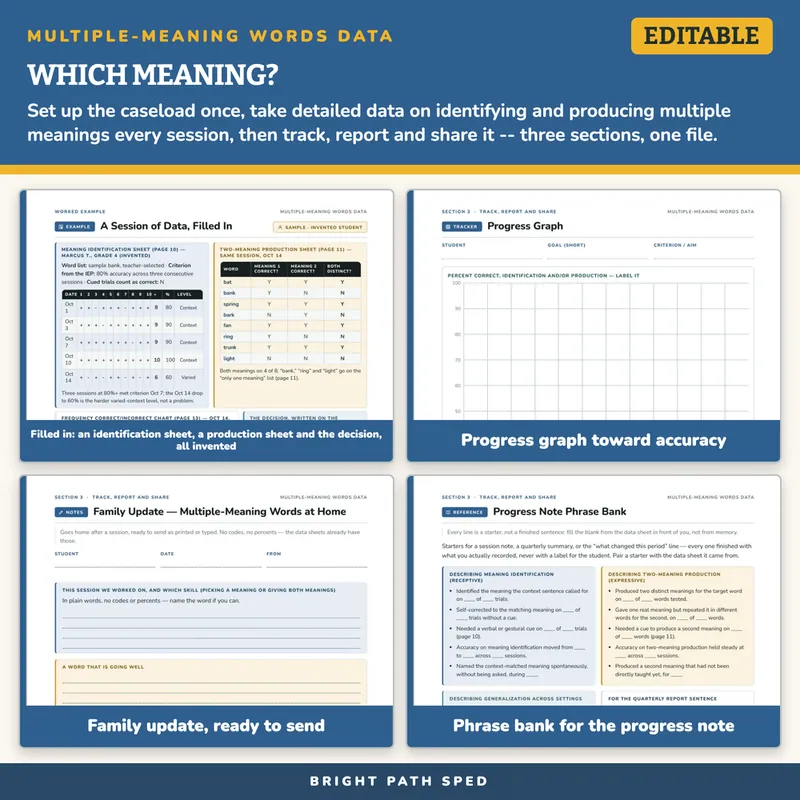
- Cumulative Accuracy Tracker — two full 12-session blocks, one for identification and one for production, with date, level and percent correct logged each session
- Progress Graph — a scaled 0–100 grid to plot the trend, with an aim line
- Quarterly Progress Summary — a 2-row table (one per skill: baseline, current level, status, one sentence), settings/percent/next-step fields, two write-on cards, and a 4-item "before this goes in the report" checklist
- Family Update — Multiple-Meaning Words at Home — a ready-to-send communication page: what was worked on and which skill, a word that is going well, one word to try at home, family questions and answers, and a 7-day practiced table
- Progress Note Phrase Bank — 20 observable-language starters across 4 groups (meaning identification, two-meaning production, generalization across settings, the quarterly-report sentence), every one ending in a blank pulled from a data sheet in the file
Plus a Start Here quick-start, a 3-section contents page with real page thumbnails, 3 section dividers, and a "what's next" back page.
What This Is, And What It Is Not
It is a fillable PDF. Open it in a PDF reader, click a field, type, Save As once per student. It works offline with no account or subscription. It is NOT a Google Sheets file, a Google Doc, or an Excel workbook, and it does not score a response against a published norm or compute a percent for you.
It is not Receptive/Expressive Vocabulary — a vocabulary SIZE screener asking how many words a student knows at all, not whether a specific word's two meanings are known. It is also not Semantic Word Relationships and Word Meaning Progress Monitoring Editable — that file spreads a caseload's tools across SIX semantic domains (synonyms, antonyms, word categories, multiple-meaning words, figurative language, word-family production), with multiple-meaning words as one page inside it, so a team that only needs this one skill still buys and navigates all six. This file is the one-skill data system: a detailed sheet for identifying the meaning a context sentence calls for, a separate sheet for producing both meanings of a word, a quick combined check, a frequency chart, a paraprofessional/classroom form, a tracker and graph, a quarterly summary, a family update, and a phrase bank, built for a caseload across a term. No page in this file names a condition, states an age or a milestone, or sets a rule for when a referral is warranted; every criterion is a blank line the team writes in from the IEP and its own judgment. The word list is an informal, invented sample stimulus set built for this file, not a standardized instrument — swap in your own. No health data is pre-filled anywhere, and the example student (Marcus T.) is invented and named as such on page 21.
Who This Is For
Speech-language pathologists and special education case managers with a multiple-meaning-word goal on the caseload, plus the paraprofessionals and general education teachers who help collect the data.