PreK Pre-Academic Skills Progress Monitoring Data Sheets Editable
- 24 pages
- Not Grade Specific
- PDF, fillable
$3.50
DownloadOr get it with All-Access: pick any 20 resources a month for $7.
New here? Your first month of All-Access is half off with code TEACHERTOK
Already bought this, or a member?
Instant download. One teacher's license: colleagues need their own copy. Each file carries a license number.
Also on Teachers Pay Teachers: see the Bright Path Sped store
About this resource
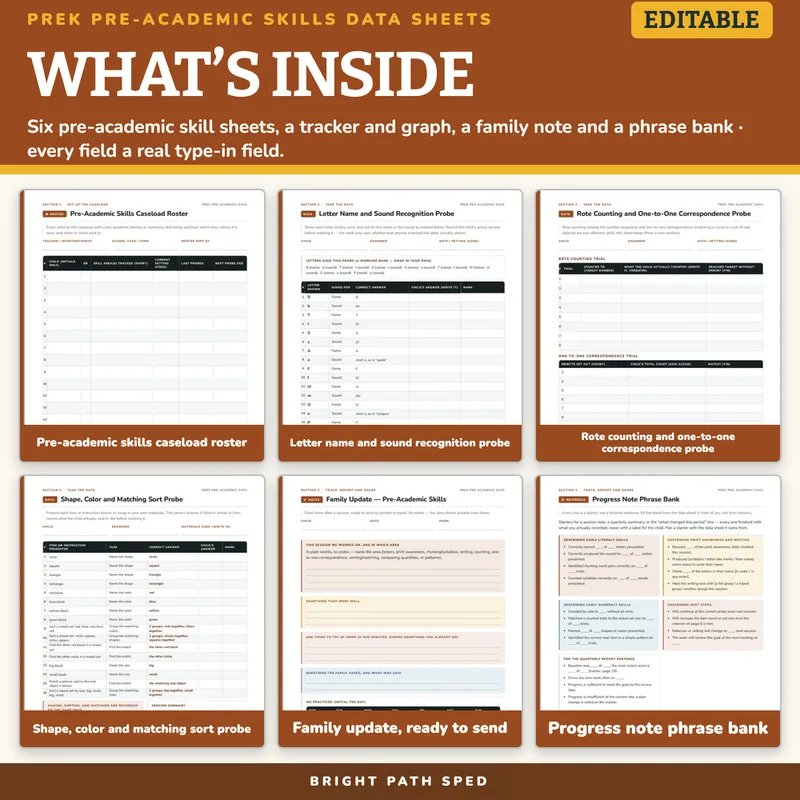
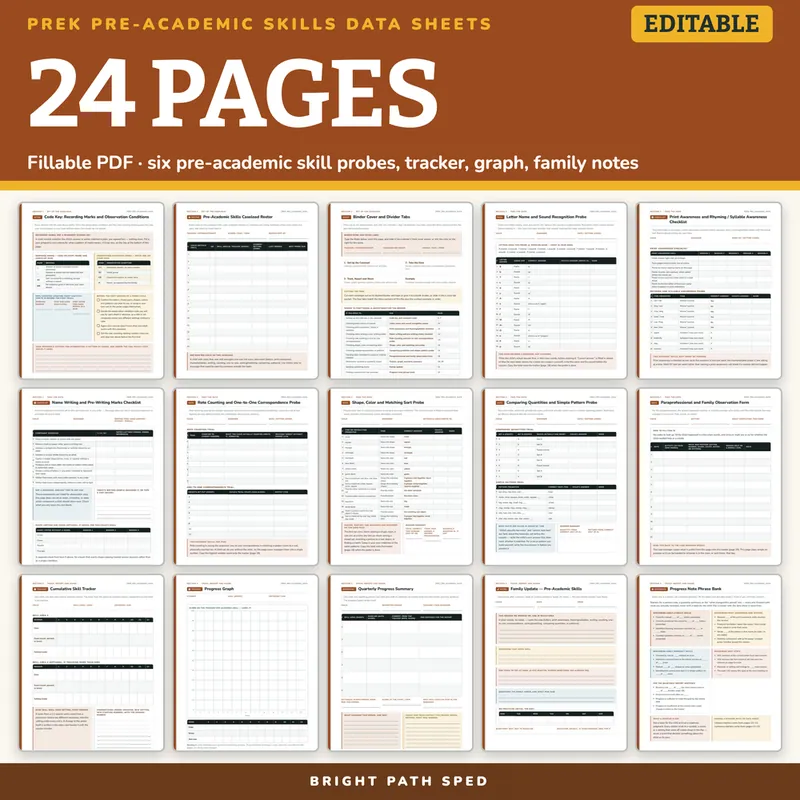
Everything inside: 24 pages, 600 type-in fields · six pre-academic skill sheets (letter name/sound recognition; print awareness and rhyming/syllable awareness; name writing and pre-writing marks; rote counting and one-to-one correspondence; shape, color and matching sort; comparing quantities and simple patterns) · a whole-caseload roster · a binder cover and 4 cut-out tabs · a 2-skill-area, 12-session tracker and graph · a quarterly summary · a family update · a 20-starter phrase bank · a simplified paraprofessional/family form · a worked, invented example.
Early-childhood special educators, interventionists and case managers are asked to show whether an early literacy or early numeracy readiness goal is changing, not just whether a lesson happened. This file is the pre-academic data companion: run a letter name/sound probe, a print-awareness and rhyming check, a name-writing checklist, a counting or one-to-one correspondence trial, a shape/color sort, or a quantity-comparison and pattern probe; mark what the child actually said or did; and roll it into a report and a family update that write themselves. Every mark on every page says only whether a recorded answer or action matched a plain, pre-agreed fact — never a score against a published norm, a readiness-for-kindergarten judgment, or a rule for when a referral is warranted.
WHAT IS INCLUDED — 24 pages
Set Up The Caseload
- Code Key: Recording Marks and Observation Conditions — 4 response marks (+/−/SC/NR), 4 observation-condition codes (1:1, small group, classroom routine, home), a starting-number/step-size box for the rote-counting trial, and a 4-item "before the first session" setup checklist, every descriptor a blank line the team defines
- Pre-Academic Skills Caseload Roster — 14 rows: child (initials), grade, skill area(s) tracked, current setting, last probed, next probe due
- Binder Cover and Divider Tabs — a spine/cover card, 4 cut-out tabs matching the file's sections, and an 11-row "where to find things" index
Take The Data
- Letter Name and Sound Recognition Probe — a 16-item working letter bank (8 name items, 8 sound items, mixed upper/lower-case) with the actual correct answer printed ahead of time, and a row for the child's own answer and the mark
- Print Awareness and Rhyming/Syllable Awareness Checklist — a 6-skill print-awareness log across up to 5 sessions, plus a 10-item rhyme/syllable probe (6 rhyme-judgment pairs, 4 syllable-count words) with the true fact filled in ahead of time
- Name Writing and Pre-Writing Marks Checklist — a 9-component observation checklist (grasp through independent name writing, explicitly not a sequence or a timeline), a writing-sample note card, and a 4-shape copying sub-check across 3 sessions
- Rote Counting and One-to-One Correspondence Probe — an 8-trial rote-counting log and an 8-row one-to-one correspondence table (set sizes 3–12), kept in two sections because a child can do one without the other
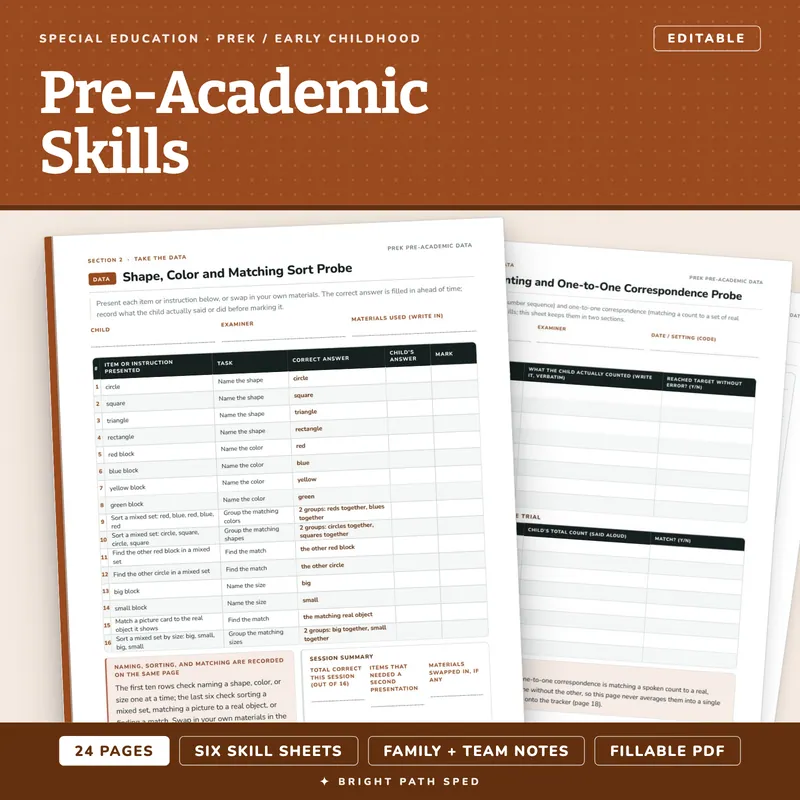
- Shape, Color and Matching Sort Probe — a 16-item working bank (10 naming items across shape/color/size, 6 sorting/matching items) with the correct answer filled in ahead of time, plus a session-summary box
- Comparing Quantities and Simple Pattern Probe — an 8-item quantity-comparison table and a 6-item simple-pattern table, both with the true fact filled in ahead of time, plus a session-summary box
- Paraprofessional and Family Observation Form — 12 rows, plain words instead of codes, for the adult in the room who is not the case manager
Track, Report And Share
- Cumulative Skill Tracker — two 12-session blocks (skill area 1, and an optional skill area 2), with date, score and setting logged each session
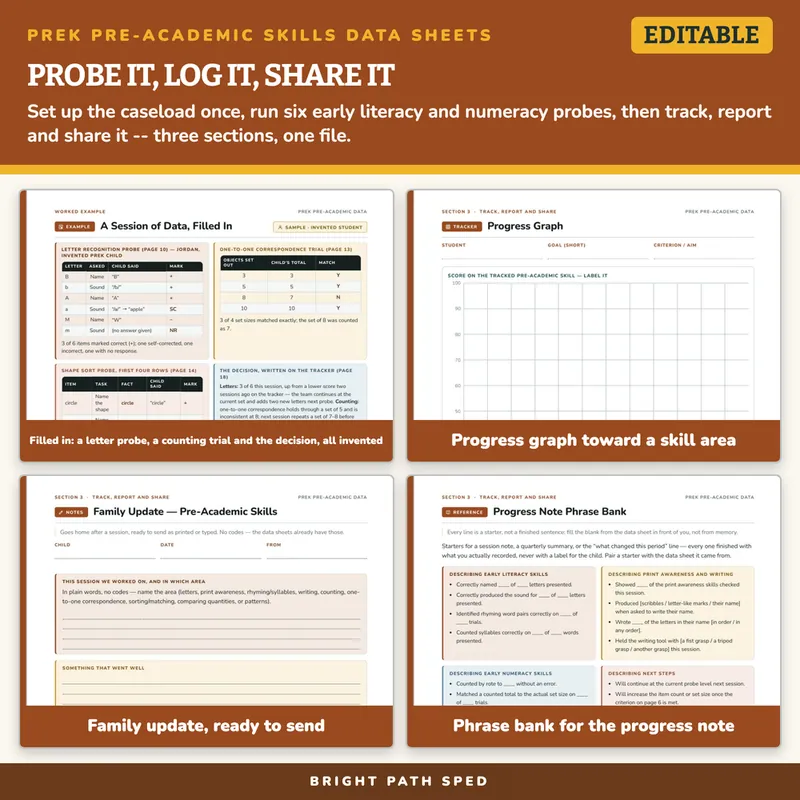
- Progress Graph — a scaled 0–100 grid to plot the trend, with an aim line
- Quarterly Progress Summary — 6 rows (baseline, current level, one sentence per skill area), plus settings, score then/now, and two write-on cards
- Family Update — Pre-Academic Skills — a ready-to-send communication page: what was worked on and in which area, something that went well, one thing to try at home, family questions and answers, and a 7-day practiced table
- Progress Note Phrase Bank — 20 observable-language starters across 5 groups (early literacy, print awareness and writing, early numeracy, next steps, the quarterly-report sentence), every one ending in a blank pulled from a data sheet in the file
Plus a Start Here quick-start, a 3-section contents page with real page thumbnails, 3 section dividers, and a "what's next" back page.
What This Is, And What It Is Not
It is a fillable PDF. Open it in a PDF reader, click a field, type, Save As once per child. It works offline with no account or subscription. It is NOT a Google Sheets file, a Google Doc, or an Excel workbook, and it does not score a probe against a published norm or compute a percent for you.
It is not Preschool and Early Childhood Progress Monitoring Data Sheets Editable — that file covers communication, fine and gross motor, self-care and adaptive, and social-emotional and play skills. This file is the pre-academic companion: letter name and sound recognition, print awareness, rhyming and syllable awareness, name writing, rote counting, one-to-one correspondence, shape/color sorting and matching, comparing quantities, and simple patterns. No page in this file names a condition, states an age or a milestone, or sets a rule for when a referral is warranted; every criterion is a blank line the team writes in from the IEP, the intervention plan, or its own judgment. The letters, words, shapes and patterns used are informal, invented working banks built for this file, not a standardized or published instrument. No health data is pre-filled anywhere, and the example child (Jordan) is invented and named as such on page 23.
Who This Is For
Early-childhood special educators, interventionists, and PreK case managers with an early literacy or early numeracy readiness goal on the caseload, plus the paraprofessionals and family members who help collect the data.
If You Want More
Preschool and Early Childhood Progress Monitoring Data Sheets Editable is the companion file for communication, motor, self-care and social-emotional skills, built the same way.
You might also need
10 Fat Turkeys Book Companion November Preschool Kindergarten 1st 2nd Special Ed
$5.00 or with All-Access
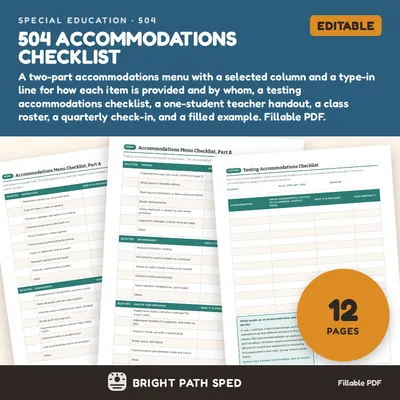
504 Accommodations Checklist Editable
$3.00 or with All-Access
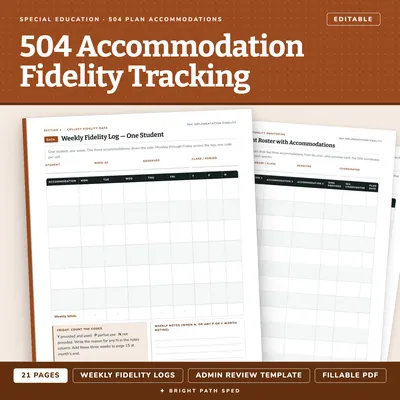
504 Plan Accommodation Implementation Fidelity Data Collection Editable
$3.50 or with All-Access
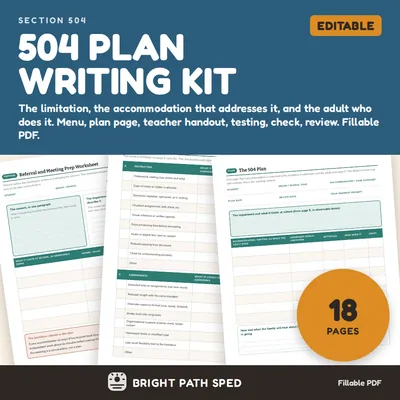
504 Plan Template Accommodations Checklist Teacher Handout
$5.00 or with All-Access